For online learners, engaging in Self-Regulated Learning is a vital skill today. Often the content to be learned is simply placed into a learning management system – think about MOOCs – rather than spending time to explicitly design it for a great learning experience. And, as learners are individuals with their own preferences, it also makes sense, IF both video and transcript are provided. (My confession: I like to read. And nobody can talk as fast as I can read.)
But learning, especially deep learning, takes much more work than just simply watching the videos and following the discussion prompts. When we learn one of these processes takes place: accumulation, assimilation, accommodation, or (the BEST ever!!) transformation. You know, the amazing A-HA!!! moment when the new information literally shakes our world and makes us think about things in a new way. And then adjust what we already knew to fit in with this new revelation. That’s deep learning at its best. 🙂 The moment when we see the lightbulb lit in our students’ brains. This is the very reason why I am in education.
Now, how do we assess this new, deep learning? Just giving a grade would not cover it, because assigning a grade is an evaluation, not an assessment. Evaluations don’t support our learning processes, they just put an approval (or denial) stamp onto our final product – worksheet, test score, essay, or portfolio. It is just a professional judgment of the output, the product of learning, but doesn’t tell how we got there. It doesn’t address the learning process, which is where learner agency lives.
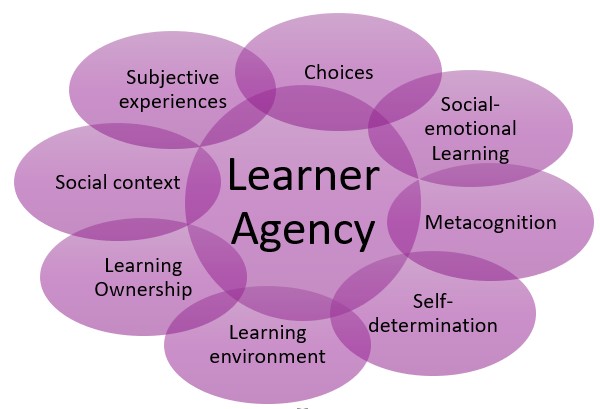
Assessment and evaluation are two different processes for two different purposes. Student-centered assessment for learning and assessment as learning are to support students’ #deeperlearning process, evaluation is to determine the level of their performance. Assessment is for students and teachers, evaluation is for stakeholders.
Formative assessments that inform (the educator and student about learning process) and summative assessments that sum up the competence are both important and useful, however they require different approaches and interpretations. Both can be designed by the teacher to meet learning objectives. At best assessment is a meaningful and a positive learning experience for students, increasing their interest in learning and boosting growth mindset. Summative assessment is usually a cumulative examination, and can be done as a final project or portfolio. My personal-professional preference is portfolios because they can visualize the learning process and accumulation of ideas and knowledge, as well as the choices where to dig deeper.
Evaluation is making a judgment about an artifact (essay, test score, behavior, teaching practice) against a relevant evaluation criteria, usually a predetermined goal or standard. Evaluation is also interpreting and making decisions about program effectiveness, for example for accreditation purposes and to build capacity. The OECD report is clear: “The point of evaluation and assessment is to improve classroom practice and student learning.”
References:
American Psychological Association (2020). The APA Guide to College Teaching: Essential Tools and Techniques Based on Psychological Science. https://www.apa.org/ed/precollege/undergrad
American Psychological Association, Coalition for Psychology in
Schools and Education. (2015). Top 20 principles from psychology for preK–12 teaching and learning. Retrieved from http://www.apa.org/ed/schools/cpse/top-twenty-principles.pdf
OECD (2013), Synergies for Better Learning: An International Perspective on Evaluation and Assessment, OECD Reviews of Evaluation and Assessment in Education, OECD Publishing, Paris, https://doi.org/10.1787/9789264190658-en.

 NotesFromNina