Collaborative problem-solving (CPS) is an important #SEL relationship skill we start learning during early childhood while learning to play with others and share our toys, and later the same skill is also used in scientific problem-solving. The first step to support collaboration is to help participants self-regulate – just because we cannot use higher-order thinking while upset or distracted. #traumainformed I am sure we all have witnessed some melt-downs in playgrounds.
For us adults the collaborative problem solving often means having to learn how to respond, instead of reacting to the situation or behavior – otherwise we are not collaborating, but directing or explaining. Learning the skill of choosing our responses matches the definition of resilience: “the process and outcome of successfully adapting to difficult or challenging situations”[1]. As educators we face these situations every day. To support students’ learning process, it is important to discuss why and how we collaborate and the benefits of learning from each other. The SEL competencies of self-awareness and self-management are priceless skills for anyone who wants to teach.
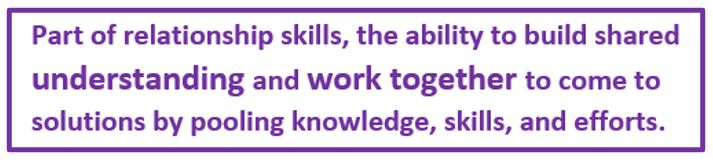
This is the CASEL definition for Collaborative Problem-Solving as a component of Transformative SEL #tSEL which means adults and students collaborating and learning from each other.
The other parts of Transformative SEL are Identity, Agency, Belonging and Curiosity to build “strong, respectful, and lasting relationships to engage in co-learning” [2] The learning process begins by starting a new path – trying something new or different. Often our curricula dictates the directions and outcomes of learning, yet in an emotionally safe learning environment they can reach the goal. We as educators, embark on learning paths to increase out competencies and to learn something new. And at this point I need to state this very clearly: learning is a different experience from being taught something – it really is a process, not product.
Collaborating and helping others to self-regulate to support their learning process is not always easy. And, quite honestly, learning to help myself to self-regulate has been a long journey, and there are still times when I need to remind myself to take a breath and make sure that I am self-regulated before I respond. Most of the self-management happens outside of our work hours because we all have very personal needs. I have always known that walking on the beach makes me feel better. Now I also know why, and can use it to manage my stress, which then enables me to engage in collaboration with others on the following day.

Collaborating with others to solve a problem is an important 21st century life skill – we are not likely to be successful in our relationships without it. In workplace communication and collaboration skills are important to avoid interpersonal conflicts and keep teams functional. Being able to gather the information related to the problem, use visuals to represent the problem, device a strategy to solve it and complete it together, while reacting appropriately to feedback during the process is one way to measure it. PISA introduced a CPS assessment in 2015 [4].
Fortunately, we often have daily opportunities for honing our CPS skills – these may be present at work, or with family and friends. We just need to choose to start the learning path and see where it takes us.
References:
[1] American Psychological Association. (2020, February 1). Building your resilience. https://www.apa.org/topics/resilience/building-your-resilience
[2] Collaborative for Academic, Social, and Emotional Learning. (n.d.). Transformative
SEL as a lever for equity & social justice. https://casel.org/fundamentals-of-sel/how-does-sel-support-educational-equity-and-excellence/transformative-sel/
[3] Jagers, R. J., Skoog-Hoffman, A., Barthelus, B., & Schlund, J. (2021). Transformative social emotional learning: In pursuit of educational equity and excellence. American Educator, 45(2), 12. https://www.aft.org/ae/summer2021/jagers_skoog-hoffman_barthelus_schlund
[4] Mo, J. (2017), “How does PISA measure students’ ability to collaborate?”, PISA in Focus, No. 77, OECD Publishing, Paris, https://doi.org/10.1787/f21387f6-en and https://www.oecd.org/pisa/innovation/collaborative-problem-solving/

 NotesFromNina