Archive | Effective Teaching RSS feed for this section

Meaningful Learning

10 Jan

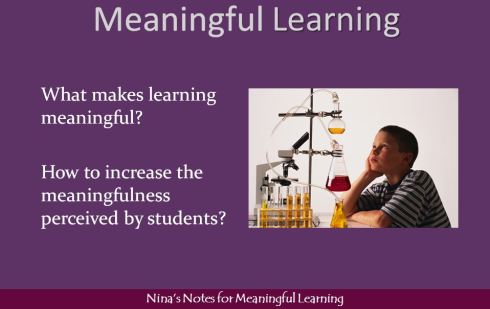
What makes learning meaningful? And how could we increase the meaningfulness perceived by students? Research shows how important  it is for students to engage in active learning and purposefully construct their own knowledge and understanding.

We also know from research how much easier is to deep learn anything that makes sense and piques interest, so just utilizing that basic understanding about learning fundamentals would help schools achieve better results. Of course it is ridiculous to assume the same things interest all students, so introducing choice would be a good place to start.
Meaningful learning

A presentation of meaningful learning is available in the end of this post. 

Meaningful learning allows students to acquire knowledge in a way that is useful for them. When you can use learned information easily, this often means that you have stored it in several different places in your mind, and you can also access that knowledge in different contexts – this is what we refer as transfer in the teaching jargon, but it actually is the natural or original way of learning.  Several contexts equals multiple connections and these multiple connections mean the objective is deep learned, because it is integrated to everything else we  know, so well that it cannot be separated from them. No learning loss happens to this knowledge – but then again it requires the content to have personal value to the learner, to be meaningful.

Learning is highly individual and takes anything between 2 milliseconds to 25 years to happen, yet in educational systems we often expect students to complete learning tasks within a certain time frame. Why? Wouldn’t it be better to allow some flexibility and let students learn in their own pace? We already have the necessary technology to do provide highly individualized learning, but are still somehow stuck in the cohort mentality. We should more diligently use tools for learning facilitation instead of sticking in traditional teaching and lecturing, because the time needed for learning is different for each student. Acquiring knowledge requires individual amount of interactions between the student and the material to be learned. These interactions can vary from reading to discussions and projects, and from lecturing to engaging students in a learning game – and the guiding principle should be meaningfulness for the learner, because that guarantees better quality learning.

Meaningful learning is also competency based, so that regurgitating same content for umpteenth time is understood and accepted to be unnecessary. This is also the basic recipe for truly diverse classrooms: students get to learn what they need to learn, not what their peers need to learn. Facilitating self-paced and autonomous learning would be extremely easy with existing technology, so why don’t we use all our tech like that? I am afraid the answer is quite ugly: we want to control what our students are learning, and how they do that (and also measure their performance). So we are asked to teach everything and everyone in the same way, and wish our students would miraculously deep learn it all, and even find it meaningful. Then we reprimand students for not being happy and enthusiastic to learn, or at least work hard to memorize all the (unnecessary) information we pour onto them. I know there are too many details in any given curriculum, and not enough higher level concepts – but there are many daily choices for teachers to either teach those details or facilitate students learning about them.

While discussing with the teachers I mentor there is one common theme they highlight about their work: the blissful feeling of being successful in teaching when a student has an “a-ha!” – moment. In that moment learning is extremely meaningful for the student, and it often has been described like windows suddenly opening and seeing the world/ the problem with new eyes. What happens in reality is brain creating new connections and applying knowledge in a new context. The extreme case of this is a flow experience, which can be quite addictive, actually.

Empowering students to learn helps them to like learning – or even crave  for more knowledge and understanding. This means they are learning for life not just for school. We can change the future world by choosing to provide meaningful learning experiences for our students. How do you choose to teach today?


Here is a presentation of meaningful learning:  Meaningful Learning NotesFromNina


[1] Ausubel, D. P., Novak, J. D. & Hanesian, H. 1978. Educational psychology a
cognitive view. 2. painos. New York: Holt, Rinehart and Winston.

Bransford, J.D., Brown, A.L., & Cocking, R. (1999). How people learn: Brain, mind, experience, and school. Washington, DC: National Academy Press.

Mayer, R. E. (2002). Rote versus meaningful learning. Theory into practice41(4), 226-232.

Global education everywhere

27 Nov

Every child has a right to learn.  This makes education a global issue. I am glad we are cooperating in educational research and making the latest information available for everyone via internet. In my mind this makes education more global as we become more aware about different practices around the world.

Every teacher should be empowered to teach and to know they have choices. Comparing educational practices internationally may help us all to adapt better practices. I like to share the Finnish know-how of education, and  while I am excited to see yet another study highlighting Finland as the best country in education, I am also hoping  that the takeaways are much greater than just a simple ranking list.

Having data is not important, but knowing what to do with it!

New Pearson education study ” The Learning Curve”  provides 5 important talking points:

  1. No magic bullets – there are no quick fixes in education, long term joint planning is needed for sustainable education quality.
  2. Respect teachers – trust in your teachers and value them, because they are your professionals that schools cannot function without!
  3. Culture can be changed – find the positive elements in your educational culture and highlight them, then start building on that foundation.
  4. Parents are not the key – but they certainly should be your allies! We have a joint mission: student success.
  5. Educate for the future – empower students to learn. Focus education on how to  learn and how to think, because that improves transfer to all other areas of education.

I think these points are no news for people who are working on improving the quality of education around the world. It is very nice, though, to get additional affirmation for thoughts we have been posting  and discussing about.

The one very important message is about changing your culture. We often talk about students, how they are not clones and should not be treated like ones. Standards are not the solution. Educational systems have their distinctive characteristics, too, and thus global education must have a unique look in different countries, districts and schools.

The paradigm change for educational quality must start at all levels of education – we cannot afford to wait for someone else to change first. Sometimes it is hard to find opportunities to choose. But, I refuse to believe there would be a classroom/school/educational system/country with absolutely no choices for students/teachers/administrators/policymakers to make learning more meaningful – the least we can do is to choose a “can do”  attitude.

How could your class/school/district be global and unique at the same time? What are your positive elements?

Successful learning experiences

24 Nov

Defining success is not easy, and sometimes we get tangled in details and want to define students’ success as mastery of a single subject or unit, or course. Often applying unnecessary power over students is also disguised as success – but do students really need to perform according to minor details, or should we emphasize understanding the concepts and entities, so that the learned skill is transferable? In contemporary education negotiating meaning is more important than ever before, just to be sure that we are talking about the same concept/word/idea – and the word “success” certainly has several different connotations.

To me student success means simply making myself unnecessary as a teacher by empowering my students become autonomous learners, who can work independently and who know where to find the information and guidance they need. This requires handing over the tools for learning to students, and trusting in their motivation and drive to get their learning done, but having open and honest interactions with students to be able to help if needed.

Many schools aspire to empower their students to become life-long learners, and that is great! This is the true paradigm shift we need in education! But, it is not enough if we say this aloud (or write it on the visions and missions of school, or publish it on the school website), this goal must be integrated into everyday teaching practices as well as to the assessments.  Students’ perception matters. We need open and honest communication to remain believable so that our students understand and feel their success and learning being important for us.

Students’ perception creates the emotional learning environment of the classroom or the entire school. Please note, though, that I am not talking about entertaining students. My intention is to describe a learning environment where students cooperate and are accountable for their own learning.  In Finland one measurement for successful education is “kouluviihtyvyys”, which approximately translates to school enjoyment, or school satisfaction, but actually has some deeper connotations[1]. School satisfaction is seen to be built of several components where  school conditions create one part, social relationships another part and means for self-fulfillment in school the third crucial part – following the categories of having, loving, being by Erik Allardt[2]. I cannot but see the equivalence to the 3Cs: constructive tools used in cooperative way to provide cognitive connections.

Classroom management and curricular choices belong to having/school conditions, and often are the most emphasized component in student success. However, no matter how constructively you build the conditions, the two other components must be present to complete the picture of successful learning experiences.

Cooperation falls into social relationships/loving – part of school enjoyment, and it covers school climate, teacher-student relationships and all interactions – also those with students’ homes and family members. Cooperation increases students’ success in all levels starting from informal peer tutoring among classmates, covering anything and everything that happens during a school day, but also reaching to professional collaboration between education professionals (yes, I am against to Race to the Top or any other competitive attempts to improve education). Loving is a strong word for me to use about social relationships at school, but I do see how well it fits here.

Being/the means of self-fulfillment cover many important areas: value of work (no busywork!), creativity (students and teachers are so much more than parts in a machine), encouragement (feedback about learning process), and having opportunities to practice making good choices. Knowing how I learn is essential for becoming a good learner, and this is why metacognitive tools should be an essential part of each and every teacher’s toolbox. This is also why I am so sceptical about standards – when learning is an individual process, how could it be measured with standardized testing?

To me well-being in schools as defined above is an essential measure of providing students with successful learning experiences. What do you think? And how can you increase student success by improving having, loving or being in your school?

Open and honest communication

3 Nov

We teachers are actually communication professionals, we live in dialogue. We try to transmit the message about important information to our students in many different ways: speaking, writing, showing, and of course also via electronic media. We also try to convey ideas, perspectives, ideologies and concepts, and yet it is up to students to choose whether they want to learn all that, or not.

Communication in education must be reciprocal. This also presents the need for open and honest interpersonal relations between teachers and students, because that builds trust and helps students choose to become involved in their own learning. I have often joked about best teachers being the master manipulators. Now how does that fit together with the open and honest communication?

It actually does. Being a non-native speaker of English I frequently need to visit dictionary pages to gain more understanding about words. Often I seem to have a different connotation to a certain word – like manipulation, which doesn’t sound malicious to me, but obviously is that for most people. Dictionary suggests alternative words for the verb manipulate: influence, control, direct, guide, conduct, negotiate, exploit, steer. To me these seem acceptable descriptions for teaching as a profession. It is okay to guide students towards the right direction, that is what teaching is about. Forcing students to obey obscure rules is just bad management.

Shared responsibility to reach the mutual goal is the first step in open communication. As a learning facilitator, or mentor, I practice open manipulation: I tell my students that I am purposefully attempting on changing their perception about something. Grown up students find it funny, but also tend to think about it and then discuss or ask questions about it later, after they have had time to reflect upon it. Children get excited, because they sense the honesty behind the statement. They also feel empowered as they recognize the opportunity to choose, instead of doing something an adult just tells them to do. Cooperative learning can be as easy as this.

Negotiating meaning is the second step of being open and honest in classroom communication. We certainly have different connotations to words and we also have different understanding about concepts we teach and learn, so negotiating what a word actually means is important in order to improve the classroom communications. And, no, it cannot be just the teacher who gives the definition of the word, because how would students then have any ownership over the subject? Those times are long gone (or at least they should be gone) where teachers possessed the one and only correct answer or definition. (I can imagine math and science teachers disagreeing with this, but please bear with me.) Negotiating the meaning of a simple concept can just be facilitated by students explaining to each other in their own words what they think the word means, and then creating a mindmap showing the thoughts of each group. Of course the teacher can (and should) guide students towards the correct understanding by asking questions while groups are working, but the definitions are still students’ own production. Constructing their understanding together helps students master the concept, as each student needs to explain to their group how they understand it. This is also the way how bilingual brain works: creating more connections and having several words to describe a concept or a word.

The third step in open and honest communication is the cognitive part: knowing what I learned and how I did it. Often teacher’s help is invaluable here, because it is hard to see beyond one’s own frame of reference.  Being aware about the choices I made in order to plan my future actions helps the goal setting.  Monitoring and guiding  my own actions, and regulating my own behaviour and learning to be successful. The umbrella term for these is executive functions. Being able to communicate in an open and honest way the reasons for success or the need for revising work makes assessment very non-punitive and it becomes a part of the individual learning process.

Non-threatening feedback immensely improves learning and goal setting. I haven’t found any other way to provide that, but by communicating in an open and honest way. Have you?

Reflective practice

13 Oct

It is a fancy name for thinking about your workday, and processing the events in order to make better choices next time. Or, maybe I have a tendency to over-simplify things?

Educators make several instant and instinctive decisions during each and every workday.  Where do these judgments come from? How to be more aware about the reasoning behind these decisions?  Now, this is where the reflective practice steps in.

Reflecting upon choices not only increases the awareness about reasons behind certain decisions, but often also reveals other possible options. Recognizing these possible choices being available arises from the awareness of different practices – and this is exactly why having conferences and workshops, lectures and moocs, books and magazines discussing the best practices is so necessary. Yet, if participating or reading doesn’t transfer to the everyday work and life, one could rightfully ask whether it was time well spent.  Reflecting and implementing extend the benefits of any professional development.

The best and worst of reflective practice deals with emotions. You will explore areas that need improvement and those can invite you grow professionally, but you also will see your strengths and get to celebrate the success. And that actually is the main idea behind the stylish name of learning about your own teaching: being objective and finding out what works and why. Using the functional parts and discarding the unnecessary or harmful (even if it is something you are fond of) helps to improve your teaching practice

Some reflection happens in action while intuitively correcting your responses and “automatically” changing the way to interact with students.  Consciously thinking about the instructional materials and activities while doing the daily teaching, making mental notes about how well they work (or not) and planning for improvements is the foundation of reflective practice. To promote effective and student centered learning you need to think about the students’ point of view about the activities and materials as well.  Deeper reflection, the intentional improvement,  happens after you have done with teaching, and have time to think about your day.

A very simple way to begin your journey to professional reflection is to each day ask yourself these three questions:

1. What went excellently today and why?

2. What could have been better and how?

3. What do I want to change in my teaching?

Processing the events of your workday by writing these three things down either in a notebook or on computer makes it easier to focus on things you choose to improve and not go by the feeling, or become biased by an apparent success or failure. Exploring your own teaching by writing down some thoughts about the day, or at least the week, also creates a journal that reveals your own thinking habits and the way your teaching philosophy and practice have evolved during time. It allows you to get some necessary distance to what happens in the classroom, and see patterns and outlines of your own way of teaching, so that you can improve your practice.

This is the real accountability measure for a teacher, but because it requires ultimate honesty it cannot be implemented by someone else but the teacher herself/himself. Nor can it be forced. But, it can be supported and encouraged – just like learning.

And exactly like learning is a process, not a product, also teaching is a process, because being a teacher also means being a learner.

World Teachers’ Day 2012

5 Oct

“Take a stand for Teachers” is the 2012 slogan for World Teachers’ Day.

UNESCO calls on everyone to consider undertaking a special celebration for World Teachers’ Day:  “Teachers… ultimately determine our collective ability to innovate, to invent, to find solutions for tomorrow. Nothing will ever replace a good teacher. Nothing is more important than supporting them.”

On the UNESCO page there is another statement I liked very much:

Teachers are among the many factors that keep children in school and influence learning. They help students think critically, process information from several sources, work cooperatively, tackle problems and make informed choices. 

Isn’t this the essence of good quality education? Making informed choices outlines well the other highlighted skills: thinking, processing, cooperating and problem-solving.  Emphasizing these skills leads to deep and meaningful learning. Building a cooperative learning environment where students can practice choosing empowers them to think and share, and also helps students to understand how learning is an individual process.

Please note how teachers are rightfully recognized as one of the many factors that keep students in school. We should always remember not to ask teachers produce miracles, because every teaching-learning situation is constructed from many different pieces.

Over time teachers are able to enhance the other pieces of learning,  especially when learning is viewed as a process, not as a product or performance.  Yet, too often it seems that teachers are expected to solve all the pieces of the puzzle at once. The teacher’s piece is important, because the star will not be there without the teacher – but other pieces are equally important. Each and every teacher in the world should know that they can choose how they teach: teacher centered vs. student centered way, viewing learning as a product vs. process, cooperatively vs. competitively, creating opportunities to practice choosing vs. expecting blind obedience, and so forth.   All these choices are available for teachers to use in any given system or while teaching any given curriculum.

These everyday pedagogical choices are made either instinctively or with awareness of making an active choice. Even deciding not to choose is a choice. My way of supporting teachers is twofold: to spread awareness about the fact that they can choose and then empower teachers to learn more about their choices.

We all as parents and teachers are trusted with great shared responsibility: to help next generation achieve their full potential. So, supporting teachers in their important profession should be an easy choice.

What can you do to support a teacher today?

HOW instead of WHAT

9 Sep

Why do we so often emphasize the frames or structure over deep understanding? Knowing what something is only takes you so far. Isn’t knowing how something works or how it is connected much more valuable than just knowing it exists? And the very same principle applies to teaching: understanding how to help your students learn makes a real difference for both the effectiveness of learning and for classroom management, too.

Patricia Buoncristiani discusses this in beautiful details, and reminds us about the importance of improving teacher education: http://thinkinginthedeepend.wordpress.com/2012/09/09/its-not-the-kids-fault/

She says how effective teachers employ good strategies:

“Above all this, these teachers know how to engage their kids in activities that grab their intellects, their senses and their emotions.

They also know that if they can effectively teach their students how to think skillfully, they will be able to approach everything that goes on in the classroom from an intelligent, thoughtful point of view. By teaching the behaviors that characterize thoughtful, successful people their students will know how to listen with empathy, to manage their impulsivity, to think and work interdependently.

Where do our teachers learn all this? In my experience teacher education programs today offer very little explicit teaching about the HOW of teaching. They focus on the WHAT.

And I cannot but wholeheartedly agree. Knowing how to create an optimal learning environment in your classroom makes a huge difference. How could we help more teachers achieve this (while waiting for the teacher education to be improved)?

Less Teaching – More Learning

11 Aug

Fixed mindset is a scary thing. It prevents us from seeing/hearing other options or opinions than the ones we have already selected. And if this option happens to be the idea of the teacher being the main source of information for students, I can understand how ridiculous learning facilitation sounds. Yet, in today’s world we have more information available than ever before and it would be unwise for any teacher to imagine this fact NOT having an effect on teaching practices.


We can’t (and shouldn’t) keep students in a vacuum where they don’t hear anything that is in contradiction to what they are being taught. This could only happen in a totalitarian world where just a single one truth (or correct answer) is accepted (Nina’s personal note: somehow this always makes me think about multiple choice testing, I am sorry!). This transfer of static facts is hardly learning, even though it can be teaching: transmitting our culture to the next generation.  Of course, one purpose of formal education IS to preserve the culture. Yet the other, equally important purpose is to prepare students to face the world we know nothing about, the future.  In today’s world, where the amount of  information doubles with increasing speed, it is important to build strong thinkers and lifelong learners.  And learning starts from wondering.


I can see how having just one single correct answer feels safer than having too many choices – but we really need to teach students how to choose wisely, because we cannot contain them from information outside. Their foundation for thinking and comparing must be wide  and solid enough to sustain observing foreign ideas, and the framework of their learning must be strong enough to allow flexibility. Having the freedom to explore, but also safety to return is the same strategy a safely attached two-year-old uses: gradually moving in larger circles away from the parent, but returning to her/his lap when needed. How can we foster this same combination of freedom and safety in education?


While attending the AERO – Education Revolution Conference last weekend I admired the way different teaching-learning disciplines came naturally together. Differences were not emphasized, but the things we all shared: lifelong learning, free sharing of information and using communication for understanding.  Negotiating the meaning of a word or concept happened frequently and spontaneously, because I cannot expect others to understand my subjective connotations. Why are we not using this tool more in education? I think we should.


Our students may be using the same words we do, but their understanding about it differs from ours, I can guarantee this. And because we are not attempting to create clones (I sure hope we aren’t!) , we should create lots of opportunities for negotiating the meaning (=personalized understanding) of the concepts that belong to our curricula, and thus provide students with the opportunities to reflect and create connections to existing knowledge and understanding. While thinking about student motivation to ponder and participate, one simple thing becomes clear to me. The ultimate question in investing my time and my effort in thinking and learning usually is: What’s in it for me?


What do you do to provide your students with this one important piece of making their learning more meaningful? How do you help them wonder?


Effective learning – what are the ingredients?

19 Jul

Creating a truly learner centered educational environment requires quite a few thoughts even before the learning-teaching interaction begins. You as teacher must make a choice of the frame of reference to be used. Sometimes this choice is an unintentional one – especially if you have not reflected upon your own learning philosophy.

To promote effective learning you should think about the learning environment (both emotional and physical) to ensure there are no obstacles for learning. Students prior knowledge plays a major part in their learning, and if you start teaching where the curriculum tells you to start, you may be passing by their actual horizon of understanding.

Some students arrive to the class ready to learn – others do not. Finding gentle ways to increase the readiness, and decreasing the fears, anxieties and misconceptions of students ensures a less bumpy ride towards the mutual goal: effective learning. Also, an aptitude for learning is highly individual among students in any given group. You as their teacher can either help students to become more interested in what they are learning – or simply communicate about passing the test as a measurement of education and learning itself not being important. Imagine how huge difference there is in between those two approaches! Yet we sometimes non-verbally communicate about passing/performing instead of learning.

Students’ own goals and their motivation to learn are also related to the learning aptitude. Certain (widely accepted) classroom practices actually cater for extrinsic motivation (i.e. performing tasks for a reward), which does not help your students to become lifelong learners. The last piece in this picture of effective learning is the quality of teaching – actually just one sixth of all the important ingredients of  effective learning, but too often highlighted as the only measurement of education excellence.

This all, among other topics, are discussed in my new book: Choosing How to Teach & Teaching How to Choose: Using the 3Cs to Improve Learning. It is already available on Amazon  and Barnes & Noble. Of course they are the same things I will be sharing in the AERO conference  in Portland, OR, August 1-5, 2012, where Sir Ken Robinson is one of the keynote speakers. I am quite excited!! 🙂

3Cs for better teaching and learning

8 Jul

The cognitive approach combined with the constructive and cooperative practices enable effective teaching and meaningful learning.

C1 –Cognitive approach makes teaching and learning easy and effective. Viewing learning as a student-centered and dynamic process where learners are active participants, it strives to understand the reasons behind behavioural patterns. The individual way we approach learning and whether we believe in our abilities are huge processes that are running all the time behind student performance. This is why I believe it is important to build strong learners.

C2 – Constructive practice emphasizes the students’ need to construct their own understanding. Delivered or transmitted knowledge does not have the same emotional and intellectual value. New learning depends on prior understanding and is interpreted in the context of current understanding, not first as isolated information that is later related to existing knowledge.

C3 – Cooperative learning engages not only the whole student in her/his learning, but also the whole class (or school, or even a district!) into the learning process. Teaching and learning become meaningful for both teacher and students, because there is no need for the power struggle in the classroom: why would a student rebel against the rules s/he has been creating? Wide range of different teaching and learning strategies can be utilized, and there is much more time to teach and learn!

Deep learning (or “syväoppiminen”, as I learned the term while studying for my M. Ed. in the University of Jyväskylä, Finland) helps brain to reconstruct the long-term memory, and stores the learned content quite permanently. Its counterpart, shallow learning, only stores learned items to our short-term memory and they get discarded after a while whey they are not needed anymore. Think of cramming for a remember-every-small-detail – type exam. The difference between these two types of learning is huge – one builds for life, other is for temporary use. And in educational settings we are always dealing with both types of learning.

While reading about the “summer learning loss”, I cannot but think that those forgotten things were never deep learned. And because re-re-redoing things is extremely frustrating for both teachers and students, I wish more teachers intentionally chose how they teach and aimed for deep learning. 3Cs are one way of focusing on deep learning. They are easy to use and applicable in all levels of education – they are equally important in early childhood education as they are for people pursuing their masters or doctorates. Very few of us (humans) enjoy experiencing someone to use unnecessary power or control over us.

How do you provide your students with meaningful learning experiences?