Archive | Deep Learning RSS feed for this section

Feedback for deeper learning

13 Dec

There are times when successful learning requires interactions between the student and the teacher/instructor.  Often this is done in the form of feedback.  As educators we should cherish these moments, because at best feedback is an opportunity to have an authentic dialogue with the student, which easily leads to a deeper learning experience.  At the worst case scenario, receiving feedback makes the student think s/he was unfairly judged, which is an experience that may lead students to hate learning.

Feedback for deeper learning is information about students’ learning process and meeting the goal.  In all levels of education feedback is an essential element in guiding students’ knowledge construction. Transparent feedback and assessment practices increase the quality of cognitive learning and help students to have better understanding their own learning process. According to APA, effective feedback must be clear, explanatory, and timely (2015, p. 12).  Engaging in dialogue with students about feedback is an important – but often forgotten –  part of of teaching-learning interactions.  This dialogue is the magic ingredient that supports deep learning in all levels of education, from preK to higher education and professional development.

Feedback for deeper learning is not evaluation, assessment, labels, praise, or providing advice. Evaluation is a formal judgment about students’ work, often summative, and as such doesn’t function as feedback and supporting the learning process. Feedback is not assessment, either, because assessments focus on meeting competencies or goals/objectives, whereas feedback must focus on learning and guiding students to take action to meet the goals and build the competencies.  Good and timely feedback enables students to “seek better strategies to complete the task” (Hattie & Timperley, 2007, p. 86). Grades, therefore, should never be considered to be feedback, because they are given after the learning is done, and there is nothing students can do to improve their learning.

Feedback is not about labeling students’ work   with attributes like “good job”, “nice work”, “sloppy”, or “needs more” – weather in person or as written on students’ product (typically in the margin of an essay?).  To enhance learning, feedback must be provided during the learning process, instead of only measuring the end result, the product (task, paper, project, etc.). Whether the label is positive (praise) or negative is irrelevant, because labels in education may have a detrimental effect of students’ academic self-concept and their self-efficacy. This is exactly why it is essential to have a strong informal feedback system to support the meaningfulness of learning and teaching. Bandura and Locke emphasize the importance of self-reflection and agency as a theory that by “embodying feed-forward self-regulation differs from control theories rooted solely in a negative feedback control system aimed at error correction” (2003, p. 87).

Feedback is an essential part of the learning process. Constructing learning environments and feedback around the fact that your students can affect their own learning helps them to become better learners for the rest of their lives. I cannot emphasize this enough! Regardless of the level of education, preK-12, college, university, workplace, or anything else, supportive feedback changes the way students think about their own learning process. Zimmerman call this “calibration” while talking about self-regulated learning (2013. p. 145).  Both agency and self-regulation grow stronger with timely feedback, because it helps students to adjust their expectations and modify the plan to learn.

Giving effective feedback is not always easy. However, it is a skill that can (and should) be learned and taught. The basic principle in effective feedback is: Mistakes are a proof of trying. Acknowledging the positive in students’ attempts to learn gives the appropriate kind of feedback to keep students willing to try new things, and make new choices. Being afraid of making the wrong choice prevents students (or employees) from learning anything meaningful.

Moving away from labeling students or their skills, and starting to point out the progress they show in their learning process is a great way to start changing the feedback practices and emphasize deeper learning. Non-punitive assessment system is a requirement for feedback to support deeper learning.

The first step is to have a clear idea of the most important target for the feedback and an understanding of the desired outcome of the dialogue. Using open ended questions to get students’ input on how they see their own progress helps to figure out where and why they may struggle. Sometimes just inquiring about the next steps the student is planning to take and verbally situating those into the bigger picture of their learning experience or task completion is enough. When students are thinking about their own learning plan they are already engaging in deeper learning.

Please remember: only those mistakes that are allowed to be corrected can help students to learn more!


American Psychological Association, Coalition for Psychology in Schools and Education. (2015). Top 20 principles from psychology for pre K–12 teaching and learning. Retrieved from http:// http://www.apa.org/ed/schools/cpse/top-twenty-principles.pdf

Bandura, A., & Locke, E. A. (2003). Negative self-efficacy and goal effects revisited. Journal of applied psychology, 88(1), 87.

Hattie, J., & Timperley, H. (2007). The power of feedback. Review of educational research, 77(1), 81-112.

Zimmerman, B. J. (2013). From cognitive modeling to self-regulation: A social cognitive career path. Educational psychologist, 48(3), 135-147.  Available at researchgate.
Deep learning for teachers

4 Nov


It easier to teach something you have experienced firsthand. This is why teachers’ learning should reflect the ways we wish their students to learn. Instruction is situated in one’s own experiences.

I am not talking about activities in professional development, but those same elements that provide deeper learning experiences for students in classroom:

  • focusing on transferable understanding,
  • providing opportunities to reflect,
  • relating new information to previous knowledge, and
  • bridging theory with practice.

Truly focusing on life-long learning.

Teachers as learning professionals still need occasional reminders about how to support their own learning process, because in the professional world the expectations for showing competence by generating learning products (evidence, projects, artifacts, exams, etc.) sometimes take over the deep learning process, and thinking about how learning really happens, and how it can be supported on personal level. Knowledge of metacognitive skills is an essential tool for anyone who wants to teach.

Metacognitive awareness includes the knowledge and perceptions we have about ourselves, understanding the requirements and processes of completing learning tasks, and knowledge of strategies that can be used for learning.  Teaching metacognitive knowledge and skills is an important part of supporting deep learning. We as teachers should have extensive knowledge and skill to embed metacognitive strategies into our everyday practices.

Just like classroom learning experiences, also teacher learning should be designed to support self-regulated learning (SRL) practices.  SRL refers to students’ cognitive-constructive skills and empowering independent learning, focusing on strengthening the thoughts, feelings and actions that are used to reach personal goals (Zimmerman, 2000). This approach aligns well with the research of adult learning, which highlights the use of constructive-developmental theories (e.g. Mezirow, 2000; Jarvis, 2009; Stewart & Wolodko, 2016).

Supporting students’ SRL becomes easier to embed into instruction when we have first practiced in our own learning. This cannot be achieved by following a script or curriculum book, but situating the knowledge of pedagogy in classroom practice.

Using SRL as a chosen approach in professional development or other learning opportunities helps to recognize our own fundamental beliefs about learning. These beliefs, that either help or hurt learning process, are always present in both teaching and learning situations.

Following the three steps of SRL helps us to approach learning tasks within their context, and first create a functional plan and choose learning strategies to support learning process. Then, we will want to monitor our own performance and learning process during the second part, performance phase. This is where the knowledge of deep learning strategies is very important, because sometimes instruction and design reward surface processes, and we might want to change our strategies to still engage in deep learning. In the third phase, self-reflection, is the most important one, but often forgotten. Without engaging in self-assessment about our own learning process, it would be hard to do things differently next time, if needed. Yet, the whole idea of using metacognitive knowledge to improve deep learning relies in dealing with our own perception and managing our emotional responses, so that our beliefs about deep learning are strengthened. Some beliefs are detrimental for deep learning, and for example mentally punishing ourselves (for failure, procrastination, etc.) leads toward using surface learning processes.

Instructional approaches that emphasize choice, learning ownership, knowledge construction, and making connections are more likely to facilitate deep learning and understanding – for teachers and students alike.


Here is more information about SRL for adult online learners  in a PDF form.


Jarvis, P. (2009). Learning to be a person in society. In K. Illeris (Ed.) Contemporary theories of learning: learning theorists… in their own words. London: Routledge.

Mezirow, J. (2000). Learning as Transformation: Critical Perspectives on a Theory in Progress. The Jossey-Bass Higher and Adult Education Series. San Francisco: Jossey-Bass

Stewart, C., & Wolodko, B. (2016). University Educator Mindsets: How Might Adult Constructive‐Developmental Theory Support Design of Adaptive Learning?. Mind, Brain, and Education10(4), 247-255.

Zimmerman, B. J. (2000). Attaining self-regulated learning: a social-cognitive
perspective, in M. Boekaerts, P. Pintrich, and M. Zeidner (Eds.) Handbook of Self-regulation (pp. 13–39). San Diego, CA: Academic Press.


Deep Learning

19 Aug

Are your students engaging in deep or shallow learning?

I believe “learning loss” is a made up concept. Think about it: you still remember many things and concepts  you learned as a kid, right? Only those things that had no significance for you have been forgotten. Yet, we still seem to think that what is taught is also learned. That could not possibly be true! Understanding subjectivity and learning ownership is very important for every educator.

Deep Learning and Shallow Learning (which is also called Surface Learning) are fundamentally different. 

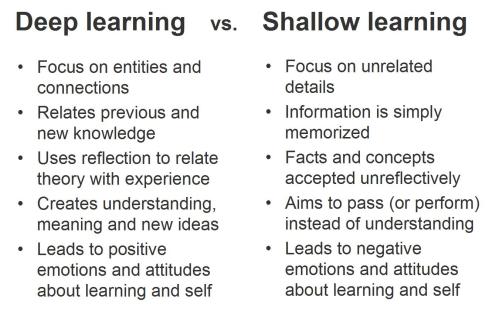
The following  short comparison explains the differences:   

wp-1503129883296.
The difference between the two types of learning is huge, isn’t it? Each of us utilizes shallow learning sometimes. Usually with subjects or topics that carry little significance to us but that we still need to learn to some extent, or maybe with something that we don’t expect to need after a while.

Shallow learning can be seen as a chosen learning strategy and is a well accepted choice in certain situations. What scares me is that some students use shallow learning as their only strategy to learn or to even approach subjects to be learned. This inevitably leads to underachievement, and of course also losing the memorized bits of information, which we then call “learning loss”. Yet, it is worth noticing that some strategic learners choose to use shallow learning as their main learning strategy, in order to pass their exams and get good grades, while not being interested in really learning the content.

The educational reality revolves around the fact that what is taught is not necessarily learned. And if the assessment is taken immediately after instruction, the facts and concepts are mainly held in our short term memory. When transfer happens, and students are able to use and apply the learned concepts in other situations, it also means they have been deep learned. Getting there requires collaboration between students and teachers: meaningful instruction from teacher’s part, and buy-in from students’ part.

“What’s in it for me?” is the question every learner asks (more or less knowingly) before engaging in any given task. The answer may be an external reward (grade, certificate, badge, sticker, etc) or intrinsic interest (curiosity, need to know more about the subject, general interest), and this is where intrinsic/extrinsic motivation comes into the equation of teaching and learning.

It seems obvious that shallow learning relates to perceiving learning as a product. Supporting student’s individual learning processes also promotes deep learning!


Original research about deep learning:

Marton, F. & Säljö, R. (1976a). On the qualitative difference in learning I-Outcome and Process. British Journal of Educational Psychology, 46, 4-11.

http://www.psy.gla.ac.uk/~steve/dands/dandstable.html


Learner Agency – an important part of Deep Learning

13 Aug

Learner agency as a concept in 21st century education relates tightly into students’ perceptions of their own learning experiences.  Agency is the capacity to act, to make decisions about one’s own life and learning.

Deep learning requires ownership and individual engagement with the content. Here is a succinct definition for deep and surface level learning strategies: “the basic processing operations that describe how students react to and interact with the learning material and with people present in the learning environment in order to enhance domain-specific knowledge and skills” (Boekaerts, 2016, p. 81).

This is why learner agency is so important. Students must develop their skills in independent judgment. In order to do that they need ample opportunities to practice choosing. Being or becoming responsible for one’s own actions is one of the possible byproducts of public education.

Recent research recognizes the importance of learning experiences that emphasize autonomous and agentive participation, including the opportunity to have control over oneself and one’s learning environment. There are various ways to perceive agency in the classroom.

It is different to learn something than to be taught something. Being taught doesn’t necessarily mean that learning happens. It only means that the student has been present when the teaching has happened. This is very detached view of learning, and hardly motivates students to try. Memorizing content until the next test is included in students’ perceptions of detached learning.

Sometimes students feel they belong to the school community, which makes them more compliant in learning activities, and a little bit less eager to exercise their agency. In these cases students depend on their teachers and just go through the motions and learning activities, as they are expected to do.

Open dialogue can help students choose to actively engage in their own education and to become more accountable for their own learning. Teachers should support growing agency in the classroom, because the ownership contributes to engaging in deep learning. Students who have strong ownership are interested in learning more.

Deep learning experiences can lead students to become ubiquitous learners, who learn anytime, anywhere.  This unbound learning extends beyond school walls and hours, but we as educators must learn to acknowledge and credit this very independent learning.

Students’ perceptions of their agency can span over several categories. These descriptive categories cannot be used to label students.

In formal education the tradition has been to perceive students as objects of the teaching-learning interaction, with the expectation for students to absorb the facts presented by teachers or faculty.  This view of education doesn’t fit into contemporary learning theories that emphasize knowledge construction. Educational research shows how important factors students’ ownership and knowledge construction are for academic success, yet many educational practices still rely on teacher-centered instructional models. Why?  This seems to support the perceptions of detachment.

There are many ways to support agency in the classroom.

Building a learner-centered environment where students can choose how they practice and learn is an easy way to support learner agency. Students must have choices while selecting their learning resources.  Researchers say that agency is about understanding what choices and resources are available (Kumpulainen et al., 2011, p. 13). Becoming responsible for one’s own learning can and must be fostered in the classroom context.

Supporting learner agency improves the quality of students’ engagement in their own learning process, and help students become ready for the requirements of living in 21st century.  Examples of engagement quality are “going through the motions” vs. “I make my own motions” and “being a classroom sheep” vs. “trying to understand how to transfer learned”.

The table below displays components of learner agency and students’ perceptions of it, as see in my research.

Sometimes agency may seem negative, for example when a student decides to leave homework undone, because they are okay with a grade that is less than perfect. Obviously, this is only a problem when learning is seen as a product, instead of (life-long) process.

Understanding students’ perspectives and using practices that support learners’ agency helps teachers create better teaching-learning interactions.  These learner-centered interactions will improve the quality of students’ learning experiences and also their academic achievement (e.g. Reyes et al. 2012).

The importance of intentional engagement, subjectivity and shared classroom experiences cannot be overemphasized as means for deeper learning. Students must have an opportunity to exercise their agency.

More about Learner Agency at Nina’s Notes

—–

Boekaerts, M. (2016). Engagement as an inherent aspect of the learning process. Learning and Instruction43, 76-83.

Kumpulainen, K., Krokfors, L., Lipponen, L., Tissari, V., Hilppö, J., & Rajala, A. (2011). Learning bridges – Toward participatory learning environments. Helsinki: CICERO Learning, University of Helsinki.

Reyes, M. R., Brackett, M. A., Rivers, S. E., White, M., & Salovey, P. (2012). Classroom emotional climate, student engagement, and academic achievement. Journal of Educational Psychology104(3), 700 – 712.

Smith, N.C. (2017). Students’ perceptions of learner agency: A phenomenographic inquiry into the lived learning experiences of high school students. (Doctoral Dissertation).  Northeastern Repository

NCS Dissertation PDF

Praise and punishment – two sides of control

17 Nov

It is surprising how often people, who think punishments to be detrimental for learning, still approve praise as an effective tool in education.  How is this possible? Both are based on the concept of superiority and having control over other human beings. Often this power is just artificial authority. Please understand that I am not against classroom management, just the behaviorist regime of it! Using SEL (social-emotional learning) and ensuring student-centered management practices is important!

I know this may sound like semantics, but hear me out! Praise always carries a value judgment, an evaluation, and is based on our personal/professional opinion. Encouragement in the form of feedback is non-judgmental. It points out facts. And in education we want to point out all the things students have learned because we have names for them and also know the big picture of how competencies relate to each other. We know what students need to learn to be successful. Hence: no praise, just facts, please. Alfie Kohn has written much about this!

My current position as a mentor for graduate students pursuing their M.Ed. degrees is delightful: I spend my days supporting my students’ understanding and learning process, but I don’t have to be a gatekeeper (and I don’t have to do any grading, yay!). Mentoring requires a specific disposition: the belief that everyone can learn, and that learning cannot be enhanced by praise and punishment. Now, please don’t get me wrong. Performance can be increased (up to a point) by praising and punishing and pushing students to complete their products, but engaging in one’s own learning process and deeper learning requires self-regulation and self-reflection. We can lead students to that path but we cannot force them to walk it. External control cannot help students forward in the path to self-transformation.

I do remember the time when I still believed in praise and punishment.  I am sure my children remember that, too. And for that I want to apologize to them, wishing that I knew more about learning and development when they were young. Fortunately it is never too later for additional development.  Kegan and Drago-Severson have an excellent framework of adult development.

It hurts my ears when I hear someone talk about praise and growth mindset in the same sentence. The two could not possibly fit together. Praising someone means that they have met an invisible standard, for which we want to extend our approvals as superiors. Rewards and gold stars are just a tangible form of praise. Growth mindset carries the same notion of self-transformation as engaging in the personal learning process. As educators it is important to offer timely feedback for students about their learning. However, praise and feedback should not be mixed. Feedback focuses on the achievement and based on transparent criterion of expectations. Praise is based on hidden expectations or personal opinions. It is a value judgement about the behavior or qualities of another human being.

Every educational institution has their own hidden curriculum – the expectations that are not voiced or written. Often these appear in the form of practices and traditions. Hidden objectives are the hardest to meet. A common coping mechanism to meet hidden expectations is the attempt of pleasing the person at control – whether teacher, professor, boss, or anyone else in the position of power. The damage for the organization gets doubled: the person in control only hears the voice of pleasers and cheerleaders, and the structure becomes skewed with the lack of open and honest dialogue. This can easily lead to cliques in classroom (or workplace) and decreased collaboration.

Those who remember Berne’s Transactional Analysis (TA) will probably recognize the roles of Parent and Child in the praise and punishment situations.  Engaging in dialogue on Adult-Adult level is the most important tool for every educator. Students often fall into the trap of playing the child role, especially if their learning process gets reduced to creating learning products that may have no real-life connections, and if they often face praise and punishments in their learning environment. This can happen to adult students too, especially when their learning motivation is externalized. On the positive side it is fascinating to observe young children to behave with maturity above their years when the human dignity is extended to them and they are offered opportunities to self-regulate.

Fear, force and artificial authority

17 May

Learning and teaching in 21st century should definitely be fueled with something much more than fear, force and artificial authority.  After all we want for students to have strong integrity and self-confidence.  And the curricula and evaluations, in addition to the classroom management practices, have been designed for students to benefit from the time they spend in the school.  Right?

Alas, the history of education is filled with good intentions turned into catastrophies.  When teachers and education policy makers are operating with the objective view of learning in mind, the end result becomes a standardized description of a well performing student (without any individual interests and goals, being a puppet in the system bending to the intractable forces of maximum achievement).  Einstein expressed his views of the principal educational methods being fear, force and artificial authority. (Clark, 1971, p.13)

Einstein

The scary part is that even today, more than one hudred years later, the same methods of fear, force and artificial authority are still well and alive in the schools around the world. Why?

Maybe it is easier to convince students about the importance of doing well on tests by instilling the fear of not being able to get admitted to a reputable college/univeristy/workplace unless the test scores demonstrate brilliance? Maybe it is easier to control student behaviors by displaying artificial authority of being the keeper of the scores or grades?  But, from decades of research and practice we know that students learn better when they learn in an environment that is safe, supportive and collaborative.  And we don’t need “servile helots”, but critical thinkers who will thrive in the 21st century environment where information and choices are more abundant than ever before.

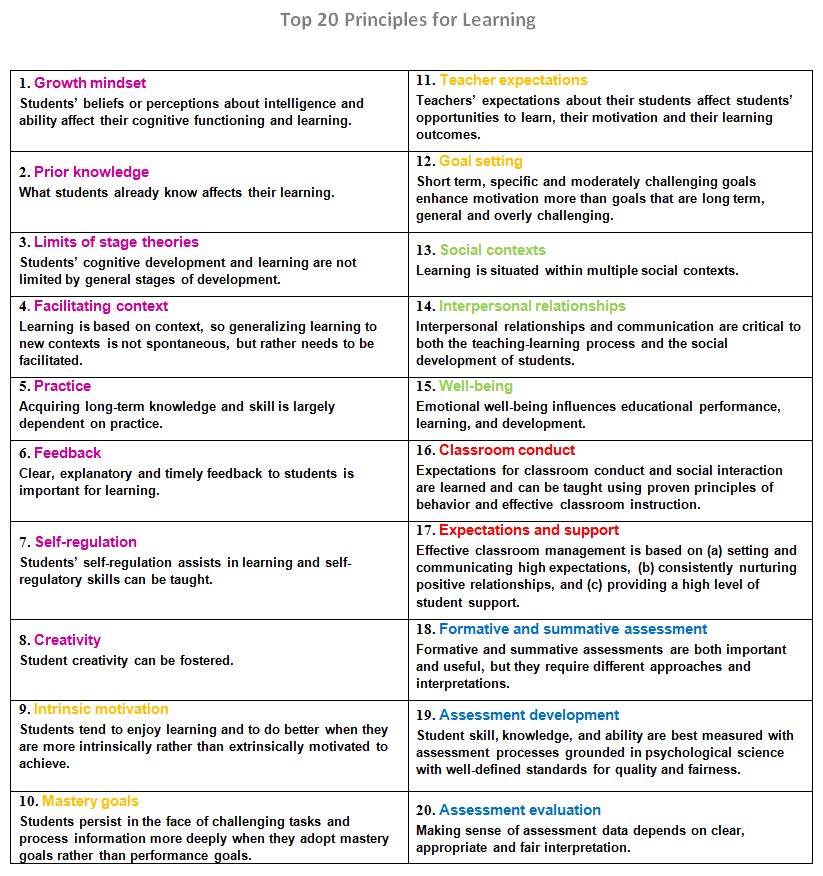
The psychological research and practice have advanced very much during the past century. American Psychological Association has published the Top 20 Principles to be used at schools.  What blows my mind is how few teachers have heard about these, or their predecessor Learner-centered Psychological Principles.  Yet, I consider the APA to be the highest authority of educational psychology in the U.S. and a positive influence in the world in general.

These Top 20 principles have been divided into 5 areas of psychological functioning:

  1. Cognition and learning: How do students think and learn?
  2. Motivation: What motivates students?
  3. Social context and emotional dimensions: Why are social context, interpersonal relations and emotional well-being important to student learning?
  4. Context and learning: How can the classroom best be managed?
  5. Assessment: How can teachers assess student progress?


All the 20  principles are displayed below in a table.

Top 20


What you do in your classroom – whether online on traditional – is your choice.  The psychological principles are compatible with every subject and every curriculum. Why not give it a try and implement a safe, supportive and collaborative learning environment?


American Psychological Association, Coalition for Psychology in Schools and Education. (2015). Top 20 principles from psychology for pre K–12 teaching and learning. Retrieved from http:// http://www.apa.org/ed/schools/cpse/top-twenty-principles.pdf

Clark, R.W. (1971). Einstein: The life and times. New York: World.


Learning-centered education

12 Feb

What is the central focus in your classroom or course? What is in the nexus of your instruction? Is it learning, performing, socializing, producing (or reproducing), obeying, memorizing, or something else? What is the most important thing for your students to remember from your class or course?

It is surprising to realize how often our everyday teaching practices contradict our teaching philosophy!

Thinking about the core purpose of education: helping students to learn. How easily it gets diverted from the original focus on learning, and becomes a rite of passage or about measuring academic performance!

In everyday language we use such a huge a variety of definitions for “learning” – like answering correctly, passing,  “learning a lesson”,  memorizing, and so on – that it is easy to get confused and think that measured performance is equal to learning. I don’t think it is. Sometimes performance as learning means just cramming information into short term memory in order to pass an assessment or evaluation. Then that information can be forgotten, and it never becomes the much needed intellectual capital of knowledge.

When we simply measure performance with assessments and evaluations, we only get to see the end result of students’ learning process. We don’t know how the skill or knowledge was acquired. We just know that this student passed an exam, or created an acceptable product.  But the “learning” behind the score may not not what the educational systems wish it was: this kind of surface or strategic learning is usually not learning for life. It is memorizing for survival in testing-oriented educational context.

To change the learning context we must focus much more on supporting students’ learning process, because acquiring transferable and life-long knowledge and skills is exactly what real learning is, or what it should be. When we are too busy cramming all the minor details of our beloved subject matter into the lesson or syllabus, we easily forget what learning really is about: for students to construct their own understanding of the subject. Not only reproduce something the textbook says, but to use critical thinking in order to fully understand the topic and how it relates to the world where student lives.  Decontextualized learning is shallow or superficial by default. This is why I am very critical about prescriptive curricular and instructional design – students have different ways of thinking, different ways of learning, and different ways of knowing, and education has to accommodate those needs in order to be effective!

The easiest ways that I know to engage in learning-centered education is to provide choices for students. Thinking about learning as acquisition and elaboration of information (Illeris, 2003), it is handy to let students choose how they obtain the information. Sometimes letting students have a choice of where they get the information is beneficial (yes, I think wikipedia is a good starting point, but obviously students will have to dig deeper than that, and provide appropriate references for their sources). Also providing choices for learning strategies supports both students’ self-regulation and their learning process. Does it really matter how your student learned the concept or topic, if they learned it well? In order to help students’ independent learning skills to grow even more,  it is a great idea to provide choices for assignments and assessments, and use rubrics and formative feedback to guide students to the level of competence where they need to be. Naturally, each student will arrive to that point on their own, individual pace.

I know that standardized tests don’t really fit into this picture, but their purpose is not to support students’ learning. Those tests exist to provide numerical data for stakeholders in the form of summative evaluations, not to promote learning-centered education. As teachers we may not have enough voice to change the current educational policies, but engaging in learning-centered education helps students to be ready for both the tests and life.

How about making learning the central focus of your instructional practice?

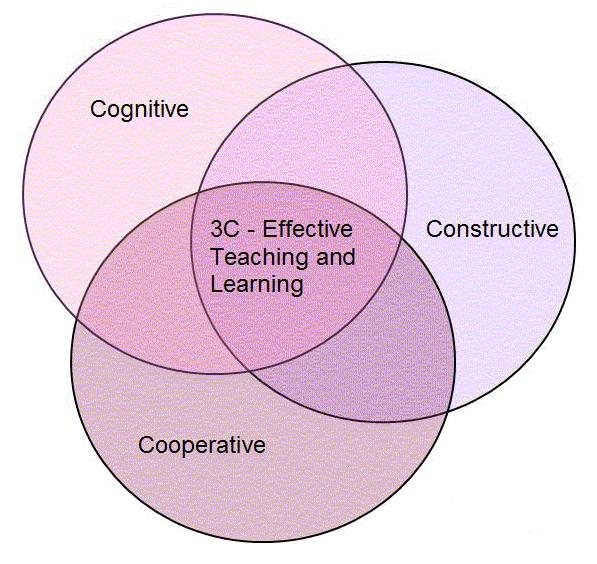
N3C

Illeris, K. (2003). Toward a contemporary and comprehensive theory of learning. International Journal of Lifelong Education, 22(4), 396-406. doi:10.1080/0260137032000094814

Visible and invisible learning and teaching

13 Jan

Learning process is anything but linear and visible.

Best learning experiences are often messy and hard, but oh-so-rewarding. For education professionals it is sometimes nice to think about how the learning process is rolling forward like a simple cycle (like Kolb’s), and emphasize the perception and processing, but the reality is far more complex. There are pits, loops and rabbit holes along the way.

The discussion of learning process must include these invisible or intermediate processes of learning, and acknowledge the personal preferences that make learning stick. One size does not fit all.

Learning process

Our personal preferences for the intermediate processes of learning are the ways we prefer to perceive, choose, store, reflect and retrieve the data and information needed for learning. These preferences result from our previous experiences in life and learning, and they can either help or hinder our academic learning process (Green et al. 2012). Acknowledging the individual preferences and emphasizing the importance of metacognitive skills in learning helps to focus more on these invisible parts of learning process.

Teaching the metacognitive skills could be called invisible teaching, because it requires significant amount of interactions between the teacher and the student – interactions that may or may not relate directly to the learning objectives.

Learning happens everywhere. This must be acknowledged in the learning design process, because without transfer to personal lives of students the formal learning is quite worthless. (This is obviously not a new idea, non scholae sed vitae has been around for a long time.) Unfortunately, teaching is sometimes seen as a simple act of delivering information.  In such learning environments evaluations of learning (or performance) are based only on the tests, exams, essays, worksheets and other ways of demonstrating the  mastery of the subject/topic.  Grades are handed out to students in the end of term or semester, but what do these grades actually mean?

Invisible learning could be called unvalued leaning, because it is not included in the evaluations conducted in formal education.  To be effective, contemporary education must strive “to capture intermediate learning processes in student work,” not just outcomes (Bass & Enyon, 2009, p. 15). One way to broaden the evaluation of learning is to use performance assessments with rubrics, so that students know what they are supposed to demonstrate, and use all their knowledge in the tasks, not just a small, segmented amount of knowledge that belongs to that specific class.

The challenge for contemporary education is to include the invisible learning into formal learning. Learning should always be life-long, life-deep and life-wide.  Students have lots of knowledge gained outside of the school systems, and in information societies we cannot – and should not – try to restrict students’ access to information. Visiting websites like wikipedia should be encouraged, with the constant reminder of not taking any information at a face value.  Not even what is printed in the textbook. 🙂

Bridging this informal or invisible/unvalued learning to formal education helps students to see their classroom learning more meaningful because it carries personal significance. Emphasizing invisible learning empowers students to engage in self-regulated learning and be more active in building their own, personal knowledge-base.

What is the easiest way for invisible learning to become valued in your class?


Bass, R. and Eynon, B. (Eds.). (2009). The difference that inquiry makes: A collaborative case study of technology and learning, from the Visible Knowledge Project. Academic Commons. Retrieved from http://academiccommons.org/).

Green, J., Liem, G. A. D., Martin, A. J., Colmar, S., Marsh, H. W., & McInerney, D. (2012). Academic motivation, self-concept, engagement, and performance in high school: Key processes from a longitudinal perspective.Journal of adolescence35(5), 1111-1122

Growth mindset for grit vs. empowerment

5 Sep

I enjoyed reading Alfie Kohn’s critique about Dweck’s mindset because it made me think about how we empower students to engage in their own learning process.  The article addresses points that are extremely important while using the mindset in the classroom, especially the pedagogical choices about focusing on traits like grit or supporting the individual learning process of each student. Mindset itself is important, but the way we discuss the growth mindset with students is even more important.

Personally, I find it controversial to focus too much on learning styles or personality traits like grit (other labels are extroversion, openness, impulsivity, etc, google Big 5 for additional information).  This is because the contemporary learning theories highlight the subjectivity of learning, and the expected teaching dispositions are very clear about the need for all teachers to display the belief  that every student can learn (regardless the personality traits students have). Furthermore, I prefer to focus on supporting my students’ individual learning processes, because this helps them to become independent learners. Every student, child or adult, has their unique set of skills and needs, and perception of their own strengths and areas of growth. Discussing the growth mindset in the classroom may help some students to adopt better learning dispositions and engage more deeply in their own learning process.

It seems that mindset is a refined and renewed version of attribution theory and deals with students’ self-efficacy beliefs and locus of control.  We all have had those students and parents with the firm belief how “nobody in our family has ever been good in math” or “everyone in the family struggles with reading”. When children hear these messages stated over and over again in casual discussions, they often start to believe that they couldn’t possibly learn math, or be fluent readers, because those attributions don’t belong into their family. These beliefs easily create self-fulfilling prophecies that can seriously harm students’ learning.  Growth mindset can be an excellent tool to diminish these negative causal attributions and help students create a realistic (academic) self-concept. But, I don’t believe this can be achieved with something as simple and effortless as praise.

Praise is normative by its nature. Praise implies that the student met an invisible norm, known or set by the subject matter experts (teachers, educators, parents, etc). Thus praise is always about evaluation, because it is an external judgement about what the student did or what the student is (doing referring to the growth mindset and being referring to the fixed mindset). In education we need to increase the use of assessments and self-assessments with clear criteria about expected outcomes of assignments, so that students know what they are supposed to achieve and don’t have to rely on hit-and-miss strategies. Evaluations are very much overused, which is problematic because they emphasize the control over students and their performance, instead of providing learning support or feedback about the learning process.

The very first decision for every teacher to make before introducing the mindset to her/his students, is whether the mindset is used in the classroom to promote grit or to empower students to learn more.

Using mindset to promote grit in the classroom is fairly straightforward: create standards and labels for appropriate behaviour (maybe checklists), and we are good to go and evaluate students’ behaviours, actions and displays of true grit for demonstrating their growth mindset.  It is easy to quantify how many work sheets students have filled, or how many minutes they have engaged in the activities – and then praise the persistence in task (whether the task is meaningful for students is irrelevant in this environment).

I can understand why effort-praising, grit-building growth-mindset practices are appealing: they appear to be a quick fix for the most important problem in education – student disengagement. I am sure we could build a robot to offer praise every time when a student displays gritty behavior! But doesn’t this kind of praise seriously underestimate our students as vibrantly intelligent, creative and curious human beings? While persistence is important in successfully completing tasks or projects, it certainly cannot be the most important ingredient in educating students to become productive citizens of 21st century!

Grit vs empowerment

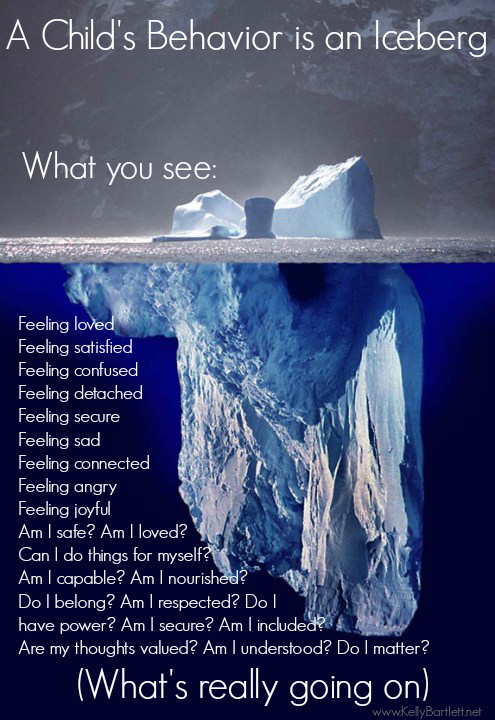
In the classroom reality the difference between the environments is obviously much less black and white, and features from both sides (grit and empowerment) are used in most learning environments I have seen. Balance is what matters. Taking behaviour at face value, and believing that it truly communicates what students are thinking is a big mistake. Students are not as experienced in communication and interaction as we teachers are, they are still trying to figure it out. (Here is a nice iceberg image about behaviour to remind us about the reality!)

Focusing on empowerment in mindset discussions is harder and more time consuming for educators, because empowerment requires a dialogue between students and the teacher. It is about engaging in authentic interaction where both parties are heard. In this environment assessment becomes an opportunity for feedback and growth. I am currently working on my dissertation about learner agency in formal education, and these very same themes of empowerment are important for educating students who are “self-organizing, proactive, self-reflecting, and self-regulating, not just reactive organisms shaped and shepherded by external events”  (Bandura, 1999, p. 156).  To thrive in the with the constant information overflow in the world today, this active choosing (instead of reacting) is exactly what our students need to learn.

We as teachers need to make informed choices about our pedagogical and instructional practices. Is it more valuable for students to remember that finishing all tasks gets them rewarded (with praise or grades), or to know that they can have an effect on their own learning process? This is a value level choice about the classroom practices we communicate to students with expectations and grading policies. So, when introducing the mindset in your classroom, please do think about the long-term goals. What do you really wish for students to gain from the mindset discussion?

Update on 9/29/2015:

Carol Dweck revisited mindset stating that she may have “emphasized sheer effort too much”. Wonderful!
Maybe this mislead educators to think that promoting grit is beneficial, and so it became this widely accepted misconception about contemporary learning!

Growth mindset

Bndura, A. (1999). Social cognitive theory of personality. Handbook of personality: Theory and research, 154-196.

Teaching and learning dispositions

28 May

What is your teaching disposition?

Providing a short answer to this question has always been a struggle for me, because so much falls under the concept of teaching disposition: values, beliefs about teaching and learning, interaction styles,  even worldview. So, where to start?

Those who have been following my blog already know that I am very passionately supporting student-centered learning and teaching, so obviously my teaching disposition focuses more on  supporting  students’ individual learning processes than anything else.  Pedagogical skill is very high on my priority list.

Believing that everyone can learn is one of the fundamental dispositions in contemporary education. This belief doesn’t always seem to fit perfectly with standardized testing, or labeling schools (and sometimes even students) as “failing”, based on a quantitative snapshot evaluation that tells very little if anything about the learning process (i.e. the learning quality).

Being convinced that knowledge is much more than a fixed bunch of  facts (information) brings another dimension to the dispositions because it defines the extent of our teaching. We must prepare students for the world that is a complex mixture of cultures and diverse beliefs, and while memorizing disconnected pieces of information may be a nice trick in trivia game, students also need to understand the contexts and connections of that information. Where did it come from, and is it trustworthy?  And an especially important question is: how can we use it productively?

Unfortunately the discussions about the nature of knowledge are seldom highlighted in professional meetings, but it should be. Misusing information is easy because it is shallow and has no situationality or contextuality – these are qualities of knowledge, where an individual has constructed an understanding of how given information fits into her/his worldview, beliefs and values. The use of labels falls into the category of misusing information, and it often leads into otheringwhich is how we define “us” and “others”.

It is easy to sort people, categorize them and label their qualities. But, when we use labels and define the problem in education for example as underachieving students, it locates the solutions to fixing the students. Not education, nor instruction, but students. How scary!  This is how something we know from research and experience to be beneficial for students, their learning and their future (e.g. bilingualism) suddenly becomes a problem (e.g. ELL, underachieving).  Of course these diverse students score lower in the standardized tests.  But their individual learning processes may be incredible.

In order to effectively communicate to students about the  importance of individual learning process, two additional parts of teaching dispositions must fall into place: keeping my bias in check, and differentiating for students’ needs – not for the labels we too often attach to students (you know: ELL,  poverty, learning disabilities, behavioral needs etc etc).   When we keep on othering, we point our fingers to students, label them, and provide remedial education — without checking our bias (is the problem really the student, or maybe the environment, instruction or context?) and without differentiating for students’ individual needs.  This deficit thinking also seems to be the origin for the grit discussions. Have you noticed that nobody is asking for successful students to show more grit? It may be because they don’t need to persist, because they have gained the sufficient knowledge with informal learning, and are getting bored out of their minds in the classroom. But these seemingly successful students would really need to learn how to learn effectively something new, because nobody can be excellent in everything.

Recent research also recognizes the importance of teachers’ interaction styles and skills as mediators for learning, and suggest that setting limits is more beneficial for students’ learning than guilt-inducing appealing to students emotions[1]. This makes perfect sense from the viewpoint of dispositions: respecting the diverse needs and skills of learners also leads to offering every student an individual amount of freedom and choice and providing the information in student-sized chunks.

So this is probably the shortest description of my teaching dispositions:  focused on supporting students’ individual learning process I strongly believe everyone can learn, I do also understand the importance of connected knowledge, and I try to check my own bias regularly to avoid engaging in othering and keep on striving to differentiate for my students’ individual needs.

Oh… and our teaching dispositions are of course very close to our learning dispositions, but even more up close and personal. Learning dispositions regulate our learning efforts, our interests and motivation. The origin of learning dispositions is complicated, but they are partially born from our everyday learning experiences.

What kind of learning dispositions you think your students are creating? What is important and valued in your classroom?


__________________________________________

1. Viljaranta, J., Aunola, K., Mullola, S., Virkkala, J., Hirvonen, R., Pakarinen, E., & Nurmi, J.-E. (in press). The role of temperament on children’s skill development: teachers’ interaction styles as mediators. Child Development.