Archive | Deep Learning RSS feed for this section

Would you try competency-based education in your class?

14 Mar

Competency based education has several strengths over traditional seat-based education.  It supports students’ accountability of their own learning and allows students to advance in their own pace after meeting the explicit and transferable learning objectives, demonstrated by the assessment criterion (usually rubrics).

Time is the first element of individualization of learning — or at least it should be. We all have our own ways of processing the information that is thrown at us in formal education. It is foolishness to imagine that all students would take exactly the same time to process things to be learned.

This is exactly why I LOVE competency based education: when you are done learning one concept/topic, you can move on. Well defined learning objectives break down the skill/knowledge acquisition for students, and as a teacher (learning facilitator) I am there to ensure that nobody has to struggle too much, and that everybody has something meaningful to do, while engaging in her/his own learning process. This is how I have successfully taught on all school levels (and now work in a competency based university), and it is also the way I build my asynchronous PD courses.

The Working Definition of Personalized Learning is very good:

Personalized learning is tailoring learning for each student’s strengths, needs and interests — including enabling student voice and choice in what, how, when and where they learn — to provide flexibility and support to ensure mastery of the highest standards possible.[1]

It also discusses the learner-centered principles, which should be given in 2015 while designing curricula and instruction — but, alas, it is not. To refresh what learner-centered[2] principles are about:

The Principles apply to all learners, in and outside of school, young and old.  Learner-centered is also related to the beliefs, characteristics, dispositions, and practices of teachers – practices primarily created by the teacher.When teachers and their practices function from an understanding of the knowledge base delineated in the Principles, they:

(a) include learners in decisions about how and what they learn and how that learning is assessed

(b) value each learner’s unique perspectives

(c) respect and accommodate individual differences in learners’ backgrounds, interests, abilities, and experiences, and

(d) treat learners as co-creators and partners in the teaching and learning process.

Changing the focus from universal delivery of information (i.e. traditional teacher-centered educational model) to learner-centered or personalized learning approach (i.e. learning facilitation) is the first step.  Then, changing assessment and grading to reflect students’ learning process and engaging in non-punitive assessment model is the second step.

Here is a nice table about the elements for student-centered and competency-based education. While the table discusses children’s learning, I would like to remind all readers that adults’ learning is not much different, and the same elements are very applicable in all levels of education (and training).

12 elements for designing learning
I have been engaging in competency based learning for nearly 20 years now, and in all levels of education. The main gain is that it shifts the focus from doing busywork to being engaged in one’s own learning process. What more could an educator wish for? 🙂

The table above has a good alignment with Choosing How to Teach:

Learning Star3

The most Effective Learning occurs in the middle of the picture, where you can see the star.  If we are missing even one piece, the star –or learning – is not complete. Students’ achievement depends on their engagement and interactions with the learning environment and the materials. Competency-based education provides tools for achieving this.

Would you be willing to give competency-based education a try and change something in your current practice?

1 Patrick, S., Kennedy, K., & Powell, A. (2013). Mean what you say: Defining and integrating personalized, blended and competency education. Report, October.

[2] Learner-Centered Principles Work Group of the American Psychological Association’s Board of Educational Affairs, BEA. (1997, November). Washington, DC: American Psychological Association. https://www.apa.org/ed/governance/bea/learner-centered.pdf

Student-centered assessment

18 Jan

Good quality assessment is an important tool for every educator.  At simplest it is just informally checking how students are progressing in their learning, which can provide a nice snapshot of an individual student or the whole class. Arranging these snapshots chronologically creates a display of individual learning process. These portfolios, learning journals, or other displays are very useful in learning environments where students are not formally evaluated, but they can also be used very effectively in all educational systems.

Formal education is often built on learning objectives and learning outcomes and thus assessing students’ performance is seen to be necessary.  Students’ progress in formal education is tied to a curriculum and students are evaluated to see if they meet the standards of the educational system. But, to support students’ individual and self-regulated learning process we also need to have strong formative assessment practices. Formative assessment of learning is then used to inform future instruction in the class, and thus also may become assessment for learning.

Classroom assessment has several requirements, though, to be beneficial for students and their learning process.  The very first and the most important requirement is that all assessments are non-punitive, so that they don’t create a threat for students to engage in their learning.  It is detrimental to use assessments that direct students to use shallow or strategic learning approaches!

An assessment cannot be a one-shot-only situation, because that emphasizes the view of learning as a product, not a process. Criterion based (or standards based) assessment where students get try again until they reach the standard is a good option. It is important to remember that while trying to measure students’ knowledge/skill in the content, the assessment shouldn’t be focused on students’ work habits or organization skills. Including learning about executive function to lessons is a good way to improve study skills.

The second requirement is that students must be included in decisions about how and what they learn and how that learning is assessed (as per APA learner-centered psychological principles). This doesn’t mean  letting students to do whatever they want, but opening the discussion with students about their learning process, allowing students to choose their learning/study strategies, and providing choices for both assessments and assignments.

The third requirement is for the assessment to improve the learning process, and build students’ self-efficacy beliefs while treating learners as co-creators and partners in their learning process (APA). Assessment contributes to students’ growing meta-cognitive skills, by providing feedback about both the learning and studying strategies and practices (not just the product, i.e. worksheet, paper, project, poster etc) in order to support students growth.  There is a big difference in evaluating the study strategies and providing feedback about them.

To be effective assessment must also inform the teacher about next steps in instruction and help the teacher to accommodate individual differences in learners’ backgrounds, interests, abilities, and experiences (APA). This also presents the requirement for providing choices in the classroom.

It is a good practice to include students’ self-assessments into the formative assessment system in the classroom, because it improves students understanding of their own skills and learning when they see how well the self-assessment and formative assessments meet. And, a major discrepancy between self- assessment and formative assessment is an excellent conversation starter between the teacher and the student — in both situations when the student over- or underestimates her/his skills and knowledge – and in which case it easily becomes both an assessment of learning and an assessment for learning.

And please, let’s not get confused between (formative) assessments and (summative) evaluations! One question about Finnish education that I often get to answer is about the absence of standardized testing in K-12 in Finland.  While this is absolutely true, and students don’t have to be prepped for tests for several weeks, the reality is that teachers engage in ongoing formative assessment and use students’ self-assessments in order to know how their students are learning and how to support their learning processes.

APA Work Group of the Board of Educational Affairs (1997, November). Learner-centered psychological principles: A framework for school reform and redesign. Washington, DC: American Psychological Association. https://www.apa.org/ed/governance/bea/learner-centered.pdf
Why leadership is so important in education

23 Sep

We often talk about the importance of leadership in education, but what does it actually mean?

My favourite definition of leadership is this:

Leadership is about leading others towards an imaginary future.

It is not easy, because we don’t actually know what is there.  But, by having sufficient knowledge and data, we can make educated guesses about it. Effective leadership in education is about engaging the whole team to improve educational outcomes – yes, this means including students into the improvement process, and engaging them in their own learning (not just schooling: see the previous blogpost).

The other hard, but oh so important step in leadership is to move the focus and action from what is urgent to what is important. In classroom this means teaching and learning for life, not for test (this also can be seen as engaging in deep learning).

For teachers and instructors the job description has (at least) three parts: leadership, management and coaching. A major part of my daily work is about my attempts to provide leadership and  empower my students to step up on the plate and be in charge of their own learning and meaning-making. The managerial aspect of being a teacher (grading, disciplining, being the gatekeeper) is not as appealing to me, and in my current position I am very happy that the assessment department does the grading, and I can just coach and support my students to understand what their tasks entail.

It is always important for students to interact with the content to get all the information provided about the topic of the lesson or unit, but an equally important thing is to engage in thinking, because otherwise the readings/lectures/videos only remain as information, they do not become knowledge. I really like the definition of information only becoming knowledge after it has been processed through our minds, because the individual interpretation of any given fact is what makes effective learning to happen.

Leadership is very much needed in everyday classroom situations to empower students to learn what they need to learn, not what others in the classroom need to learn. One size doesn’t fit all and blanket statements are quite useless when the focus is in learning instead of teaching. This personalization, of course, is also the premise of differentiated instruction, but it actually takes the student even further on the road towards self-directed and self-regulated learning. Knowing what I know and what I need to learn is the foundation of engagement in independent learning.

Leading each student forward on their path of individual learning process is what makes teaching so hard: all students have individual needs and should have personal goals in their learning, but setting and updating those goals would take a lot of teachers’ time. This is why it is so important to engage students in setting their own learning goals (within the classroom/curricular goals – or even beyond them, if the student is very advanced). The standards are an excellent tool for providing the descriptions of what good learning or good skill looks like. The next step on the path towards independent learning is providing opportunities for students to engage in self-assessment to “calibrate” their thinking about their own learning/skills to meet the view of curriculum designers.  Imagine how effective learning is in classrooms like this – and how students are learning for life, not just for the next test! And imagine the ownership of learning students have! This is where the appropriate leadership takes education in the classroom.

Equally important is to have the appropriate balance of leadership and management in school administration and school districts. Grant Wiggins wrote a wonderful post about the difference of leadership and management in regards of curriculum leadership:

Wanted: real curriculum leaders, not just managers

The questions of purpose, audience, the level of detail, feedback, etc. asked from curriculum writers are equally valid in the classroom practice, even if in a different scale.  Effective teaching, or instruction, is about providing learning facilitation and leadership for students, so that they can feel empowered to engage in learning and meaning-making and have solid ownership for their learning.

Collaborative meaning making is the best tool for engaging people in a dialogue. The shared vision of learning is the imaginary future; and real curriculum leadership, not just management is the way to get there. Unless students and teachers are buying into the district vision, it doesn’t really matter what the papers have written on them, or how beautifully crafted the mission and vision statements are.

COMPASS learning

23 Jun

Nina’s Note 8/31/2022: I just revised this blog post from years back when I was working on my doctoral studies. The literature review contributed to my dissertation about learner agency.  🙂 These same topics are still very important to use in every level of education – just because we need these ingredients to design great learning experiences for our students.

Having choices is the prerequisite for ownership!

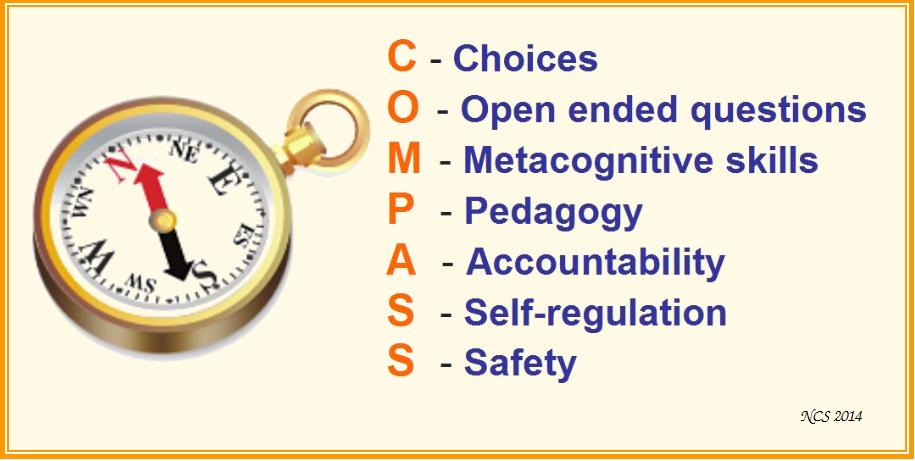
After working for few weeks on a literature review about learning and teaching being disconnected, and how student empowerment improves learning, I just wanted to share the highlights. Here they are in a form of a compass:

COMPASS learning

Choices and open-ended questions are needed for increased student engagement and motivation in learning. Choosing is a skill that can (and should) be taught. It relates very straightforwardly to problem solving skills. If there is just one correct answer, and students should find it, no thinking or choosing is needed, and less learning occurs. Open-ended questions help us to understand better what the student thinks.

  • Feuerstein, R., & Falik, L. H. (2010). Learning to think, thinking to learn: A comparative analysis of three approaches to instruction. Journal of Cognitive Education and Psychology, 9(1), 4-20.
  • Goetz, T., Frenzel, A. C., Hall, N. C., & Pekrun, R. (2008). Antecedents of academic emotions: Testing the internal/external frame of reference model for academic enjoyment. Contemporary Educational Psychology, 33(1), 9-33

Metacognition needs to be emphasized and taught as a byproduct in every class. How cold anyone be proficient in learning, if they don’t have the information how learning happens best? We teachers sometimes forget that students don’t have all the same information we do.  Students academic self-concept is important for their learning competence, and if you are a university instructor, please remember that it is never too late to help students to find their confidence as learners. Sharing tools how others learn is an important part of any educational event.

  • Alexander, P. A. (2008). Why this and why now? Introduction to the special issue on metacognition, self-regulation, and self-regulated learning. Educational Psychology Review20(4), 369-372.

Pedagogy should be the focus in the classroom, and preferably in the literal meaning of the word “to lead the child”, i.e engaging students in learning facilitation instead of pre-scripted instruction. Students’ learning dispositions and the instructor’s teaching dispositions are equally important in the teaching-learning situation!

  • Shum, S. B., & Crick, R. D. (2012, April). Learning dispositions and transferable competencies: pedagogy, modelling and learning analytics. In Proceedings of the 2nd International Conference on Learning Analytics and Knowledge (pp. 92-101). ACM.

Student’s accountability -or better yet, responsibility-for their own learning is far superior measure for achievement than externally set teacher goals could ever be.  However, this requires a huge increase in learner agency and explicitly teaching SEL skills. Furthermore, in the Berry & Sahlberg article the external accountability measures seemed to prevent teachers from using effective small group practices. That sounds just downright wrong to me.  Teachers are the learning professionals. They should get to engage in lerning experience design for their students and choose the instructional method that best fits the group of students they are teaching.

  • Berry, J. & Sahlberg, P. 2006. Accountability affects the use of small group learning in school mathematics. Nordic Studies in Mathematics Education, 11(1), 5 – 31.)
  • Bryk, A. S., Sebring, P. B., Allensworth, E., Easton, J. Q., & Luppescu, S. (2010). Organizing schools for improvement: Lessons from Chicago. University of Chicago Press.

Self-regulated learning is essential for academic success. After all, learning IS individual, and the sooner students learn to self-regulate their own learning needs, the more likely they are to become lifelong learners.  The world is changing very fast, and it seems that the pace of change is not going to slow down anytime soon. This presents the dire need for every student to become a proficient lifelong learner, so that they can update their skills and keep up with the pace of the  progress.

  • Scardamalia, M., & Bereiter, C. (2006). Knowledge building: Theory, pedagogy, and technology. The Cambridge handbook of the learning sciences, 97-115.
  • Zimmerman, B. J. (2000). Attaining self-regulation: a social cognitive perspective. Handbook of self-regulation, 13-39.

Safety should be a given attribute in every school. In addition to ensuring the physical safety, the learning environment MUST be emotionally safe for students to engage in higher level thinking (check Maslow if you don’t want to take just my word for it). Students spend a lot of their time in school and classroom. If we want to have well-adjusted and balanced citizenry in the future, then the learning environment should contribute towards that goal.

  • Willms, J. D., Friesen, S., & Milton, P. (2009). What did you do in school today. Transforming classrooms through social, academic, and intellectual engagement.

Please try some COMPASS learning this school year! It always makes a difference for students and teachers both!

🙂

Nina

Lifelong learning

20 Jun

I wish we didn’t so exclusively connect the concept of learning with formal education and going to school or being a (college) student.  Because learning actually happens everywhere, all the time. At school learning is just more focused and targeted to meet the standards or performance measures of the course.

Maybe it is just me, thinking how being a learner only depends on your mindset?  With a curious approach to life even reading your daily newspaper can become a learning experience, not to talk about diving into books…or the wonderful open source journals, databases, libraries… and wikipedia. Maybe I am addicted to learning, but I consider a great fun to hit the random article button in wikipedia and reading about something I maybe knew nothing about.

Lifelong learning is so important in these times when there is more information available in our fingertips than ever before!

Unfortunately many students are schooled out of their minds with too tight performance measures and learning objectives that leave very little or no space for wondering and creativity.  How can we help students to become interested in learning, not just expecting to be schooled or pass a test? How to help more students to become lifelong learners?

One way is to equip students with the skills to self-regulate their learning.   Helping students to think about their learning (tasks) and how they relate to a bigger picture, focus on their own thinking and learning while engaging in the task, and self-evaluate their learning?  (These components are also called forethought, performance control and self-reflection, as seen in Zimmerman, 2002.)

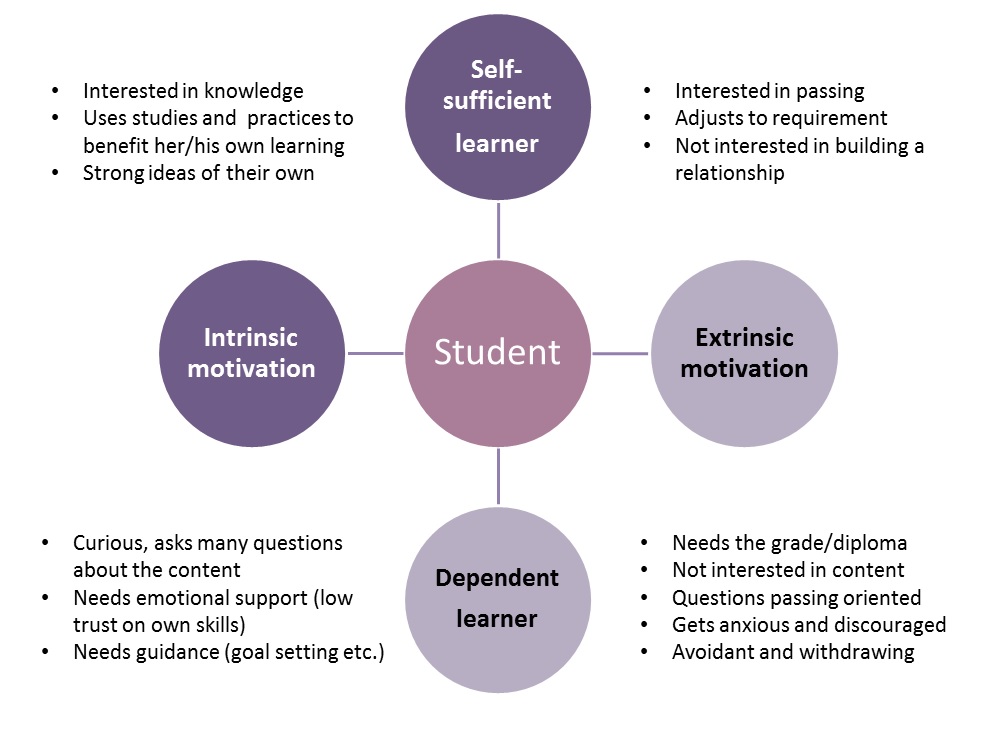
As a teacher and mentor I try to understand what is the mindset of my students, and I created the typology below to illustrate the  four different types of students we have.


Typology for motivation and dependence


Newman, R. S. (2008). The motivational role of adaptive help seeking in self-regulated learning. Motivation and self-regulated learning: Theory, research, and applications, 315-337.

Zimmerman, B. J. (2002). Becoming a self-regulated learner: An overview.Theory into practice41(2), 64-70.


Is Learning a Product or Process – part 2

27 Feb

Best teacher is the one who makes herself unnecessary by

empowering students to become autonomous learners.

~Nina Smith

When learning is seen as a product, the emphasis of the learning-teaching interaction is in instruction – and the thinking behind comes from the idea of students only learning when the teacher is instructing them, and only what they have been taught.  The reality is different, as any curriculum leader can tell you. At any given moment of time any given classroom has several ongoing curricula: intended, written, taught, actualized, learned, etc., so we cannot simply look at the learning product.  This product may be a paper, worksheet, notes, homework, essay, grade, etc., that we use to measure the results of students’ learning.

Emphasizing learning products makes mistakes very undesirable phenomena in the classroom – after all a perfect product is the goal, right?  And often the grade only reflects the finished learning product, without paying attention to how the student got there.  Maybe s/he already knew the content or had the skill, and didn’t have to study  or practice at all?  If we pay too much attention to the product, we may miss the important part of the learning-teaching interaction: the individual students’ main gain,  her/his increase in knowledge/understanding/skills that has happened as the result of instruction.

Now, very seriously: which one is more important to you? What your students know/can do — or how much they improve in what they know/can do? 

There is a big difference.

Improving what students know/can do inevitably leads to different end results, because each student has her/his own starting point. And this improvement, the increase, of course, IS the result of the individual learning process of each student.  This is also why helping students to become independent learners is so important.

Independent learners tend to automatically (or by learned habits) engage in their own learning process.  While observing these students we can see them intentionally influencing their own learning behaviours, and Bandura  (2006, p.164-165) described the four following components in their engagement: the intentionality of their learning, the forethought of their actions, their self-reactiveness and self-reflectiveness. Of course, to be able to do all this, students must have certain amount of freedom in the classroom, which is why I am so fervently advocating for providing more choices in classrooms. Choosing is a skill that can (and should) be taught and learned, and it only grows when students have ample opportunities to try choosing in an emotionally safe learning environment, where mistakes are not only allowed but celebrated.

Just imagine how much more these students learn! They don’t need the teacher to motivate or engage them, because they are already “in the zone”. In the classroom these components apply straightforwardly to students’ engagement as intentional learning activity, and learning motivation and goal-setting as their forethought. Meta-cognitive knowledge is about knowing and understanding how I learn, knowing what is easy and what is hard for me, and where do I need to put in extra effort in learning. Independent learners, who engage in their own learning process already know these things. Wouldn’t it be important to help every student to possess this knowledge of themselves?

The third component in independent learning, self-reactiveness, relates to the way students control their own learning actions and regulate their own behaviour in classroom. As a teacher it is important for me to ask myself, how can I support my students’ self-regulation and  provide more autonomy for them. When students get to regulate their own learning process (pace, depth, breaks, note-taking, collaboration, additional information, etc) also the learning results, the visible and tangible products of learning, do improve.

Maybe the easiest way to support students’ learning process is to provide accurate and timely feedback. This strengthens the fourth component of independent learning, student self-reflection,  which is too often overlooked.  Feedback has been statistically identified as one of the  important teaching-learning factors (Hattie & Timperley, 2007), because it enhances both the learning process and the product we get as an end result of successful learning. Students self-evaluation is an important classroom practice, because it combines feedback and self-reflection.

To me it seems that too strong focus on the learning product leads to shallow learning (to just get by), and strategic learners  (to just get a good grade) instead of deep learning.  While independent students may have strategies to cope in product centered learning environment, the dependent students may not have a clue what they should do, or how they are supposed to do it – which further decreases their learning motivation.

Focusing on the learning process emphasizes the students’ responsibility in the learning-teaching interaction. It both enables and encourages students to engage in their own learning. This engagement helps both students and teachers to build learning up from standards and to achieve competencies needed in our modern world.


Bandura, A. (2006). Toward a psychology of human agency. Perspectives on psychological science1(2), 164-180.

Hattie, J., & Timperley, H. (2007). The power of feedback. Review of educational research77(1), 81-112.

Student-centered learning and teaching

16 Oct

I was working on one of my assignments for my doctoral studies and searching for a good definition of student-centered learning. Imagine my delight when I realized that APA provides a beautiful and comprehensive definition that is a real joy to read. What I see below fits perfectly well into my teaching/learning philosophy (emphasis and coloring mine):

This definition of learner-centered is based on an understanding of the Learner-Centered Psychological Principles as a representation of the current knowledge base on learners and learning.
The Principles apply to all learners, in and outside of school, young and old.  
Learner-centered is also related to the beliefs, characteristics, dispositions, and practices of teachers – practices primarily created by the teacher.
When teachers and their practices function from an understanding of the knowledge base delineated in the Principles, they
(a) include learners in decisions about how and what they learn and how that learning is assessed
(b) value each learner’s unique perspectives
(c) respect and accommodate individual differences in learners’ backgrounds, interests, abilities, and experiences, and
(d) treat learners as co-creators and partners in the teaching and learning process.
 

What else can I say?

This is exactly how I was taught during my own teacher education in Finland.  The teaching and learning process where teachers are learning facilitators and students intrinsically motivated and accountable for their own learning  should look like this in the classrooms everywhere in the world! And APA even provides more tools for  getting there!

Please read ahead:

COGNITIVE AND METACOGNITIVE FACTORS

Principle 1: Nature of the learning process.
The learning of complex subject matter is most effective when it is an intentional process of constructing meaning from information and experience.
Principle 2: Goals of the learning process. 
The successful learner, over time and with support and instructional guidance, can create meaningful, coherent representations of knowledge.
Principle 3: Construction of knowledge. 
The successful learner can link new information with existing knowledge in meaningful ways.
Principle 4: Strategic thinking
The successful learner can create and use a repertoire of thinking and reasoning strategies to achieve complex learning goals.
Principle 5: Thinking about thinking
Higher order strategies for selecting and monitoring mental operations facilitate creative and critical thinking.
Principle 6: Context of learning
Learning is influenced by environmental factors, including culture, technology, and instructional practices.


MOTIVATIONAL AND AFFECTIVE FACTORS

Principle 7: Motivational and emotional influences on learning
What and how much is learned is influenced by the learner’s motivation. Motivation to learn, in turn, is influenced by the individual’s emotional states, beliefs, interests and goals, and habits of thinking.
Principle 8: Intrinsic motivation to learn
The learner’s creativity, higher order thinking, and natural curiosity all contribute to motivation to learn.
Intrinsic motivation is stimulated by tasks of optimal novelty and difficulty, relevant to personal interests, and providing for personal choice and control.
Principle 9: Effects of motivation on effort
Acquisition of complex knowledge and skills requires extended learner effort and guided practice. Without learners’ motivation to learn, the willingness to exert this effort is unlikely without coercion.


DEVELOPMENTAL AND SOCIAL FACTORS

Principle 10: Developmental influence on learning
As individuals develop, they encounter different opportunities and experience different constraints for learning. Learning is most effective when differential development within and across physical, intellectual, emotional, and social domains is taken into account.
Principle 11: Social influences on learning 
Learning is influenced by social interactions, interpersonal relations, and communication with others.


INDIVIDUAL DIFFERENCES FACTORS

Principle 12: Individual differences in learning
Learners have different strategies, approaches, and capabilities for learning that are a function of prior experience and heredity.
Principle 13: Learning and diversity
Learning is most effective when differences in learners’ linguistic, cultural, and social backgrounds are taken into account.

Principle 14: Standards and assessment
Setting appropriately high and challenging standards and assessing the learner and learning progress-including diagnostic, process, and outcome assessment-are integral parts of the learning process.

How can we make this become reality in classrooms?  Please check the posts tagged with “student centered” for some tools!  And let’s keep on collaborating in highlighting the importance of student-centered practices!


Summarized from the APA Work Group of the Board of Educational Affairs (1997, November). Learner-centered psychological principles: Guidelines for school reform and redesign. Washington, DC: American Psychological Association. http://www.jodypaul.com/LCT/LCT.PsychPrinc.html

Also see:  http://www.apa.org/ed/governance/bea/learner-centered.pdf for more information about learner-centered practices and their importance to the field of contemporary education.  
 

3 Core Concepts of Meaningful Learning

15 Sep

Meaningful learning is contextual and situational, and it greatly helps students to be more interested and more successful in their studies. The concept of meaningful learning is not new: already in 1978 researchers empahsized how important it is for students to engage in active learning and purposefully construct their own knowledge and understanding[1].  Meaningfulness of learning content and instructional delivery support students’ motivation and engagement.

Contemporary educational research recognizes the importance of students’ intrinsic motivation and self-concepts as means for improving their academic performance[2].  The first premise for any deep learning to occur is to introduce the new information in a way that makes students interested in acquiring it (buy-in from students’ part improves the effect teaching has).

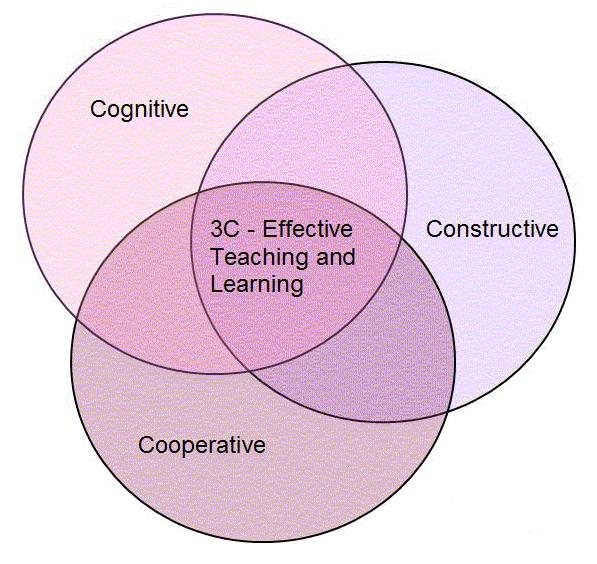
The three core concepts that help making learning more meaningful are:

Cognitive approach – to create the foundation, because students’ thinking needs to change, not just their behaviour.

Constructive tools  – to focus on supporting students’ learning process and create the real-life connections

Cooperative tools  – to guide the classroom management decision and help students engage int heir learning goals

Learning new things in a way that makes them useful in the future, and also seeing that connection while learning occurs, makes acquiring new information more interesting.  When new information is added to our existing knowledge it needs to have as many connections as possible to ensure fast and easy retrieval from memory.

The more retrieval paths we create and use while learning, the deeper the new knowledge becomes (this is one part explaining why multilingual students can learn more easily), and the more confidence we have about our own learning competence.  It is really hard to find something that forces us to struggle  every day to be meaningful and interesting to do.

As teaching and learning are two very different phenomena that occur in the same physical space, I want to discuss the 3Cs first from the students’ point of view and then form the teachers’ point of view.

The Three Cs for Students

Cognitive learning (developing knowledge) means that the student is an active participant in the learning process, and focuses on understanding concepts, not just remembering facts. Cognitive learning is also is about using reasoning skills and finding logical solutions for problems, as well as about the student knowing how s/he learns, and being confident that s/he has an effect on how her/his learning happens (self-efficacy).

Constructive learning (integrating knowledge) is about building on previous experiences and using time spent in the classroom in a productive manner, so that students don’t engage with busywork, but get to learn on their own level (regardless being above of below the standards).  Constructive learning is not shallow or superficial, but creates meaningful experiences that help students become successful in life.

Cooperative learning (externalizing knowledge) makes learning a pleasant journey shared with friends. It is about getting and giving help, and being collaborative instead of competitive. Classroom organization and behavior management also fall under the label of cooperative learning, because it is important to accommodate everyone’s needs equally. This builds an emotionally safe learning environment where everyone feels accepted. In such environments, students won’t hesitate to ask for help from the teacher or from each other if they don’t understand something.


The Three Cs for Teachers

Cognitive teaching means catering to students’ intellectual needs and providing opportunities for students to process what they have learned.  We must increase our understanding of individual learning and make opportunities for students to negotiate meanings (i.e. have them get answers to a common question: “what’s in it for me?”). It is also important to teach different learning strategies (e.g. concept mapping, other graphic organizers, ways to chunk details, how to practice recalling, etc.)  to help students engage in active learning.  Learning motivation carries the baggage of beliefs about personal learning competence and also the family’s beliefs about being able to learn. These are often called to “causal attributions”, the most common of which is the theory of learned helplessness, the belief that individuals have no control over events that have an effect on them.

Constructive teaching means handing the tools of learning over to the student. In the classroom, this is visible in the form of students being provided with choices. Having choices strengthens students’ executive functions, as they are able to plan for their actions and carry out their plans with the teacher’s support. Constructive teaching focuses more on experiential and  problem based learning and engaging students in the complete learning cycle (Kolb) than just delivering a bunch of facts [3]. When used in conjunction, constructive and cognitive teaching emphasize the process of learning and guide the individual learning process.

Cooperative teaching means that the teacher doesn’t want to use unnecessary power over students, but strives to create a solid structure in the classroom so that everybody knows what to do and how to behave. Rules should be created in cooperation with students, because following rules that you have helped create is much easier than following externally imposed rules. Cooperative teaching also means that students are held accountable for their own learning, and the teacher is there to help students achieve their individual learning goals.

Makes sense, anyone?

Education changes the life of our students, so in a way it is always transformative.  In the worst case student drops out of the educational system believing that s/he is a failure, that s/he cannot learn. Choosing to teach in a way that enhances meaningful learning helps every student towards the positive transformation. Our knowledge and beliefs are references to the life we live, so living and learning cannot be separated from each other, no matter how old or young  the students are.


[1] Ausubel, D. P., Novak, J. D. & Hanesian, H. 1978. Educational psychology a
cognitive view. 2. painos. New York: Holt, Rinehart and Winston.

[2] Green, J., Liem, G. A. D., Martin, A. J., Colmar, S., Marsh, H. W., & McInerney, D. (2012). Academic motivation, self-concept, engagement, and performance in high school: Key processes from a longitudinal perspective.Journal of adolescence35(5), 1111-1122.

Veermans, M., & Tapola, A. (2004). Primary school students’ motivational profiles in longitudinal settings. Scandinavian journal of educational research,48(4), 373-395.

[3] Kolb, D. A. (1984). Experiential learning: Experience as the source of learning and development (Vol. 1). Englewood Cliffs, NJ: Prentice-Hall


Great teachers

25 Aug

Good teachers have strong organizational skills. Good teachers have solid decision-making skills. Good teachers get important things done.

Exceptional teachers do all of the above–and more. Sure, they care about their school and students, their principals and administrators. But most importantly, they care to an exceptional degree about the people who work for them, their students.

That’s why extraordinary teachers give every student:

1. Autonomy and independence

Great organizations are built on optimizing processes and procedures. Still, every task doesn’t deserve a best practice or a micro-managed approach. Engagement and satisfaction are largely based on autonomy and independence. I care when it’s “mine.” I care when I’m in charge and feel empowered to do what’s right.

Plus, freedom breeds innovation: Even heavily product-oriented assignments have room for different approaches.

Whenever possible, give your students the autonomy and independence to work the way they work best. When you do, they almost always find ways to do their jobs better than you imagined possible.

2. Clear expectations

While every assignment should include some degree of independence, every assignment does also need basic expectations for how specific situations should be handled.

Criticize a student for writing an opinion today even though yesterday that was standard practice and you make that student’s learning impossible.  Few things are more stressful than not knowing what is expected from one day to the next.

When an exceptional teacher changes a standard or guideline, s/hes  communicates those changes first–and when that is not possible, s/he takes the time to explain why s/he made the decision s/he made, and what she expects in the future.

3. Meaningful objectives

Almost everyone is competitive; often the best students are extremely competitive–especially with themselves. Meaningful targets can create a sense of purpose and add a little meaning to even the most repetitive tasks.

Plus, goals are fun. Without a meaningful goal to shoot for, studying is just work.

No one likes work.

4. A true sense of purpose

Everyone likes to feel a part of something bigger. Everyone loves to feel that sense of teamwork and esprit de corps that turns a group of individuals into a real team.

The best courses involve making a real impact on the lives of the students you teach. Let students know what you want to achieve for your class, for your school, and even your community. And if you can, let them create a few lessons of their own.

Feeling a true purpose starts with knowing what to care about and, more importantly, why to care.

5. Opportunities to provide significant input

Engaged students have ideas; take away opportunities for them to make suggestions, or instantly disregard their ideas without consideration, and they immediately disengage.

That’s why exceptional teachers make it incredibly easy for students to offer suggestions. They ask leading questions. They probe gently. They help students feel comfortable proposing new ways to get things done. When an idea isn’t feasible, they always take the time to explain why.

Great teachers know that students who make suggestions care about their learning, so they ensure those students know their input is valued–and appreciated.

6. A real sense of connection

Every student works for a grade (otherwise they would bring you more of their work than just assignments), but every student wants to work for more than a grade: They want to study with and for people they respect and admire–and with and for people who respect and admire them.

That’s why a kind word, a quick discussion about family, an informal conversation to ask if an student needs any help–those moments are much more important than group meetings or formal evaluations.

A true sense of connection is personal. That’s why exceptional teachers show they see and appreciate the person, not just the student.

7. Reliable consistency

Most people don’t mind a teacher who is strict, demanding, and quick to offer (not always positive) feedback, as long as s/he treats every student fairly.

(Great teachers treat each student differently but they also treat every student fairly. There’s a big difference.)

Exceptional teachers know the key to showing students they are consistent and fair is communication: The more students understand why a decision was made, the less likely they are to assume unfair treatment or favoritism.

8. Private criticism

No student is perfect. Every student needs constructive feedback. Every student deserves constructive feedback. Good teachers give that feedback.  Great teachers always do it in private.

9. Public praise

Every student–even a relatively poor performer–does something well. Every student deserves appreciation. It’s easy to recognize some of your best students because they’re consistently doing awesome things.  (Maybe consistent recognition is a reason they’re your best students? Something to think about.)

You might have to work hard to find reasons to recognize a student who simply (or barely) meets standards, but that’s okay: A few words of recognition–especially public recognition–may be the nudge an average performer needs to start becoming a great performer.

10. A chance for a meaningful future.

Every course should have the potential to lead to greater things. Exceptional teachers take the time to develop students for the course they someday hope to take, even if that course is in another school.

How can you know what a student hopes to do someday? Ask.

Students will only care about your course after you first show you care about them. One of the best ways is to show that while you certainly have hopes for your school’s future, you also have hopes for your students’ futures.


Good advice, isn’t it?  Let me confess: these are not my words.

I owe this article to Jeff Haden, who published it in Inc. under the title of extraordinary bosses.  I just couldn’t pass the uncanny resemblance between being an awesome boss and being an awesome teacher. So, what I did was just to change words like boss, company, customer and employee to teacher, school and student.  With small adaptation it would fit well as a parenting advice, too. It made me think about the best places where I have worked and felt like a valued member of the team.

We have all this good knowledge about leadership (which resembles teaching much more than management does), and how to put it into practice.

Imagine how different education would look like if we treated our students like best companies treat their employees?

Or,

better yet,

if we treated students like valued customers??


Active and meaningful learning

7 Aug

Have you noticed how there are people who seem to “happen to the world” and others who have the “world happen to them”? People who are proactive and engaged, and others who are passive and alienated?

People who happen to the world are the ones who make their own choices about their lives, learning and everything.  Isn’t that how things should be?  People being active and make decisions about their future, and shaping their own thinking. How about people with the passive approach to life, people who let the world happen to them? What is their learning like?

Psychologists use the term “locus of control” to describe whether people believe that they can control the items and actions of their own lives. Intrinsic control means that I am responsible for my own life. Extrinsic control means that someone else decides for me, and I need those others to come and save me from hard situations.

But, it also means that my achievements are controlled by external factors concentrated to explanations like “It’s about luck”, “This is too hard”, and “I don’t know xyz”- the last one being super funny as there is more information at the reach of our fingertips than ever before. And after teaching for a few years you have pretty much heard them all.

My favourite one is: “S/he made me do it”. Really? Did s/he now? And how, exactly?

Why this long intro, you may ask. Well, so much of our academic success depends on what we believe about ourselves and education, and the interactions of the two.  Life and learning cannot (and shouldn’t) be separated from each other. Simply measuring up to a performance standard, or creating a product (essay, project, worksheet, etc.) asked by the teacher shouldn’t be the end result of learning. Outcomes should be seen as a new configuration of students’ own knowledge, instead of superficial external measures.

This is the real problem in education: teaching is so disconnected from learning.  In the U.S. we invest more funds in education per pupil than many other OECD countries, yet the learning results are not improving. In a way it doesn’t surprise me because the fundamental idea of education is not matching reality.  When teaching is seen as is simple as imparting or transmitting teachers’ knowledge into students, or imposing the teachers’ worldview into them, then one could easily argue how creating more standards or paying big money for additional testing is the solution for the underachievement problem.  But information sharing is not teaching!  Learning must be active and meaningful for students!

When learning is understood as students internally constructing their own knowledge and effectively using it in problem solving and to support their learning process, then learning and teaching are certainly something more than just information sharing.

Students’ academic performance derives from their  learning, right?    And students’ learning depends on their academic self-concept, which consists their motivation (intrinsic and/or extrinsic) as well as engagement,  and also their own beliefs about their competence as learners. Understanding how students create their mindsets and beliefs about intelligence is important, and the research shows how ” there is more support for an effect of academic self-concept on achievement than vice versa” .[1]

Please note that I am not talking about boosting anyone’s self-esteem. I am trying to paint a picture of  having realistic self-image as a learner and a human being. Both our knowledge and our beliefs are references to the life we live. Children (students) are no exception from this rule. This is why it is so important, both individually as well as in communities like schools,  to ask questions like:

Do we believe in fixed intelligence as static and unchanging, based on inherited qualities like gift or talent (Mindset concept by Carol Dweck)?

Or,  do we view intelligence with a growth mindset, which understands the developing nature of it, and emphasized how everyone can learn?

Researchers strongly recommend the latter one:  “Encouraging a malleable (growth) mindset helps to sustain children’s intrinsic motivation, thereby enhancing both academic success and life-long learning”[2].  I think it is also very clear that only by empowering students to be active participants in their own learning and providing choices, we can create the culture of being responsible of our own lives and learning.

So, what can we all as adults – parents and teachers – do to foster this academic competence in every student?


N3C


[1] Bossaert, G., Doumen, S., Buyse, E. &  Verschueren, K. (2011). Predicting children’s academic achievement after the transition to first grade: A two-year longitudinal study.  Journal of Applied Developmental Psychology. 32, 47-57.

[2] Haimovitz, K., Wormington, S. V., & Corpus, J. H. (2011). Dangerous mindsets: How beliefs about intelligence predict motivational change. Learning and Individual Differences21(6), 747-75