The answer to this simple but very important question defines not only your personal teaching dispositions and learning philosophy, but also the daily practices in your classroom.
When learning is viewed as a product, and the same performance measures apply to all students, instruction can be reduced to cookie-cutter teaching: same pieces of information delivered and same level of support provided is sufficient for all students. This is visible in classroom practices: providing students with an example of the ready product and asking them (more or less) to copy that – whether it is an art project, notes, homework, essay or something else. There is not much room for individualization or differentiation, because the finished products are the measurement showing that learning has happened – which of course is not reality, but may greatly satisfy administrators and policymakers. What surprises me is how heavily behaviorism is still emphasized in product-centered classrooms.
In a product-centered classroom the goal is completing activities – worksheets, charts, pre-designed projects, and any other “canned” activities – that are either teacher-made or provided by the publisher of the curriculum. The important part of completing these tasks is getting them right because these products are usually graded! Assessment focuses on memorization of disconnected facts. Skilled and obedient students comply with these requests and try hard to get their tasks done right, yet there are many students who just leave them undone. Completed products may show the “level” of each student, and let the teacher know who needs more practice in writing, multiplication or something else, but they don’t tell when or how the student acquired the skill, or if they have more advanced knowledge or competence of the topic.
Learning as a product can also refer to surface approaches in learning, where learning is considered to be:
- quantitative increase in knowledge
- memorizing information to be reproduced, and
- acquiring facts, skills and methods to be used later. [1]
When learning is seen as a product of instruction, students’ agency is reduced to being a recipient of information transfer. This may cause detachment and diminishing learning motivation. In such environment “worksheets are crutches, used primarily as tools to teach to a test, and this creates a vicious cycle of bad education.”[2] Pre-designed materials are handy and easy to use, but they often lead to surface learning simply because they were designed for another group of students in different educational setting with diverse connections to the subject. Your group of students is unique! They deserve instruction designed for them!
What about viewing learning as a process? Many things will change from the previously described environment: the first premise is that because students begin their daily/weekly/yearly learning from different levels of knowledge and understanding, they also will end up in different levels of competency. And that is okay, honestly. We are not clones. Students shouldn’t be treated like ones.
The goal of 21st Ccentury education is to create life-long learners. “Fixed procedures for teaching are insufficient because learning is not a one-way process” [3]. The curriculum and instruction must promote the attitude of continuing interest to learn [4]. This aligns with contemporary research of viewing learning as a process instead a product, as a sustainable choice for knowledge societies where individual, ongoing learning is crucially important. When learning is understood primarily as a process of acquisition and elaboration of information [5], the natural consequences in the classroom are ongoing differentiation and individualization. Assessment becomes an individual quest to compare your own current achievement to your previous level of proficiency or competency – instead of comparing your learning against the achievements of your peers. Evaluations are extremely non-punitive by nature: mistakes and second attempts are not only allowed but treasured, because they show the growth in deeper understanding and the height of the learning curve. Isn’t this the recipe for providing the experiences of success for each and every student? And from educational research we already know how important that genuine thrill of achievement is for intrinsic motivation to learn [6].
Worksheets, exercises, activities and even homework are individualized, because learners have diverse needs and the teacher wishes to accommodate every student’s needs. As you can imagine there is not much need for cookie-cutter activities in these classrooms, but flexibility for students to choose within well-defined limits and pick activities they find meaningful or are interested in doing. I have heard people say how students will not do what they need to do, but what pleases them. Funny enough, students who get to choose usually learn much more than those forced into performing and producing, and they often pick tasks that are almost too hard for them. The same phenomenon happens when you let students choose their homework, from an appropriate selection, of course – and it is harder for even an under-performing student to explain why s/he didn’t do the homework s/he got to choose. This supports students’ growth towards self-regulated learners!
Approaching learning as an individual process helps us refocus learning and teaching: the student is in the nexus of her/his own learning, and the oh-so-tiring power struggle is minimized. I know most of my teachers and readers are bound to the state/national/other high stakes testing – yet, approaching learning as a process is applicable everywhere, because independent learners also perform better in the tests. Independent learners often engage in deep learning, and perceive learning as making sense (or abstracting the meaning) or interpreting and understanding reality in a different way [1]. It seems that overemphasizing competition in education leads to the perception of learning as a product and pushing the teacher-centered instructional model, instead of emphasizing the individual learning process. Learner-and learning-centered practices are focusing on supporting the ongoing learning process. This is an important part of viewing learning as a process vs. product, and a sustainable choice for knowledge societies where individual, ongoing learning is crucially important.
Which way do you want to teach? What are your teaching dispositions and philosophy?
Also visit the page Process or Product?
Summary
Learning as a product refers to meeting the external objectives of instruction with a measurable change in behavior. This view emphasizes the importance of instruction and information delivery. Students are the object of instruction. Their choices and learner agency are very limited.
Learning as a process refers to the internal development caused by acquiring new information and elaborating one’s own understanding of using it. This view emphasizes learners’ active engagement in their own learning process and making sense of the content. Students are subjects of their own learning. They have choices and learner agency is supported with SEL (Social-Emotional Learning).
My book about supporting learning process: Choosing How to Teach
Research about learning as a process:
We often talk about learning without defining what it means. This causes confusion! For the sake of clarity, I am using the definition of Illeris (2003) while discussing the learning process: “external interaction process between the learner and his or her social, cultural or material environment, and an internal psychological process of acquisition and elaboration” (p. 398).
Definition of learning as a process as seen on Lachman (1997) [7]: First, learning may not include a change in behaviour (this would exclude classical conditioning). Second, it is important not to confuse learning with the product of learning. Observable change is a product (p. 477).
Barron et al. (2015) [8] discuss how disciplines differ in their specific definitions of learning for pragmatic reasons, but it is possible to reconcile most of these definitions by reference to a common theoretical framework: learning as a structured updating of system properties based on the processing of new information (p. 406).
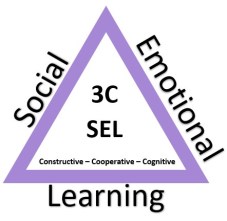
Social-Emotional Learning was already part of my teacher training progam in 2001-2003 in Finland and I am so glad to see it gaining more traction around the world! CASEL site is the best resource I have found! As learning cannot happen in a vacuum, we must support students’ growth with constructive, cognitive and cooperative strategies in the classroom to support durable learning process [9]. It is important to have a well-balanced approach and follow current science of evidence-based practices! [10]
References:
[1] Säljö, R. (1979) ‘Learning in the learner’s perspective. I. Some common-sense conceptions’, Reports from the Institute of Education, University of Gothenburg, 76.
[2] Barnes, 2013, ASCD Express, Vol. 8, No. 11. http://www.ascd.org/ascd-express/vol8/811-barnes.aspx
[3] Cresswell, J. (2016). Disengagement, Pedagogical Eros and (the undoing of?) Dialogic pedagogy. Dialogic Pedagogy: An International Online Journal, 4. DOI: 10.5195/dpj.2016.182 http://dpj.pitt.edu
[4] Noddings, N. (2013). Curriculum for the 21st century. In D.J. Flinders & S.J. Thornton (Eds.). The curriculum studies reader (4th ed.) (399-405). New York, NY: Routledge Falmer.
[5] Illeris, K. (2003). Toward a contemporary and comprehensive theory of learning. International Journal of Lifelong Education, 22(4), 396-406.
[6] American Psychological Association (APA), 2015. http://www.apa.org/ed/schools/teaching-learning/top-twenty-principles.aspx
[7] Lachman, S. J. (1997). Learning is a process: Toward an improved definition of learning. The Journal of psychology, 131(5), 477-480.
[8] Barron, A. B., Hebets, E. A., Cleland, T. A., Fitzpatrick, C. L., Hauber, M. E., & Stevens, J. R. (2015). Embracing multiple definitions of learning. Trends in neurosciences, 38(7), 405-407.
[9] Stahl, S. M., Davis, R. L., Kim, D. H., Lowe, N. G., Carlson, R. E., Fountain, K., & Grady, M. M. (2010). Play it again: The master psychopharmacology program as an example of interval learning in bite-sized portions. CNS spectrums, 15(8), 491-504.
[10] Schell, J., & Butler, A. C. (2018). Insights from the Science of Learning: Understanding Why Peer Instruction Is Effective Can Inform Implementation. In Frontiers in Education (Vol. 3, p. 33). Frontiers.
Tags: empowering, Learning Process, learning product, meaningful learning, pedagogy, student centered



 NotesFromNina