Archive | Learning Design RSS feed for this section

Deep learning for teachers

4 Nov


It easier to teach something you have experienced firsthand. This is why teachers’ learning should reflect the ways we wish their students to learn. Instruction is situated in one’s own experiences.

I am not talking about activities in professional development, but those same elements that provide deeper learning experiences for students in classroom:

  • focusing on transferable understanding,
  • providing opportunities to reflect,
  • relating new information to previous knowledge, and
  • bridging theory with practice.

Truly focusing on life-long learning.

Teachers as learning professionals still need occasional reminders about how to support their own learning process, because in the professional world the expectations for showing competence by generating learning products (evidence, projects, artifacts, exams, etc.) sometimes take over the deep learning process, and thinking about how learning really happens, and how it can be supported on personal level. Knowledge of metacognitive skills is an essential tool for anyone who wants to teach.

Metacognitive awareness includes the knowledge and perceptions we have about ourselves, understanding the requirements and processes of completing learning tasks, and knowledge of strategies that can be used for learning.  Teaching metacognitive knowledge and skills is an important part of supporting deep learning. We as teachers should have extensive knowledge and skill to embed metacognitive strategies into our everyday practices.

Just like classroom learning experiences, also teacher learning should be designed to support self-regulated learning (SRL) practices.  SRL refers to students’ cognitive-constructive skills and empowering independent learning, focusing on strengthening the thoughts, feelings and actions that are used to reach personal goals (Zimmerman, 2000). This approach aligns well with the research of adult learning, which highlights the use of constructive-developmental theories (e.g. Mezirow, 2000; Jarvis, 2009; Stewart & Wolodko, 2016).

Supporting students’ SRL becomes easier to embed into instruction when we have first practiced in our own learning. This cannot be achieved by following a script or curriculum book, but situating the knowledge of pedagogy in classroom practice.

Using SRL as a chosen approach in professional development or other learning opportunities helps to recognize our own fundamental beliefs about learning. These beliefs, that either help or hurt learning process, are always present in both teaching and learning situations.

Following the three steps of SRL helps us to approach learning tasks within their context, and first create a functional plan and choose learning strategies to support learning process. Then, we will want to monitor our own performance and learning process during the second part, performance phase. This is where the knowledge of deep learning strategies is very important, because sometimes instruction and design reward surface processes, and we might want to change our strategies to still engage in deep learning. In the third phase, self-reflection, is the most important one, but often forgotten. Without engaging in self-assessment about our own learning process, it would be hard to do things differently next time, if needed. Yet, the whole idea of using metacognitive knowledge to improve deep learning relies in dealing with our own perception and managing our emotional responses, so that our beliefs about deep learning are strengthened. Some beliefs are detrimental for deep learning, and for example mentally punishing ourselves (for failure, procrastination, etc.) leads toward using surface learning processes.

Instructional approaches that emphasize choice, learning ownership, knowledge construction, and making connections are more likely to facilitate deep learning and understanding – for teachers and students alike.


Here is more information about SRL for adult online learners  in a PDF form.


Jarvis, P. (2009). Learning to be a person in society. In K. Illeris (Ed.) Contemporary theories of learning: learning theorists… in their own words. London: Routledge.

Mezirow, J. (2000). Learning as Transformation: Critical Perspectives on a Theory in Progress. The Jossey-Bass Higher and Adult Education Series. San Francisco: Jossey-Bass

Stewart, C., & Wolodko, B. (2016). University Educator Mindsets: How Might Adult Constructive‐Developmental Theory Support Design of Adaptive Learning?. Mind, Brain, and Education10(4), 247-255.

Zimmerman, B. J. (2000). Attaining self-regulated learning: a social-cognitive
perspective, in M. Boekaerts, P. Pintrich, and M. Zeidner (Eds.) Handbook of Self-regulation (pp. 13–39). San Diego, CA: Academic Press.


Deep Learning

19 Aug

Are your students engaging in deep or shallow learning?

I believe “learning loss” is a made up concept. Think about it: you still remember many things and concepts  you learned as a kid, right? Only those things that had no significance for you have been forgotten. Yet, we still seem to think that what is taught is also learned. That could not possibly be true! Understanding subjectivity and learning ownership is very important for every educator.

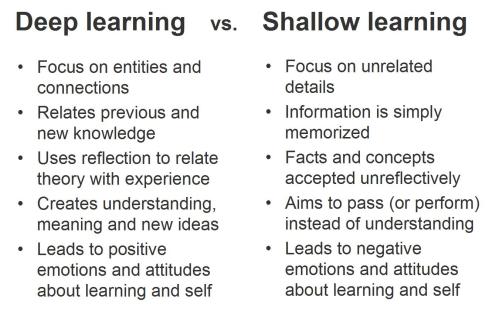
Deep Learning and Shallow Learning (which is also called Surface Learning) are fundamentally different. 

The following  short comparison explains the differences:   

wp-1503129883296.
The difference between the two types of learning is huge, isn’t it? Each of us utilizes shallow learning sometimes. Usually with subjects or topics that carry little significance to us but that we still need to learn to some extent, or maybe with something that we don’t expect to need after a while.

Shallow learning can be seen as a chosen learning strategy and is a well accepted choice in certain situations. What scares me is that some students use shallow learning as their only strategy to learn or to even approach subjects to be learned. This inevitably leads to underachievement, and of course also losing the memorized bits of information, which we then call “learning loss”. Yet, it is worth noticing that some strategic learners choose to use shallow learning as their main learning strategy, in order to pass their exams and get good grades, while not being interested in really learning the content.

The educational reality revolves around the fact that what is taught is not necessarily learned. And if the assessment is taken immediately after instruction, the facts and concepts are mainly held in our short term memory. When transfer happens, and students are able to use and apply the learned concepts in other situations, it also means they have been deep learned. Getting there requires collaboration between students and teachers: meaningful instruction from teacher’s part, and buy-in from students’ part.

“What’s in it for me?” is the question every learner asks (more or less knowingly) before engaging in any given task. The answer may be an external reward (grade, certificate, badge, sticker, etc) or intrinsic interest (curiosity, need to know more about the subject, general interest), and this is where intrinsic/extrinsic motivation comes into the equation of teaching and learning.

It seems obvious that shallow learning relates to perceiving learning as a product. Supporting student’s individual learning processes also promotes deep learning!


Original research about deep learning:

Marton, F. & Säljö, R. (1976a). On the qualitative difference in learning I-Outcome and Process. British Journal of Educational Psychology, 46, 4-11.

http://www.psy.gla.ac.uk/~steve/dands/dandstable.html


Learner Agency – an important part of Deep Learning

13 Aug

Learner agency as a concept in 21st century education relates tightly into students’ perceptions of their own learning experiences.  Agency is the capacity to act, to make decisions about one’s own life and learning.

Deep learning requires ownership and individual engagement with the content. Here is a succinct definition for deep and surface level learning strategies: “the basic processing operations that describe how students react to and interact with the learning material and with people present in the learning environment in order to enhance domain-specific knowledge and skills” (Boekaerts, 2016, p. 81).

This is why learner agency is so important. Students must develop their skills in independent judgment. In order to do that they need ample opportunities to practice choosing. Being or becoming responsible for one’s own actions is one of the possible byproducts of public education.

Recent research recognizes the importance of learning experiences that emphasize autonomous and agentive participation, including the opportunity to have control over oneself and one’s learning environment. There are various ways to perceive agency in the classroom.

It is different to learn something than to be taught something. Being taught doesn’t necessarily mean that learning happens. It only means that the student has been present when the teaching has happened. This is very detached view of learning, and hardly motivates students to try. Memorizing content until the next test is included in students’ perceptions of detached learning.

Sometimes students feel they belong to the school community, which makes them more compliant in learning activities, and a little bit less eager to exercise their agency. In these cases students depend on their teachers and just go through the motions and learning activities, as they are expected to do.

Open dialogue can help students choose to actively engage in their own education and to become more accountable for their own learning. Teachers should support growing agency in the classroom, because the ownership contributes to engaging in deep learning. Students who have strong ownership are interested in learning more.

Deep learning experiences can lead students to become ubiquitous learners, who learn anytime, anywhere.  This unbound learning extends beyond school walls and hours, but we as educators must learn to acknowledge and credit this very independent learning.

Students’ perceptions of their agency can span over several categories. These descriptive categories cannot be used to label students.

In formal education the tradition has been to perceive students as objects of the teaching-learning interaction, with the expectation for students to absorb the facts presented by teachers or faculty.  This view of education doesn’t fit into contemporary learning theories that emphasize knowledge construction. Educational research shows how important factors students’ ownership and knowledge construction are for academic success, yet many educational practices still rely on teacher-centered instructional models. Why?  This seems to support the perceptions of detachment.

There are many ways to support agency in the classroom.

Building a learner-centered environment where students can choose how they practice and learn is an easy way to support learner agency. Students must have choices while selecting their learning resources.  Researchers say that agency is about understanding what choices and resources are available (Kumpulainen et al., 2011, p. 13). Becoming responsible for one’s own learning can and must be fostered in the classroom context.

Supporting learner agency improves the quality of students’ engagement in their own learning process, and help students become ready for the requirements of living in 21st century.  Examples of engagement quality are “going through the motions” vs. “I make my own motions” and “being a classroom sheep” vs. “trying to understand how to transfer learned”.

The table below displays components of learner agency and students’ perceptions of it, as see in my research.

Sometimes agency may seem negative, for example when a student decides to leave homework undone, because they are okay with a grade that is less than perfect. Obviously, this is only a problem when learning is seen as a product, instead of (life-long) process.

Understanding students’ perspectives and using practices that support learners’ agency helps teachers create better teaching-learning interactions.  These learner-centered interactions will improve the quality of students’ learning experiences and also their academic achievement (e.g. Reyes et al. 2012).

The importance of intentional engagement, subjectivity and shared classroom experiences cannot be overemphasized as means for deeper learning. Students must have an opportunity to exercise their agency.

More about Learner Agency at Nina’s Notes

—–

Boekaerts, M. (2016). Engagement as an inherent aspect of the learning process. Learning and Instruction43, 76-83.

Kumpulainen, K., Krokfors, L., Lipponen, L., Tissari, V., Hilppö, J., & Rajala, A. (2011). Learning bridges – Toward participatory learning environments. Helsinki: CICERO Learning, University of Helsinki.

Reyes, M. R., Brackett, M. A., Rivers, S. E., White, M., & Salovey, P. (2012). Classroom emotional climate, student engagement, and academic achievement. Journal of Educational Psychology104(3), 700 – 712.

Smith, N.C. (2017). Students’ perceptions of learner agency: A phenomenographic inquiry into the lived learning experiences of high school students. (Doctoral Dissertation).  Northeastern Repository

NCS Dissertation PDF

Praise and punishment – two sides of control

17 Nov

It is surprising how often people, who think punishments to be detrimental for learning, still approve praise as an effective tool in education.  How is this possible? Both are based on the concept of superiority and having control over other human beings. Often this power is just artificial authority. Please understand that I am not against classroom management, just the behaviorist regime of it! Using SEL (social-emotional learning) and ensuring student-centered management practices is important!

I know this may sound like semantics, but hear me out! Praise always carries a value judgment, an evaluation, and is based on our personal/professional opinion. Encouragement in the form of feedback is non-judgmental. It points out facts. And in education we want to point out all the things students have learned because we have names for them and also know the big picture of how competencies relate to each other. We know what students need to learn to be successful. Hence: no praise, just facts, please. Alfie Kohn has written much about this!

My current position as a mentor for graduate students pursuing their M.Ed. degrees is delightful: I spend my days supporting my students’ understanding and learning process, but I don’t have to be a gatekeeper (and I don’t have to do any grading, yay!). Mentoring requires a specific disposition: the belief that everyone can learn, and that learning cannot be enhanced by praise and punishment. Now, please don’t get me wrong. Performance can be increased (up to a point) by praising and punishing and pushing students to complete their products, but engaging in one’s own learning process and deeper learning requires self-regulation and self-reflection. We can lead students to that path but we cannot force them to walk it. External control cannot help students forward in the path to self-transformation.

I do remember the time when I still believed in praise and punishment.  I am sure my children remember that, too. And for that I want to apologize to them, wishing that I knew more about learning and development when they were young. Fortunately it is never too later for additional development.  Kegan and Drago-Severson have an excellent framework of adult development.

It hurts my ears when I hear someone talk about praise and growth mindset in the same sentence. The two could not possibly fit together. Praising someone means that they have met an invisible standard, for which we want to extend our approvals as superiors. Rewards and gold stars are just a tangible form of praise. Growth mindset carries the same notion of self-transformation as engaging in the personal learning process. As educators it is important to offer timely feedback for students about their learning. However, praise and feedback should not be mixed. Feedback focuses on the achievement and based on transparent criterion of expectations. Praise is based on hidden expectations or personal opinions. It is a value judgement about the behavior or qualities of another human being.

Every educational institution has their own hidden curriculum – the expectations that are not voiced or written. Often these appear in the form of practices and traditions. Hidden objectives are the hardest to meet. A common coping mechanism to meet hidden expectations is the attempt of pleasing the person at control – whether teacher, professor, boss, or anyone else in the position of power. The damage for the organization gets doubled: the person in control only hears the voice of pleasers and cheerleaders, and the structure becomes skewed with the lack of open and honest dialogue. This can easily lead to cliques in classroom (or workplace) and decreased collaboration.

Those who remember Berne’s Transactional Analysis (TA) will probably recognize the roles of Parent and Child in the praise and punishment situations.  Engaging in dialogue on Adult-Adult level is the most important tool for every educator. Students often fall into the trap of playing the child role, especially if their learning process gets reduced to creating learning products that may have no real-life connections, and if they often face praise and punishments in their learning environment. This can happen to adult students too, especially when their learning motivation is externalized. On the positive side it is fascinating to observe young children to behave with maturity above their years when the human dignity is extended to them and they are offered opportunities to self-regulate.

Fear, force and artificial authority

17 May

Learning and teaching in 21st century should definitely be fueled with something much more than fear, force and artificial authority.  After all we want for students to have strong integrity and self-confidence.  And the curricula and evaluations, in addition to the classroom management practices, have been designed for students to benefit from the time they spend in the school.  Right?

Alas, the history of education is filled with good intentions turned into catastrophies.  When teachers and education policy makers are operating with the objective view of learning in mind, the end result becomes a standardized description of a well performing student (without any individual interests and goals, being a puppet in the system bending to the intractable forces of maximum achievement).  Einstein expressed his views of the principal educational methods being fear, force and artificial authority. (Clark, 1971, p.13)

Einstein

The scary part is that even today, more than one hudred years later, the same methods of fear, force and artificial authority are still well and alive in the schools around the world. Why?

Maybe it is easier to convince students about the importance of doing well on tests by instilling the fear of not being able to get admitted to a reputable college/univeristy/workplace unless the test scores demonstrate brilliance? Maybe it is easier to control student behaviors by displaying artificial authority of being the keeper of the scores or grades?  But, from decades of research and practice we know that students learn better when they learn in an environment that is safe, supportive and collaborative.  And we don’t need “servile helots”, but critical thinkers who will thrive in the 21st century environment where information and choices are more abundant than ever before.

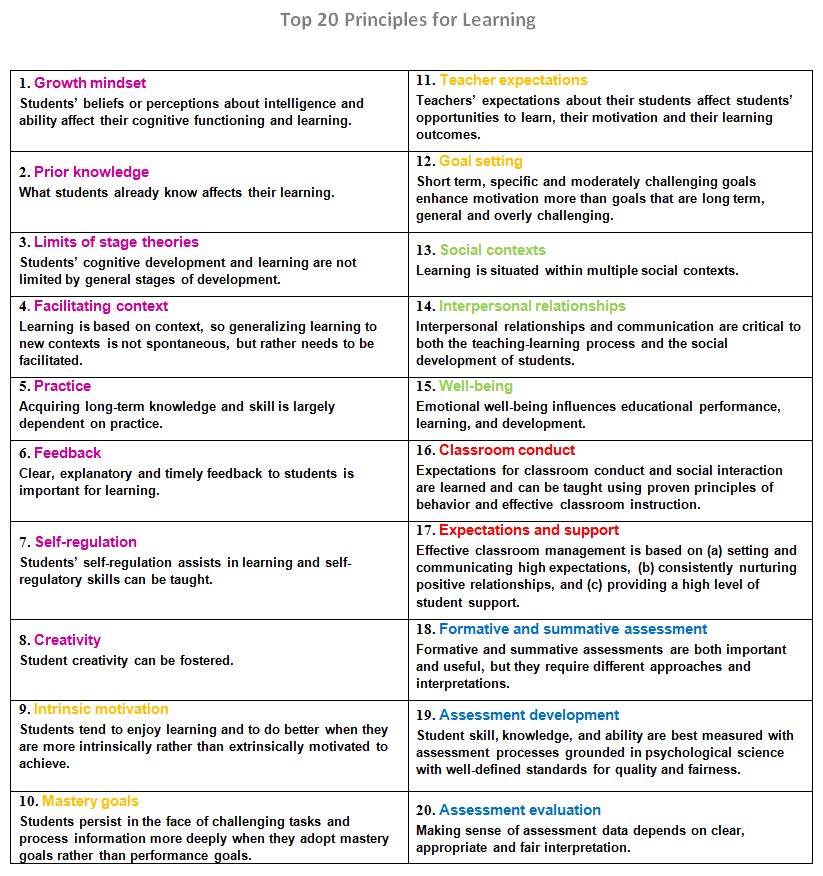
The psychological research and practice have advanced very much during the past century. American Psychological Association has published the Top 20 Principles to be used at schools.  What blows my mind is how few teachers have heard about these, or their predecessor Learner-centered Psychological Principles.  Yet, I consider the APA to be the highest authority of educational psychology in the U.S. and a positive influence in the world in general.

These Top 20 principles have been divided into 5 areas of psychological functioning:

  1. Cognition and learning: How do students think and learn?
  2. Motivation: What motivates students?
  3. Social context and emotional dimensions: Why are social context, interpersonal relations and emotional well-being important to student learning?
  4. Context and learning: How can the classroom best be managed?
  5. Assessment: How can teachers assess student progress?


All the 20  principles are displayed below in a table.

Top 20


What you do in your classroom – whether online on traditional – is your choice.  The psychological principles are compatible with every subject and every curriculum. Why not give it a try and implement a safe, supportive and collaborative learning environment?


American Psychological Association, Coalition for Psychology in Schools and Education. (2015). Top 20 principles from psychology for pre K–12 teaching and learning. Retrieved from http:// http://www.apa.org/ed/schools/cpse/top-twenty-principles.pdf

Clark, R.W. (1971). Einstein: The life and times. New York: World.


Visible and invisible learning and teaching

13 Jan

Learning process is anything but linear and visible.

Best learning experiences are often messy and hard, but oh-so-rewarding. For education professionals it is sometimes nice to think about how the learning process is rolling forward like a simple cycle (like Kolb’s), and emphasize the perception and processing, but the reality is far more complex. There are pits, loops and rabbit holes along the way.

The discussion of learning process must include these invisible or intermediate processes of learning, and acknowledge the personal preferences that make learning stick. One size does not fit all.

Learning process

Our personal preferences for the intermediate processes of learning are the ways we prefer to perceive, choose, store, reflect and retrieve the data and information needed for learning. These preferences result from our previous experiences in life and learning, and they can either help or hinder our academic learning process (Green et al. 2012). Acknowledging the individual preferences and emphasizing the importance of metacognitive skills in learning helps to focus more on these invisible parts of learning process.

Teaching the metacognitive skills could be called invisible teaching, because it requires significant amount of interactions between the teacher and the student – interactions that may or may not relate directly to the learning objectives.

Learning happens everywhere. This must be acknowledged in the learning design process, because without transfer to personal lives of students the formal learning is quite worthless. (This is obviously not a new idea, non scholae sed vitae has been around for a long time.) Unfortunately, teaching is sometimes seen as a simple act of delivering information.  In such learning environments evaluations of learning (or performance) are based only on the tests, exams, essays, worksheets and other ways of demonstrating the  mastery of the subject/topic.  Grades are handed out to students in the end of term or semester, but what do these grades actually mean?

Invisible learning could be called unvalued leaning, because it is not included in the evaluations conducted in formal education.  To be effective, contemporary education must strive “to capture intermediate learning processes in student work,” not just outcomes (Bass & Enyon, 2009, p. 15). One way to broaden the evaluation of learning is to use performance assessments with rubrics, so that students know what they are supposed to demonstrate, and use all their knowledge in the tasks, not just a small, segmented amount of knowledge that belongs to that specific class.

The challenge for contemporary education is to include the invisible learning into formal learning. Learning should always be life-long, life-deep and life-wide.  Students have lots of knowledge gained outside of the school systems, and in information societies we cannot – and should not – try to restrict students’ access to information. Visiting websites like wikipedia should be encouraged, with the constant reminder of not taking any information at a face value.  Not even what is printed in the textbook. 🙂

Bridging this informal or invisible/unvalued learning to formal education helps students to see their classroom learning more meaningful because it carries personal significance. Emphasizing invisible learning empowers students to engage in self-regulated learning and be more active in building their own, personal knowledge-base.

What is the easiest way for invisible learning to become valued in your class?


Bass, R. and Eynon, B. (Eds.). (2009). The difference that inquiry makes: A collaborative case study of technology and learning, from the Visible Knowledge Project. Academic Commons. Retrieved from http://academiccommons.org/).

Green, J., Liem, G. A. D., Martin, A. J., Colmar, S., Marsh, H. W., & McInerney, D. (2012). Academic motivation, self-concept, engagement, and performance in high school: Key processes from a longitudinal perspective.Journal of adolescence35(5), 1111-1122

If a student learns….

22 May

For the past few weeks I have observed my students to get busier and more stressed.  Most of them are teachers, feeling the strain of the end of the school year, and still trying to engage in their masters studies. While the last days of school before summer are bittersweet: it is wonderful to see students graduate and move on, yet we will miss them after they have gone (or, sometimes let out a sigh of relief – just trying to be realistic here, because I hear those stories, too), the path of getting to summer vacations is lined with testing.  And, some more testing, and frantically documenting the learning that has occurred during the year.

Meeting learning goals and objectives is important for accountability.  But, I find it funny that all too often we are talking about learning goals when we actually mean teaching goals.  The objective and subjective realities of teaching and learning get mixed together.  Each student has a different subjective experience of the learning that happened in the class during the school year.  Teacher has her/his own experience, too.  So, which one is true?

There is an old philosophical thought experiment that has attributed to philosopher George Berkeley: If a tree falls in a forest and no one is around to hear it, does it make a sound?”  

Our subjective realities are references to the lives we live.  We see and hear things based on our preferences and expectations.

Every teacher knows how hard it is to help students to learn new concepts, if they have very strong misconceptions about the topic.  Similarly, our own observations may be clouded by preconceived ideas, and we sometimes forget how much students learn  while they are not taught. Or, sometimes even in spite of the teacher (this was a common joke among the faculty in the school I taught in Finland, and I still think how a good dose of self-irony sometimes saves the day ).

In education a common misconception is to believe that significant learning only happens when students are taught.  In reality students are born learning machines, they learn all the time, everywhere. But teachers are needed to enhance those individual learning experiences and help students to dive deeper into the subject or the area of their interest. Documenting and testing should not be the primary focus of teaching.

Yet, in today’s world we are very busy in documenting all kind of things: taking pictures and videos of events to make memories, and sharing them in social media.  A common joke is to question whether a *thing* really happened, if nobody posted it into social media. This may be the modern version of the falling tree thought experiment.

But how about teaching and learning?

I sure hope nobody is seriously asking this:

If learn

Student-centered learning and teaching

16 Oct

I was working on one of my assignments for my doctoral studies and searching for a good definition of student-centered learning. Imagine my delight when I realized that APA provides a beautiful and comprehensive definition that is a real joy to read. What I see below fits perfectly well into my teaching/learning philosophy (emphasis and coloring mine):

This definition of learner-centered is based on an understanding of the Learner-Centered Psychological Principles as a representation of the current knowledge base on learners and learning.
The Principles apply to all learners, in and outside of school, young and old.  
Learner-centered is also related to the beliefs, characteristics, dispositions, and practices of teachers – practices primarily created by the teacher.
When teachers and their practices function from an understanding of the knowledge base delineated in the Principles, they
(a) include learners in decisions about how and what they learn and how that learning is assessed
(b) value each learner’s unique perspectives
(c) respect and accommodate individual differences in learners’ backgrounds, interests, abilities, and experiences, and
(d) treat learners as co-creators and partners in the teaching and learning process.
 

What else can I say?

This is exactly how I was taught during my own teacher education in Finland.  The teaching and learning process where teachers are learning facilitators and students intrinsically motivated and accountable for their own learning  should look like this in the classrooms everywhere in the world! And APA even provides more tools for  getting there!

Please read ahead:

COGNITIVE AND METACOGNITIVE FACTORS

Principle 1: Nature of the learning process.
The learning of complex subject matter is most effective when it is an intentional process of constructing meaning from information and experience.
Principle 2: Goals of the learning process. 
The successful learner, over time and with support and instructional guidance, can create meaningful, coherent representations of knowledge.
Principle 3: Construction of knowledge. 
The successful learner can link new information with existing knowledge in meaningful ways.
Principle 4: Strategic thinking
The successful learner can create and use a repertoire of thinking and reasoning strategies to achieve complex learning goals.
Principle 5: Thinking about thinking
Higher order strategies for selecting and monitoring mental operations facilitate creative and critical thinking.
Principle 6: Context of learning
Learning is influenced by environmental factors, including culture, technology, and instructional practices.


MOTIVATIONAL AND AFFECTIVE FACTORS

Principle 7: Motivational and emotional influences on learning
What and how much is learned is influenced by the learner’s motivation. Motivation to learn, in turn, is influenced by the individual’s emotional states, beliefs, interests and goals, and habits of thinking.
Principle 8: Intrinsic motivation to learn
The learner’s creativity, higher order thinking, and natural curiosity all contribute to motivation to learn.
Intrinsic motivation is stimulated by tasks of optimal novelty and difficulty, relevant to personal interests, and providing for personal choice and control.
Principle 9: Effects of motivation on effort
Acquisition of complex knowledge and skills requires extended learner effort and guided practice. Without learners’ motivation to learn, the willingness to exert this effort is unlikely without coercion.


DEVELOPMENTAL AND SOCIAL FACTORS

Principle 10: Developmental influence on learning
As individuals develop, they encounter different opportunities and experience different constraints for learning. Learning is most effective when differential development within and across physical, intellectual, emotional, and social domains is taken into account.
Principle 11: Social influences on learning 
Learning is influenced by social interactions, interpersonal relations, and communication with others.


INDIVIDUAL DIFFERENCES FACTORS

Principle 12: Individual differences in learning
Learners have different strategies, approaches, and capabilities for learning that are a function of prior experience and heredity.
Principle 13: Learning and diversity
Learning is most effective when differences in learners’ linguistic, cultural, and social backgrounds are taken into account.

Principle 14: Standards and assessment
Setting appropriately high and challenging standards and assessing the learner and learning progress-including diagnostic, process, and outcome assessment-are integral parts of the learning process.

How can we make this become reality in classrooms?  Please check the posts tagged with “student centered” for some tools!  And let’s keep on collaborating in highlighting the importance of student-centered practices!


Summarized from the APA Work Group of the Board of Educational Affairs (1997, November). Learner-centered psychological principles: Guidelines for school reform and redesign. Washington, DC: American Psychological Association. http://www.jodypaul.com/LCT/LCT.PsychPrinc.html

Also see:  http://www.apa.org/ed/governance/bea/learner-centered.pdf for more information about learner-centered practices and their importance to the field of contemporary education.  


The break-things-into-bits mistake we have been making in education for centuries – happening today with standards

20 Apr

Grant Wiggins about splintering the learning content. This is an important message for all curriculum and instruction designers, but also for each and every teacher. Good teaching is about providing information in student-sized chunks, and making sure the details don’t obscure the whole, the entity we are learning about. Contexts and connections are SO important in meaningful learning!

grantwiggins's avatarGranted, and...

In the just-released Math Publisher’s Criteria document on the Common Core Standards, the authors say this about (bad) curricular decision-making:

“’Fragmenting the Standards into individual standards, or individual bits of standards … produces a sum of parts that is decidedly less than the whole’ (Appendix from the K-8 Publishers’ Criteria). Breaking down standards poses a threat to the focus and coherence of the Standards. It is sometimes helpful or necessary to isolate a part of a compound standard for instruction or assessment, but not always, and not at the expense of the Standards as a whole.

“A drive to break the Standards down into ‘microstandards’ risks making the checklist mentality even worse than it is today. Microstandards would also make it easier for microtasks and microlessons to drive out extended tasks and deep learning. Finally, microstandards could allow for micromanagement: Picture teachers and students being held accountable for ever more…

View original post 1,331 more words

Ingredients of effective teaching

7 Feb

Effective teaching is often seen as increase in student learning.  I can understand the thought behind it, because after all teaching is futile if learning is not happening. But getting these two different phenomena -teaching and learning- productively intertwined in the classroom is a challenge all educators are facing, and correlations between the two should not be drawn in haste.

The old saying about leading the horse to the water but not being able to force it to drink is very descriptive for the differences between teaching and learning, and often also quoted as such. We attempt to measure the ways of presenting information for students to learn, and seem to think the score makes one teacher more effective than another -but I am not convinced that it makes such a big difference how we take the horse to the water: it will drink when it is thirsty.  Fortunately students are born curious and ready to learn. The only thing we need to do is find a way to cooperate with that curiosity and help students preserve their interest in learning and their sense of wonder – because that is where all true learning starts: wondering if, how, when, why….

Whether students have successful learning experiences and really (deep) learn the content depends on multiple factors found in areas of both instruction and curriculum. Students’ intrinsic motivation helps them to engage, but unfortunately in some measurements of effective teaching the motivation is translated to teachers’ duty to motivate students to learn, which leads students functioning on extrinsic motivation, and never engaging in the deep learning process. The learning environment (both physical and emotional) sets the tone for the learning experience. Students’ readiness to learn  and their previous knowledge, perceived meaningfulness of content, student autonomy (support vs. control), and cooperation with the teacher all have various effects on the learning outcomes.

The concept of effectiveness is hard to define. Maybe we should pay more attention to the quality of interactions, and see how they contribute to successful learning experiences?

Learning happens in interactions between the student and the content to be learned.  In addition to interacting with the content of their learning resources, students also interact with many other things – environment, peers, teachers, staff, parents, media, social media, etc. Focusing their attention to the learning task is a choice every student makes, purposefully or being unaware about it. We teachers can help students choose wisely and spend more time interacting with their learning resources, but we certainly cannot force them into doing it. Forced interactions are of poor quality, and result in shallow learning when students perform tasks to fulfill the expectations, but don’t engage with their thoughts and/or curiosity.

Traditionally we have perceived the teacher to be one of these learning resources, or even the source of information, but I am wondering if it is not the time to recognize how a teacher’s job is much more importantly about facilitating student’s experience and engagement in interactions that result learning.

This is what pedagogy and andragogy are about: supporting students’ learning in a dialogue, individually and as a group, so that they each can be successful in their studies. Please note that I am not undermining the subject matter expertise of teachers, because being knowledgeable is essential for effective teaching. I just want to emphasize the fact that simply with enormous knowledge about the area of expertise one does not miraculously become a master teacher, because teaching (or learning facilitation) is an art and science of its own. And quite frankly, it is hard for an expert to recall what it was like to learn the first steps of a complex skill set. We pay much less attention to the details after something has become an automated skill.

Effective teaching is knowing those details, understanding how the skill builds and being able to communicate about the process.  And of course the most effective teacher is the one who makes herself unnecessary by empowering  her students to become autonomous learners. So, when creating metrics for measuring teacher effectiveness, should we also assess  students’ independence or autonomy in learning?