Archive | Meaningful Learning RSS feed for this section

Educational Awareness

3 Feb

It sounds like a fancy and complicated thing, this educational awareness, doesn’t it? Yet is is an everyday phenomenon, and often a hot topic of common conversations. We all have an idea about how to raise our children – or better yet, the neighbour’s children!

We also have strong ideas and beliefs about teaching, because of the experiences we have had during our school years. Just like  our beliefs about the best ways of raising children were partly developed during the time we were being taken care of.  In the past these views of good parenting and good education were passed from mother to daughter, or within the community in general. I think we all should start looking for answers beyond our family traditions, or the ways “it have always been done”.

Today we have more challenges in education and parenting, due to the globalization and free information available everywhere. But where to look and find the best practices? Fortunately we have tools to define good enough parenting – or good quality education. We also have tools to understand what these good practices look like. And this is what I am talking about while asking people to raise the educational awareness in their own communities: looking for practices that support development, learning process and understanding (as opposite of obedience, performance and memorization). There is lots of data available for us in print and on the internet, and we just should communicate  about the best ways of supporting learning to people we meet in our everyday lives.

For example there was a new study published today about how maternal support has an effect on our brain, in the regions that are essential to memory and stress modulation. http://www.pnas.org/content/early/2012/01/24/1118003109  The support I am talking about is seeing the positive in the child instead the negative. So,  instead of paying attention to failure and saying negative things when students / children are misbehaving or unsuccessful we should try “catching” them in the moments of good behaviour, and just simply verbalizing the positive outcome.

How could we communicate this to all the parents, teachers, grandparents, neighbours, and other people being involved with developing children?

Will you help me tell people everywhere that children will learn better in school if they have been supported and nurtured in their early explorations within the safe structure of limits?
Teaching How to Choose

20 Jan

Making good choices seems to come naturally for some students while others need deliberate coaching to become successful learners navigating the educational systems. By allowing choices we support our students’ self-efficacy. With choices we are communicating our confidence in our students. It is letting our students know that we believe they can learn, and that we are always happy to help them.

There are things in the classroom that must be done without getting into negotiations about how and why, and we truly cannot let students rule and do whatever they please in the classroom. However, allowing choices makes it emotionally easier for students to agree with the mandatory things. Yet, this is not the main benefit of teaching how to choose. Only through making choices we can train our executive functions and create accountability for our own learning [1]. Learning to make good choices is a just another skill to learn. Knowing how to make choices contributes to our higher-level thinking.  We should not deny our students this opportunity by having too rigid rules that allow no choices.

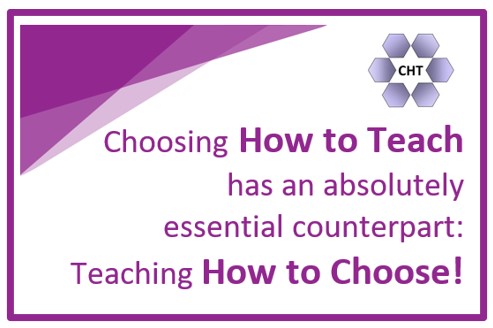
Choosing how to teach has an absolutely essential counterpart: teaching how to choose!

How to add more choices into your classroom?  During a regular day we have many opportunities to allow choices, starting from choosing whom to work with. By asking students to choose a partner who can help them in this assignment you are also encouraging students to recognize the good study habits of others. By providing a variety of assignments to choose from helps students to better articulate their competencies. By letting students choose which task they want to start with helps them understand their personal preferences.  By unpacking how decisions can be made and what we might want to think before choosing is a foundational skill in early grades. By asking students verbalize the steps they took while making a decision makes the process of choosing more visible. I think the ways of introducing more choices in learning environments are virtually infinite, if there is the will to make the change to happen.

Balance is important. If there are too many choices, students may become overwhelmed [2]. Embedding all three parts of Teachers’ Pedagogical Knowledge (TPK) framework to teacher training or PD is a way to ensure the necessary skills for fostering learning process by designing supportive instruction and assessment [2].When educators have enough knowledge of how to support students’ individual learning processes, embedding choices becomes much easier.

My personal credo about the best teacher being the one who makes herself unnecessary by empowering students become autonomous learners carries my values within it.  Our job is to help students to learn on their own, so that they can become life-long learners.

I believe, that only by allowing students to practice making good choices in an emotionally safe learning environment where their opinions or beliefs are never ridiculed, we can help the next generation reach their full potential and become critical thinkers. There is no shortcut to wisdom.

Other posts about choices:

Why choices are so important for learning process

Self-efficacy for deeper learning

Self-deternmination and learning process

Learner agency

🙂

Nina

[1] Patall, E. A., Cooper, H., & Robinson, J. C. (2008). The effects of choice on intrinsic motivation and related outcomes: a meta-analysis of research findings. Psychological bulletin, 134(2), 270.

[2] Iyengar, S. S., & Lepper, M. R. (2000). When choice is demotivating: Can one desire too much of a good thing?. Journal of personality and social psychology79(6), 995.

[3] Sonmark, K. et al. (2017), “Understanding teachers’ pedagogical knowledge: report on an international pilot study”, OECD Education Working Papers, No. 159, OECD Publishing, Paris. http://dx.doi.org/10.1787/43332ebd-en

Perspectives

31 Dec

You know how we don’t see things as they are, but how we are?  And sometimes we have hard time understanding, because the new information doesn’t seem to fit in? The same goes with your students, of course, and even more so because they have not yet learned to recognize their own filters.

Being able to help students create their own worldview is quite amazing. We as teachers are trusted with great responsibility! Being significant adults in our students’ lives we are also co-creators of their futures, and that makes me feel very humble and honoured, indeed.

One essential thing to teach your students as an all round survival skill is the ability to choose some of your own filters.

My current chosen filter is the 3C – approach for learning and teaching. It stands for cognitive, constructive and cooperative learning, and it empowers students to become autonomous learners. It places the student into the nexus of learning and helps them understand what and why they learn and become accountable for their own learning.

I strongly believe that these three components are also essential for good quality teaching.

Without cognitive part your students will never become critical thinkers – because there is nothing for them to think about, they are just asked to pass and perform.

Without constructive part students will never understand their own learning and become active learners – because knowledge is imparted to them, and someone else decides about the truth.

Without co-operational part students will never find learning meaningful and important – because they are objects in their own learning, performing learning tasks dictated by others.

Looking forward into the future (on this last day of 2011), and wondering what today’s students will grow into.  But that is the teacher’s job always: prepare students for the unknown future.

How do you want to equip your students for their journey?

Emotionally Safe Learning Environment

28 Dec

Student-centered and emotionally safe pedagogy is an attitude.  It is not a handbook of tips and tricks, to help us survive our days.  It is being physically and emotionally present when the student needs us. It is also thinking more about the process than the product. And in these classrooms the focus is in creating, not copying, no matter what the task is – this applies to art as well as note taking!

Emotionally safe classrooms are flexible by their nature and they have rules that are consistent and justified. Ordering other people arbitrarily around is only a way to show your power over them.  Being considerate is generally understood as a virtue, and showing the same politeness to children does not go without rewards. Treating students as individual human beings sounds like basic courtesy to me.

The central values of safety, co-operation, individuality, responsibility and building of realistic self image together create the foundation for an emotionally safe learning environment.  Most often these values are expressed in the classrooms and discussed with the students.  Ideally the wording of the rules is co-operationally created, and confirmed with the signatures of the teacher and students, and then posted on the wall for further reference.

Stress-free atmosphere is the first principle for creating an emotionally safe growing and learning environment. Creating the feeling of having enough time enables students to focus on their own learning instead of external factors that might disturb their concentration.  Knowing that their thoughts and ideas are valued helps students think and express their thoughts more freely. More thinking equals more learning.

The one situation when most of us feel threatened or unsafe is while we are receiving feedback.  In an emotionally safe classroom the feedback becomes a natural part of the learning process, and thus stops being scary.  While utilizing students’ daily self-evaluation and teacher’s verbal comments, the feedback system actually becomes a tool for the students to control their own learning.  This system also automatically holds students accountable for their own learning and helps them realize how much they already have learned.

The One Key for Being a Good Teacher

27 Dec

The key is teacher’s desire to empower her/his students to learn autonomously. Ultimately this makes the teacher become unnecessary. Of course, first you must convince your students that you are not a threat to them, but an ally.

Empowerment makes students want to learn. You can call it reverse psychology, or just avoiding the reactions of students when they are told to do things they might prefer not doing. Ultimately it is about teaching accountability, and doing things because they need to be done, not because someone tells me to.

The way empowerment is visible in the classrooms lies in the cooperative way of learning and teaching. We have a common goal. We work together towards reaching it. (This is so simple that I almost feel silly typing it down! – Yet, it still is too seldom practiced in our classrooms! Too many teachers engage in unnecessary power struggles every day.)

There is also a cognitive aspect in empowerment: unleashing your students intellectual curiosity. Helping and guiding students in their learning process is a non-threatening way to assess their learning, too. We all have different approaches to learning, and evaluating the process rather than the product gives much more information about how your students are advancing.

The constructive part of empowerment is helping your students make well informed choices every day. Small and big choices, but both equally justified – because it helps us understand why we do certain things. The important thing is to reflect back to previous experiences and build on the understanding we gained there. After all, we all helping our students to construct their own view of the world we live in.

Your life – your world – your choices.

I wish all students were empowered to know that!