Lifelong learning

3 Apr

Information superhighway ‘bypassing adult learners’ — new study

Does it really surprise any education professionals to read how online technology has not helped people to become lifelong learners? And how the childhood experiences about learning and education are the  most significant predictors for the future interest in learning?

“Learning in later life appears to be primarily linked to positive attitudes to education that are usually formed during compulsory schooling. This means that young people who experienced early educational failure or felt alienated by the school system are very unlikely to participate in education as adults regardless of the opportunities available or potential benefits.” says Dr. Patrick White.

Don’t get me wrong. I like (learning) technology, and am hopelessly hooked to my computer, smartphone and even kindle. What worries me, though, is how different gadgets or software programs are presented as the ultimate answer for fixing education and mending the problem of falling grades and detached students. Technology is just a tool – how we use it makes all the difference.

Providing meaningful learning experiences for students takes the power struggle away from classrooms. This can be done with or without the technology. While working as an Academic Coordinator I used to say how teachers are my most important teaching tools, and I still think that being the reality of teaching and learning. It doesn’t help to have a fancy building with all the latest gadgets in every classroom if I don’t have teachers. But having my teachers willing to make learning a meaningful experience for students my school would be operational even without classrooms or any equipment. Teaching IS a contact sport.

If we wish to foster lifelong learning our students must be involved with worthwhile activities so that they can find learning interesting and rewarding. The negative attitude is the biggest challenge for lifelong learning. Empowering students to use their thinking skills (with or without technology) caters for positive approaches to learning. This is already a recognized and valid practice in Early Childhood Education where play is an important way for making learning an adventure student wants to repeat.

What could you do to foster lifelong learning?

Explaining the Finnish Miracle – Part Two

15 Mar

Explaining the Finnish Miracle – Part Two

Excellent multidimensional explanation about Finnish system! Please read!

It also contains the broader view of curriculum being the practical and helpful guiding tool for intentional teaching and learning – yet providing flexibility for individual schools and teachers to make learning happen in an individualized way. It is the true work plan. Not something publishers are selling, but a tool created for your school and your students.

Mentioning the corridors etc. as important places for learning made me miss the days I was teaching elementary in Finland, and often sent students to study in small groups to different places (like corridors) within the school building … sometimes we used stairs or dressing rooms as small group spaces. Students completed their assignments and returned to classroom to ask for more…. 🙂  But nobody was worried about them going missing, as they were highly accountable for their own learning.

How to build student centered class environment?

25 Feb

Student centered teaching is a way of making teaching and learning better in the classroom. As this is a highly qualitative measure, it is sometimes hard to summarize the necessary changes or easily communicate the differences between student-centered and traditional teacher-led instruction.

What makes definition even harder, is the fact that student centered education is not really a method. It is a philosophy, based on the fact that each human being learns individually. What is taught in a classroom is not necessarily learned, because each student has a different perception of what was taught – and that is exactly how it should be, if we want to foster (critical) thinking skills. When we are asked to follow someone else’s thinking we will not create the same competence as while thinking it through on our own.

There are certain indicators for student centered teaching and learning. The three  main characteristics to define whether a learning environment is student centered or not, are the use of cognitive, constructive and cooperative tools in teaching and learning. One very simple “measurement” is to pay attention to the amount of open-ended questions (as opposed to questions that have just single one correct answer). The other measure is the amount of individualization used in the classroom, and the learning environment supporting learner’s autonomy in majority of tasks and assignments.

Open-ended questions cater for the cognitive growth of your students.  These questions also help your students grow as learners and understand the way their individual learning happens when they hear different correct answers to the same question.  Discussing about the different points of view leading to these answers helps students understand the connections between concepts, and thus caters for deep learning.  When you as teacher know how learning happens, you can easily guide students beyond rote memorization. The question to ask yourself while planning the lesson is: what will my students really learn about this?

Individualization sometimes seems like a bad word, or being something that only adds to the load for the teacher. But it does not have to be  that way. Constructive teaching is student centered and acknowledges the importance of building the content to be learned so that it meets the students’ increasing understanding about the subject matter. Of course,  introducing more complicated concepts after the basics have been learned is just plain common sense. But, the constructive way I have taught with also includes the idea of providing choices for students, so that the more advanced students can learn further on their own speed, while those students who may need extra time can review the content one more time, if necessary. This is not hard to do. And it still is basic common sense: keep the learning meaningful for all of your students. I used to assign different homework for students, too.

Learner’s autonomy requires cooperation in the class.  Only cooperative learning is student centered, because teacher-led instruction is based on the teacher telling students what to do. Cooperation must happen between students to provide deeper understanding about the subject. Sometimes the students’ choice of words makes it easier for another student to understand, because they share the approximately same language level, which is not the case between the teacher and student. Cooperation  in the teacher-student relationship takes away the unnecessary power struggle between teachers and students: why have a battle when we are aiming to a mutual goal? Providing autonomy in class empowers students to learn more on their own,  and makes them become more interested in things they learn at school. This of course decreases the need for behaviour management in your class, when everyone is engaged in learning. Seems like a win-win situation to me!

Does your classroom have hidden expectations?

18 Feb

Teaching is a funny profession. Everybody has an opinion about it, because they have been involved with it, either as a student, a parent or a teacher. That is why classrooms carry loads of emotional baggage, thus always being a battlefield for different sets of expectations.

Every single person entering a classroom has their own expectations regarding learning, teaching, socializing or just education in general. It might not be a clear expectation, or even something they would have actively been thinking about, nevertheless it creates a filter that “colours” everything this person sees in the classroom. Think of coloured shades: depending of the colour of the lens, the whole classroom looks different. And this expectation makes us see exactly those things we want to see (or what we don’t want – because the focus can be the negative expectation, too).

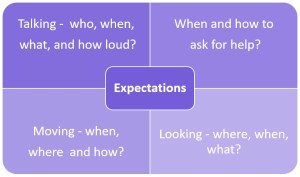
Hidden expectations in the classoom can be about talking, moving, looking and help seeking.

Discussing classroom expectations openly is fortunately a common current practice, as well is creating classroom rules together with students. However, sometimes we still have other expectations that are not spelled out. It takes a fair amount of reflection to figure out what we implicitely expect to happen. Professional learning with collegues and visiting each others’ classroom are great ways to start a discussion of what we do expect.

The hidden expectations that are never discussed tend to appear as “ghosts” in the classroom: hard to detect and hard to address or handle. But they they have a strong effect on how your students learn. Students’ expectations for school or learning in general are often far from realistic, but this does not diminish the emotional and cognitive effect of them, unfortunately.

Have you ever heard about “inherited math-phobia”? A belief how nobody in a family has ever been good at math. Or how in some other family nobody has ever learned to read well and enjoy it…? Or how a student is highly intelligent in one area, and thus should only concentrate on improving that single skill?  You know what I am talking about, right? These expectations will make learning very hard for students, unless they are gently addressed in the class. This is a big part of SEL and supporting our students’ self-awareress as individuals and students.

Learning is a complex process, and we don’t even know all factors contributing to good quality learning. Students’ subjective learning experiences in the everyday classroom context are the building blocks of their education. Based on these experiences, students construct their academic self-images and self-efficacy beliefs. And we have learned about things that make learning harder. One of these things is poor communication, when the message is received in a very different way than it was sent. Hidden expectations are one part explaining why and how this happens.

Using focused and effective feedback in your classroom is one way of addressing these hidden expectations and ensuring that you and your students are talking about the same things. It creates opportunities to understand what your students are thinking, and provides situations for asking those very important open-ended questions. Please remember: learning happens in interactions and only those mistakes that are allowed to be corrected can help students to learn more.

Discussing expectations should be one part of casual communications in education. After all we share the ultimate goal: to see our students succeed in their lives (and studies, too).

Educational Awareness

3 Feb

It sounds like a fancy and complicated thing, this educational awareness, doesn’t it? Yet is is an everyday phenomenon, and often a hot topic of common conversations. We all have an idea about how to raise our children – or better yet, the neighbour’s children!

We also have strong ideas and beliefs about teaching, because of the experiences we have had during our school years. Just like  our beliefs about the best ways of raising children were partly developed during the time we were being taken care of.  In the past these views of good parenting and good education were passed from mother to daughter, or within the community in general. I think we all should start looking for answers beyond our family traditions, or the ways “it have always been done”.

Today we have more challenges in education and parenting, due to the globalization and free information available everywhere. But where to look and find the best practices? Fortunately we have tools to define good enough parenting – or good quality education. We also have tools to understand what these good practices look like. And this is what I am talking about while asking people to raise the educational awareness in their own communities: looking for practices that support development, learning process and understanding (as opposite of obedience, performance and memorization). There is lots of data available for us in print and on the internet, and we just should communicate  about the best ways of supporting learning to people we meet in our everyday lives.

For example there was a new study published today about how maternal support has an effect on our brain, in the regions that are essential to memory and stress modulation. http://www.pnas.org/content/early/2012/01/24/1118003109  The support I am talking about is seeing the positive in the child instead the negative. So,  instead of paying attention to failure and saying negative things when students / children are misbehaving or unsuccessful we should try “catching” them in the moments of good behaviour, and just simply verbalizing the positive outcome.

How could we communicate this to all the parents, teachers, grandparents, neighbours, and other people being involved with developing children?

Will you help me tell people everywhere that children will learn better in school if they have been supported and nurtured in their early explorations within the safe structure of limits?

Teaching How to Choose

20 Jan

Making good choices seems to come naturally for some students while others need deliberate coaching to become successful learners navigating the educational systems. By allowing choices we support our students’ self-efficacy. With choices we are communicating our confidence in our students. It is letting our students know that we believe they can learn, and that we are always happy to help them.

There are things in the classroom that must be done without getting into negotiations about how and why, and we truly cannot let students rule and do whatever they please in the classroom. However, allowing choices makes it emotionally easier for students to agree with the mandatory things. Yet, this is not the main benefit of teaching how to choose. Only through making choices we can train our executive functions and create accountability for our own learning [1]. Learning to make good choices is a just another skill to learn. Knowing how to make choices contributes to our higher-level thinking.  We should not deny our students this opportunity by having too rigid rules that allow no choices.

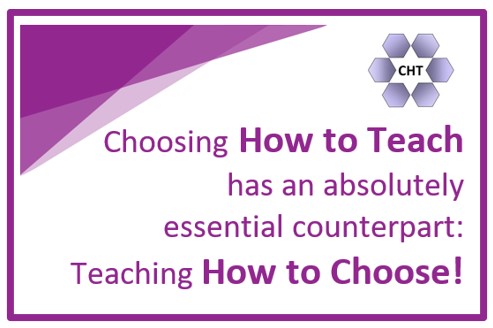
Choosing how to teach has an absolutely essential counterpart: teaching how to choose!

How to add more choices into your classroom?  During a regular day we have many opportunities to allow choices, starting from choosing whom to work with. By asking students to choose a partner who can help them in this assignment you are also encouraging students to recognize the good study habits of others. By providing a variety of assignments to choose from helps students to better articulate their competencies. By letting students choose which task they want to start with helps them understand their personal preferences.  By unpacking how decisions can be made and what we might want to think before choosing is a foundational skill in early grades. By asking students verbalize the steps they took while making a decision makes the process of choosing more visible. I think the ways of introducing more choices in learning environments are virtually infinite, if there is the will to make the change to happen.

Balance is important. If there are too many choices, students may become overwhelmed [2]. Embedding all three parts of Teachers’ Pedagogical Knowledge (TPK) framework to teacher training or PD is a way to ensure the necessary skills for fostering learning process by designing supportive instruction and assessment [2].When educators have enough knowledge of how to support students’ individual learning processes, embedding choices becomes much easier.

My personal credo about the best teacher being the one who makes herself unnecessary by empowering students become autonomous learners carries my values within it.  Our job is to help students to learn on their own, so that they can become life-long learners.

I believe, that only by allowing students to practice making good choices in an emotionally safe learning environment where their opinions or beliefs are never ridiculed, we can help the next generation reach their full potential and become critical thinkers. There is no shortcut to wisdom.

Other posts about choices:

Why choices are so important for learning process

Self-efficacy for deeper learning

Self-deternmination and learning process

Learner agency

🙂

Nina

[1] Patall, E. A., Cooper, H., & Robinson, J. C. (2008). The effects of choice on intrinsic motivation and related outcomes: a meta-analysis of research findings. Psychological bulletin, 134(2), 270.

[2] Iyengar, S. S., & Lepper, M. R. (2000). When choice is demotivating: Can one desire too much of a good thing?. Journal of personality and social psychology79(6), 995.

[3] Sonmark, K. et al. (2017), “Understanding teachers’ pedagogical knowledge: report on an international pilot study”, OECD Education Working Papers, No. 159, OECD Publishing, Paris. http://dx.doi.org/10.1787/43332ebd-en

Perspectives

31 Dec

You know how we don’t see things as they are, but how we are?  And sometimes we have hard time understanding, because the new information doesn’t seem to fit in? The same goes with your students, of course, and even more so because they have not yet learned to recognize their own filters.

Being able to help students create their own worldview is quite amazing. We as teachers are trusted with great responsibility! Being significant adults in our students’ lives we are also co-creators of their futures, and that makes me feel very humble and honoured, indeed.

One essential thing to teach your students as an all round survival skill is the ability to choose some of your own filters.

My current chosen filter is the 3C – approach for learning and teaching. It stands for cognitive, constructive and cooperative learning, and it empowers students to become autonomous learners. It places the student into the nexus of learning and helps them understand what and why they learn and become accountable for their own learning.

I strongly believe that these three components are also essential for good quality teaching.

Without cognitive part your students will never become critical thinkers – because there is nothing for them to think about, they are just asked to pass and perform.

Without constructive part students will never understand their own learning and become active learners – because knowledge is imparted to them, and someone else decides about the truth.

Without co-operational part students will never find learning meaningful and important – because they are objects in their own learning, performing learning tasks dictated by others.

Looking forward into the future (on this last day of 2011), and wondering what today’s students will grow into.  But that is the teacher’s job always: prepare students for the unknown future.

How do you want to equip your students for their journey?

Emotionally Safe Learning Environment

28 Dec

Student-centered and emotionally safe pedagogy is an attitude.  It is not a handbook of tips and tricks, to help us survive our days.  It is being physically and emotionally present when the student needs us. It is also thinking more about the process than the product. And in these classrooms the focus is in creating, not copying, no matter what the task is – this applies to art as well as note taking!

Emotionally safe classrooms are flexible by their nature and they have rules that are consistent and justified. Ordering other people arbitrarily around is only a way to show your power over them.  Being considerate is generally understood as a virtue, and showing the same politeness to children does not go without rewards. Treating students as individual human beings sounds like basic courtesy to me.

The central values of safety, co-operation, individuality, responsibility and building of realistic self image together create the foundation for an emotionally safe learning environment.  Most often these values are expressed in the classrooms and discussed with the students.  Ideally the wording of the rules is co-operationally created, and confirmed with the signatures of the teacher and students, and then posted on the wall for further reference.

Stress-free atmosphere is the first principle for creating an emotionally safe growing and learning environment. Creating the feeling of having enough time enables students to focus on their own learning instead of external factors that might disturb their concentration.  Knowing that their thoughts and ideas are valued helps students think and express their thoughts more freely. More thinking equals more learning.

The one situation when most of us feel threatened or unsafe is while we are receiving feedback.  In an emotionally safe classroom the feedback becomes a natural part of the learning process, and thus stops being scary.  While utilizing students’ daily self-evaluation and teacher’s verbal comments, the feedback system actually becomes a tool for the students to control their own learning.  This system also automatically holds students accountable for their own learning and helps them realize how much they already have learned.

Finding the Balance for More Effective Teaching

28 Dec

Imagine a wheel, like a bicycle wheel. What would the ride feel like if there were bumps on the wheel? Yet that is how we tend to emphasize only one aspect of learning and teaching in our classrooms.

Finding a balance is not always easy. After all, we have so very many details to include to our daily classroom teaching that it is sometimes hard to keep our thoughts straight. Here is a very simple 1-2-3 tool for checking the balance. It covers the most important areas of classroom teaching, no matter what level or grade you are working with.

1. Co-operate. Provide emotional support in the classroom. It helps your students learn, because they feel safe and more comfortable (read Mazlow if you don’t believe just my words). Be aware of learning problems, as well as the social ones, and address them in timely manner. Emotionally safe learning environment is the first premise for good quality teaching.

2. Be constructive. Create or adapt a classroom management system which is compatible with your own values and ideas about good teaching. Having extremely clear expectations for students cuts down the need of behaviour management – when student know what they are supposed to be doing creates lots of opportunities for the teacher to compliment them for their dedication and participation. Maximize the learning time by providing autonomous learning choices after finishing a task.

3. Strengthen the cognitive learning. Cater for concept development by asking lots of open ended questions and teaching your students ask those questions, too. Make sure to stop to listen to the answers. Provide feedback during the learning process instead of evaluating only the end result. This is the most important single thing enhancing their learning. Only those mistakes that are allowed to be corrected can help students learn more.

These steps also empower your students to move towards autonomous learning, because they focus more on learning than on teaching. And that is how it should be. After all, we are in the classroom to help our students learn, are we not? And one part of helping could be providing them a bit smoother ride.

The One Key for Being a Good Teacher

27 Dec

The key is teacher’s desire to empower her/his students to learn autonomously. Ultimately this makes the teacher become unnecessary. Of course, first you must convince your students that you are not a threat to them, but an ally.

Empowerment makes students want to learn. You can call it reverse psychology, or just avoiding the reactions of students when they are told to do things they might prefer not doing. Ultimately it is about teaching accountability, and doing things because they need to be done, not because someone tells me to.

The way empowerment is visible in the classrooms lies in the cooperative way of learning and teaching. We have a common goal. We work together towards reaching it. (This is so simple that I almost feel silly typing it down! – Yet, it still is too seldom practiced in our classrooms! Too many teachers engage in unnecessary power struggles every day.)

There is also a cognitive aspect in empowerment: unleashing your students intellectual curiosity. Helping and guiding students in their learning process is a non-threatening way to assess their learning, too. We all have different approaches to learning, and evaluating the process rather than the product gives much more information about how your students are advancing.

The constructive part of empowerment is helping your students make well informed choices every day. Small and big choices, but both equally justified – because it helps us understand why we do certain things. The important thing is to reflect back to previous experiences and build on the understanding we gained there. After all, we all helping our students to construct their own view of the world we live in.

Your life – your world – your choices.

I wish all students were empowered to know that!