Tag Archives: constructive

Does your classroom have hidden expectations?

18 Feb

Teaching is a funny profession. Everybody has an opinion about it, because they have been involved with it, either as a student, a parent or a teacher. That is why classrooms carry loads of emotional baggage, thus always being a battlefield for different sets of expectations.

Every single person entering a classroom has their own expectations regarding learning, teaching, socializing or just education in general. It might not be a clear expectation, or even something they would have actively been thinking about, nevertheless it creates a filter that “colours” everything this person sees in the classroom. Think of coloured shades: depending of the colour of the lens, the whole classroom looks different. And this expectation makes us see exactly those things we want to see (or what we don’t want – because the focus can be the negative expectation, too).
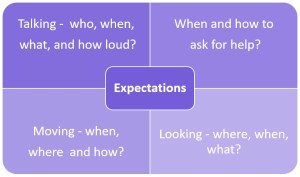
Hidden expectations in the classoom can be about talking, moving, looking and help seeking.

Discussing classroom expectations openly is fortunately a common current practice, as well is creating classroom rules together with students. However, sometimes we still have other expectations that are not spelled out. It takes a fair amount of reflection to figure out what we implicitely expect to happen. Professional learning with collegues and visiting each others’ classroom are great ways to start a discussion of what we do expect.

The hidden expectations that are never discussed tend to appear as “ghosts” in the classroom: hard to detect and hard to address or handle. But they they have a strong effect on how your students learn. Students’ expectations for school or learning in general are often far from realistic, but this does not diminish the emotional and cognitive effect of them, unfortunately.

Have you ever heard about “inherited math-phobia”? A belief how nobody in a family has ever been good at math. Or how in some other family nobody has ever learned to read well and enjoy it…? Or how a student is highly intelligent in one area, and thus should only concentrate on improving that single skill?  You know what I am talking about, right? These expectations will make learning very hard for students, unless they are gently addressed in the class. This is a big part of SEL and supporting our students’ self-awareress as individuals and students.

Learning is a complex process, and we don’t even know all factors contributing to good quality learning. Students’ subjective learning experiences in the everyday classroom context are the building blocks of their education. Based on these experiences, students construct their academic self-images and self-efficacy beliefs. And we have learned about things that make learning harder. One of these things is poor communication, when the message is received in a very different way than it was sent. Hidden expectations are one part explaining why and how this happens.

Using focused and effective feedback in your classroom is one way of addressing these hidden expectations and ensuring that you and your students are talking about the same things. It creates opportunities to understand what your students are thinking, and provides situations for asking those very important open-ended questions. Please remember: learning happens in interactions and only those mistakes that are allowed to be corrected can help students to learn more.

Discussing expectations should be one part of casual communications in education. After all we share the ultimate goal: to see our students succeed in their lives (and studies, too).
Perspectives

31 Dec

You know how we don’t see things as they are, but how we are?  And sometimes we have hard time understanding, because the new information doesn’t seem to fit in? The same goes with your students, of course, and even more so because they have not yet learned to recognize their own filters.

Being able to help students create their own worldview is quite amazing. We as teachers are trusted with great responsibility! Being significant adults in our students’ lives we are also co-creators of their futures, and that makes me feel very humble and honoured, indeed.

One essential thing to teach your students as an all round survival skill is the ability to choose some of your own filters.

My current chosen filter is the 3C – approach for learning and teaching. It stands for cognitive, constructive and cooperative learning, and it empowers students to become autonomous learners. It places the student into the nexus of learning and helps them understand what and why they learn and become accountable for their own learning.

I strongly believe that these three components are also essential for good quality teaching.

Without cognitive part your students will never become critical thinkers – because there is nothing for them to think about, they are just asked to pass and perform.

Without constructive part students will never understand their own learning and become active learners – because knowledge is imparted to them, and someone else decides about the truth.

Without co-operational part students will never find learning meaningful and important – because they are objects in their own learning, performing learning tasks dictated by others.

Looking forward into the future (on this last day of 2011), and wondering what today’s students will grow into.  But that is the teacher’s job always: prepare students for the unknown future.

How do you want to equip your students for their journey?

Emotionally Safe Learning Environment

28 Dec

Student-centered and emotionally safe pedagogy is an attitude.  It is not a handbook of tips and tricks, to help us survive our days.  It is being physically and emotionally present when the student needs us. It is also thinking more about the process than the product. And in these classrooms the focus is in creating, not copying, no matter what the task is – this applies to art as well as note taking!

Emotionally safe classrooms are flexible by their nature and they have rules that are consistent and justified. Ordering other people arbitrarily around is only a way to show your power over them.  Being considerate is generally understood as a virtue, and showing the same politeness to children does not go without rewards. Treating students as individual human beings sounds like basic courtesy to me.

The central values of safety, co-operation, individuality, responsibility and building of realistic self image together create the foundation for an emotionally safe learning environment.  Most often these values are expressed in the classrooms and discussed with the students.  Ideally the wording of the rules is co-operationally created, and confirmed with the signatures of the teacher and students, and then posted on the wall for further reference.

Stress-free atmosphere is the first principle for creating an emotionally safe growing and learning environment. Creating the feeling of having enough time enables students to focus on their own learning instead of external factors that might disturb their concentration.  Knowing that their thoughts and ideas are valued helps students think and express their thoughts more freely. More thinking equals more learning.

The one situation when most of us feel threatened or unsafe is while we are receiving feedback.  In an emotionally safe classroom the feedback becomes a natural part of the learning process, and thus stops being scary.  While utilizing students’ daily self-evaluation and teacher’s verbal comments, the feedback system actually becomes a tool for the students to control their own learning.  This system also automatically holds students accountable for their own learning and helps them realize how much they already have learned.

Finding the Balance for More Effective Teaching

28 Dec

Imagine a wheel, like a bicycle wheel. What would the ride feel like if there were bumps on the wheel? Yet that is how we tend to emphasize only one aspect of learning and teaching in our classrooms.

Finding a balance is not always easy. After all, we have so very many details to include to our daily classroom teaching that it is sometimes hard to keep our thoughts straight. Here is a very simple 1-2-3 tool for checking the balance. It covers the most important areas of classroom teaching, no matter what level or grade you are working with.

1. Co-operate. Provide emotional support in the classroom. It helps your students learn, because they feel safe and more comfortable (read Mazlow if you don’t believe just my words). Be aware of learning problems, as well as the social ones, and address them in timely manner. Emotionally safe learning environment is the first premise for good quality teaching.

2. Be constructive. Create or adapt a classroom management system which is compatible with your own values and ideas about good teaching. Having extremely clear expectations for students cuts down the need of behaviour management – when student know what they are supposed to be doing creates lots of opportunities for the teacher to compliment them for their dedication and participation. Maximize the learning time by providing autonomous learning choices after finishing a task.

3. Strengthen the cognitive learning. Cater for concept development by asking lots of open ended questions and teaching your students ask those questions, too. Make sure to stop to listen to the answers. Provide feedback during the learning process instead of evaluating only the end result. This is the most important single thing enhancing their learning. Only those mistakes that are allowed to be corrected can help students learn more.

These steps also empower your students to move towards autonomous learning, because they focus more on learning than on teaching. And that is how it should be. After all, we are in the classroom to help our students learn, are we not? And one part of helping could be providing them a bit smoother ride.