Tag Archives: education

Helping students to become learners

30 May

One could say that a teacher’s job is never done, but I would like to politely disagree. I believe this depends on how we define “teaching” and “teacher’s work“. Full confession: I work in higher education, been doing that for more than a decade – and I love is SO much! In that sense I agree that we absolutely need teachers, and we as teachers (in any given level of education) have so much work to do. But…

My very strong educational belief is that our first duty is to help our students to learn how to learn. I know, this is kind of a “teaching philosophy statement”. And it is. But in our current reality it also is so much more! When students are able to support and self-regulate their own learning, the hardest part of out work has been done. Yes, there is still content to cover and assessments to use to measure learning, but equipping people to steer their own learning is the most important quest ever! Simply because the skills of life-long learning [1] carry on years and decades after we have met the student.

Helping every student to have a strong Learner Agency is my favorite tool. I love Bandura’s theory about agency [1] because with the four components it is so relatable: we all need intentionality, forethought, self-reactiveness and self-reflectiveness to guide our learning process. Therefore, learning how to help and support our own learning is the crucial quest for all humans.

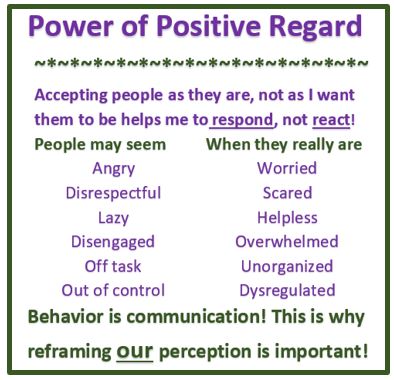
As teachers, how can we make this happen? We make sure that our students have choices! Apart from classroom teaching (or teaching online or in higher ed) I believe we have ample opportunities to support other people in our everyday encounters and encourage them to learn more. We can choose to support people agency – instead of pushing too rigid rules – and help people to enjoy learning new things! For years I have purposefully used Positive Regard so that I can choose to reframe my perception!

We can choose to volunteer in our communities to help others to learn. My current favorite is volunteering to support local resilience project to increase the awareness of ACEs (adverse childhood experiences) [2] and how to mitigate those with Trauma-Informed Practices [3], helping our local agencies to use the same language to discuss trauma, and foster resiliency of all our residents.

How do you want to use your expertise to support your students and your community?

[1] https://choosinghowtoteach.blogspot.com/2015/09/principles-of-life-long-life-deep-and.html

[2] Bandura, A. (2006). Toward a psychology of human agency. Perspectives on psychological science1(2), 164-180.

[3] ACEs – Adverse Childhood Experiences https://www.cdc.gov/aces/about/index.html

[4]  TIP – Carello, J. (2019). Examples of Trauma-Informed Teaching and Learning in College Classrooms;

Make 2025 the Year of Adult SEL

9 Jan

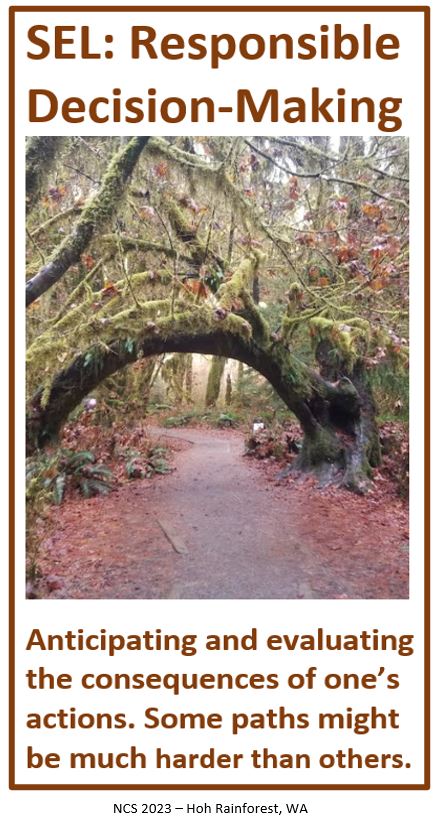
My students are teachers and instructors earning their M.Ed. degrees. I discuss adult SEL every day in my calls with my students to support their learner agency, and also share SEL images in my emails to students. I do this to ensure we are creating a safe learning environment – because we all need that safety to practice responsible decision-making. And truly effective teaching that supports students’ deep learning (not just shallow memorization of facts until passing the test) requires using all three main learning theories – cognitive, constructive and cooperative.

Adult SEL is an integral part of human development – and the day when we stop learning is also the day when we need to stop teaching. Simply because education is an ever-evolving profession, and we need to adjust to the change. I am not talking about “learning a new curriculum”, but how support students’ individual learning. The first part is checking our own assumptions so that we can respond to students’ needs instead of just reacting to their behaviors. This is not always easy to learn! Yet, today when we know so much more about Adverse Childhood Experiences (ACEs) [1] we also understand that students need help in managing their need and emotions. This is also why I believe that learning about Trauma-Informed Practices (TIP) [2] is extremely helpful for teachers, instructors, and educators in all capacities.

Learning to use Positive Regard is easier when our Adult SEL competencies increase. While Relationship skills are essential for being a teacher, the two other important competencies for responding to the needs are self-awareness and self-management – because misbehavior can seriously push our buttons, and we all know that sometimes students are (malevolently) smart to do exactly that! It can become almost like a game – we could call it the “who can derail the teacher from teaching the intended lesson” – game.

When teachers’ adult SEL needs are supported, the whole school community gets enhanced. Simply because we cannot support students if we as professionals are not learning about the toolkit we can use – and I am talking about the the “toolkit” in a broad sense, because different environments, different populations and even different curricula may require different tools. This is the situational aspect of teacher PD (and the reason why “canned” solutions seldom work). Teaching is always, ALWAYS situational and contextual.

If your district is not providing Adult SEL as a PD option, please consider focusing on Adult SEL in your PLN (Professional Learning Network) or PLC (Professional Learning Community)! There is a great Linked In group “Teachers who Coach” with a wealth of information about helpful teaching strategies to build connections with students!

[1] ACEs – Adverse Childhood Experiences https://www.cdc.gov/aces/about/index.html

[2] TIP – Carello, J. (2019). Examples of Trauma-Informed Teaching and Learning in College Classrooms;
SEL image: https://choosinghowtoteach.blogspot.com/2023/12/social-emotional-learning-responsible.html