Tag Archives: learning

Helping students to become learners

30 May

One could say that a teacher’s job is never done, but I would like to politely disagree. I believe this depends on how we define “teaching” and “teacher’s work“. Full confession: I work in higher education, been doing that for more than a decade – and I love is SO much! In that sense I agree that we absolutely need teachers, and we as teachers (in any given level of education) have so much work to do. But…

My very strong educational belief is that our first duty is to help our students to learn how to learn. I know, this is kind of a “teaching philosophy statement”. And it is. But in our current reality it also is so much more! When students are able to support and self-regulate their own learning, the hardest part of out work has been done. Yes, there is still content to cover and assessments to use to measure learning, but equipping people to steer their own learning is the most important quest ever! Simply because the skills of life-long learning [1] carry on years and decades after we have met the student.

Helping every student to have a strong Learner Agency is my favorite tool. I love Bandura’s theory about agency [1] because with the four components it is so relatable: we all need intentionality, forethought, self-reactiveness and self-reflectiveness to guide our learning process. Therefore, learning how to help and support our own learning is the crucial quest for all humans.

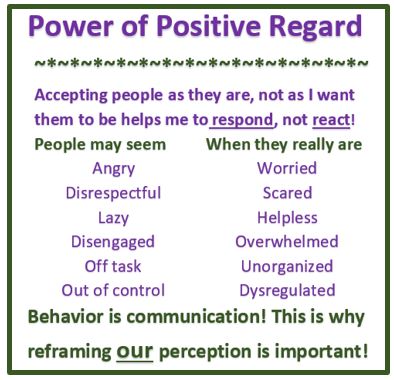
As teachers, how can we make this happen? We make sure that our students have choices! Apart from classroom teaching (or teaching online or in higher ed) I believe we have ample opportunities to support other people in our everyday encounters and encourage them to learn more. We can choose to support people agency – instead of pushing too rigid rules – and help people to enjoy learning new things! For years I have purposefully used Positive Regard so that I can choose to reframe my perception!

We can choose to volunteer in our communities to help others to learn. My current favorite is volunteering to support local resilience project to increase the awareness of ACEs (adverse childhood experiences) [2] and how to mitigate those with Trauma-Informed Practices [3], helping our local agencies to use the same language to discuss trauma, and foster resiliency of all our residents.

How do you want to use your expertise to support your students and your community?

[1] https://choosinghowtoteach.blogspot.com/2015/09/principles-of-life-long-life-deep-and.html

[2] Bandura, A. (2006). Toward a psychology of human agency. Perspectives on psychological science1(2), 164-180.

[3] ACEs – Adverse Childhood Experiences https://www.cdc.gov/aces/about/index.html

[4]  TIP – Carello, J. (2019). Examples of Trauma-Informed Teaching and Learning in College Classrooms;

Make 2025 the Year of Adult SEL

9 Jan

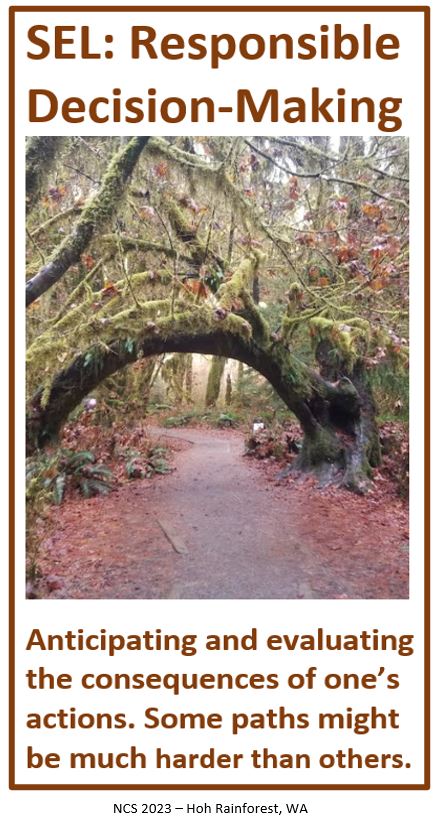
My students are teachers and instructors earning their M.Ed. degrees. I discuss adult SEL every day in my calls with my students to support their learner agency, and also share SEL images in my emails to students. I do this to ensure we are creating a safe learning environment – because we all need that safety to practice responsible decision-making. And truly effective teaching that supports students’ deep learning (not just shallow memorization of facts until passing the test) requires using all three main learning theories – cognitive, constructive and cooperative.

Adult SEL is an integral part of human development – and the day when we stop learning is also the day when we need to stop teaching. Simply because education is an ever-evolving profession, and we need to adjust to the change. I am not talking about “learning a new curriculum”, but how support students’ individual learning. The first part is checking our own assumptions so that we can respond to students’ needs instead of just reacting to their behaviors. This is not always easy to learn! Yet, today when we know so much more about Adverse Childhood Experiences (ACEs) [1] we also understand that students need help in managing their need and emotions. This is also why I believe that learning about Trauma-Informed Practices (TIP) [2] is extremely helpful for teachers, instructors, and educators in all capacities.

Learning to use Positive Regard is easier when our Adult SEL competencies increase. While Relationship skills are essential for being a teacher, the two other important competencies for responding to the needs are self-awareness and self-management – because misbehavior can seriously push our buttons, and we all know that sometimes students are (malevolently) smart to do exactly that! It can become almost like a game – we could call it the “who can derail the teacher from teaching the intended lesson” – game.

When teachers’ adult SEL needs are supported, the whole school community gets enhanced. Simply because we cannot support students if we as professionals are not learning about the toolkit we can use – and I am talking about the the “toolkit” in a broad sense, because different environments, different populations and even different curricula may require different tools. This is the situational aspect of teacher PD (and the reason why “canned” solutions seldom work). Teaching is always, ALWAYS situational and contextual.

If your district is not providing Adult SEL as a PD option, please consider focusing on Adult SEL in your PLN (Professional Learning Network) or PLC (Professional Learning Community)! There is a great Linked In group “Teachers who Coach” with a wealth of information about helpful teaching strategies to build connections with students!

[1] ACEs – Adverse Childhood Experiences https://www.cdc.gov/aces/about/index.html

[2] TIP – Carello, J. (2019). Examples of Trauma-Informed Teaching and Learning in College Classrooms;

SEL image: https://choosinghowtoteach.blogspot.com/2023/12/social-emotional-learning-responsible.html

Collaborative Problem Solving

28 May

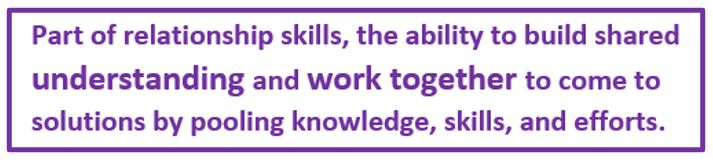
Collaborative problem-solving (CPS) is an important #SEL relationship skill we start learning during early childhood while learning to play with others and share our toys, and later the same skill is also used in scientific problem-solving. The first step to support collaboration is to help participants self-regulate – just because we cannot use higher-order thinking while upset or distracted. #traumainformed I am sure we all have witnessed some melt-downs in playgrounds.

For us adults the collaborative problem solving often means having to learn how to respond, instead of reacting to the situation or behavior – otherwise we are not collaborating, but directing or explaining. Learning the skill of choosing our responses matches the definition of resilience: “the process and outcome of successfully adapting to difficult or challenging situations”[1]. As educators we face these situations every day. To support students’ learning process, it is important to discuss why and how we collaborate and the benefits of learning from each other. The SEL competencies of self-awareness and self-management are priceless skills for anyone who wants to teach.

This is the CASEL definition for Collaborative Problem-Solving as a component of Transformative SEL #tSEL which means adults and students collaborating and learning from each other.

The other parts of Transformative SEL are Identity, Agency, Belonging and Curiosity to build “strong, respectful, and lasting relationships to engage in co-learning” [2] The learning process begins by starting a new path – trying something new or different. Often our curricula dictates the directions and outcomes of learning, yet in an emotionally safe learning environment they can reach the goal. We as educators, embark on learning paths to increase out competencies and to learn something new. And at this point I need to state this very clearly: learning is a different experience from being taught something – it really is a process, not product.

Collaborating and helping others to self-regulate to support their learning process is not always easy. And, quite honestly, learning to help myself to self-regulate has been a long journey, and there are still times when I need to remind myself to take a breath and make sure that I am self-regulated before I respond. Most of the self-management happens outside of our work hours because we all have very personal needs. I have always known that walking on the beach makes me feel better. Now I also know why, and can use it to manage my stress, which then enables me to engage in collaboration with others on the following day.

Collaborating with others to solve a problem is an important 21st century life skill – we are not likely to be successful in our relationships without it. In workplace communication and collaboration skills are important to avoid interpersonal conflicts and keep teams functional. Being able to gather the information related to the problem, use visuals to represent the problem, device a strategy to solve it and complete it together, while reacting appropriately to feedback during the process is one way to measure it. PISA introduced a CPS assessment in 2015 [4].

Fortunately, we often have daily opportunities for honing our CPS skills – these may be present at work, or with family and friends. We just need to choose to start the learning path and see where it takes us.

References:

[1] American Psychological Association. (2020, February 1). Building your resilience. https://www.apa.org/topics/resilience/building-your-resilience

[2] Collaborative for Academic, Social, and Emotional Learning. (n.d.). Transformative
SEL as a lever for equity & social justice. https://casel.org/fundamentals-of-sel/how-does-sel-support-educational-equity-and-excellence/transformative-sel/

[3] Jagers, R. J., Skoog-Hoffman, A., Barthelus, B., & Schlund, J. (2021). Transformative social emotional learning: In pursuit of educational equity and excellence. American Educator45(2), 12. https://www.aft.org/ae/summer2021/jagers_skoog-hoffman_barthelus_schlund

[4] Mo, J. (2017), “How does PISA measure students’ ability to collaborate?”, PISA in Focus, No. 77, OECD Publishing, Paris, https://doi.org/10.1787/f21387f6-en and https://www.oecd.org/pisa/innovation/collaborative-problem-solving/

Increasing Learner Resilience

1 Feb

One of my favorite projects since 2020 is mentoring a pre-K-6 school in South Africa. They wanted to “Finnish” their school and make it more learner-centered, so we created a plan to modify their curriculum and focus on implementing instructional changes and embed SEL in small steps throughout the schoolyear. The foundation is in Cooperative, Constructive and Cognitive practices to collaborate with families and students, create individual learning plans for all students and focus on documenting learning when it naturally happens (instead of formally assessing every student and their skills), and marking all the developmental milestones and learning achievements in the end of the day – sometimes by sending a picture to the parents, too, to keep them connected and informed.

We all know that children learn a lot on their own, and we want to empower their explorations as much as possible to help build learner resilience – a fundamental aspect of our development, relateing to agency and self-efficacy. Agency is our ability to make choices and self-efficacy our belief in our abilities to do thing, like learning.

Fortunately, we are born curious and ready to learn. The only thing we need to do is find a way to cooperate with that curiosity and help students preserve their interest in learning and their sense of wonder – because that is where all true learning starts: wondering if, how, when, why….

As having choices helps children to build stronger learner agency and self-efficacy, I built an infographic about learner-centered education, hoping that it would be easy for Early Childhood Educators to view on mobile phones: https://choosinghowtoteach.blogspot.com/2022/04/empower-students-to-learn.html I think we cannot overemphasize the natural learning process and building on children’s play to help them learn more. Simply put, the EMPOWER stands for Environment, Motivation, Process, Ownership, WHY? Empathy & Emotions and Relationships.

Supporting students’ agency and resilience as learners is easy to do by guiding and supporting students’ natural curiosity and offering help when needed, and figuring out together why things happen. These learning experiences are a tad harder to build, as they don’t fit into pre-structured curricula. But learning cannot be restricted into universal format – learning experiences always have individual flavors and take-aways as we are building on things we have already learned.

This is also the best way for supporting adult learning resilience: offering choices for obtaining the information (reading, listening, watching, discussing…) and demonstrating the competencies (both existing and new ones) by producing a plan or presentation or portfolio, and supporting the self-efficacy of adult learners.

Learning process and contextual wellbeing

4 Jan

My last blog post was about the importance of reflection, and how it is the best tool for anyone who wants to teach. I try to take my own advice and engage in reflection during my workdays. Supporting adult students’ learning is sometimes harder than supporting the learning of younger students. As adults we have stronger preconceptions about our learning abilities and preferences, based on the previous educational experiences. Sometimes these unwritten rules make effective learning harder.

Today I red about an amazing book and found their website: Contextual Wellbeing is such an important concept for education today! Focusing on important (instead of urgent) improves the outcomes of most processes. Learning process is no exception of this rule. Shifting focus from competitive educational model to equitable educational communities that emphasize contextual wellbeing is the challenge.

Making education better requires a systematic change, and changing focus from learning products to learning process. However, we all can make small changes in our own instructional settings and improve the learning experiences our students have. My common request for my students is that they pay forward the learner-centered education with non-punitive assessment system they have experienced. It is much harder to to change to learning- and learner-centered education if you have not experienced it. We all tend to instruct in the way we were instructed, unless we reflect on our dispositions and practices. Yet, as teachers and faculty we all can take small steps towards this direction by focusing on supporting learners autonomy, relatedness and copetency.

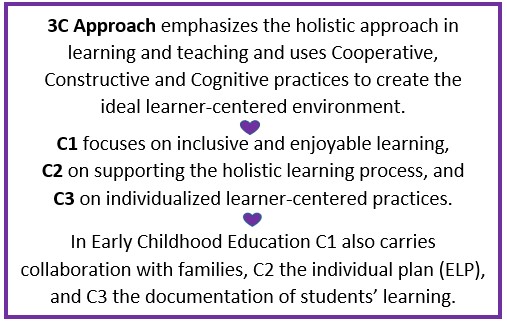
Supporting adult learners includes the same components of respect and compassion as all other teaching, and builds similarly on 3Cs: The cognitive learning approach combined with constructive and cooperative practices that enable effective teaching and meaningful learning.

N3C


C1 – Cognitive approach makes supporting adults’ learning easy and effective. Viewing learning as a student-centered and dynamic process where learners are active participants, it strives to understand the reasons behind behavioral patterns. Discussing values and mental models is the first step. Talking about forethought, performance control, and self-reflection helps students to improve their academic performance by learning how to self-regulate their behavior, engagement and learning. Having conversations about the hierarchy of concepts in learning material and providing support to create graphic organizes and mental models is an important part of the learning support. Establishing and resetting process goals and completion goals, as well as discussing conditional goal setting is important!

C2 – Constructive practice emphasizes the learning process and students’ need to construct their own understanding.  Interactions are the basic fabric of learning! Delivered or transmitted knowledge does not have the same emotional and intellectual value. New learning depends on prior understanding and is interpreted in the context of current understanding, not first as isolated information that is later related to existing knowledge. Constructive learning helps students to understand their own learning process and self-regulate and co-regulate their learning in the classroom and beyond. Regular feedback, self-reflection and joint reflection with respect and compassion are important! Teachers’ strong pedagogical content knowledge is a prerequisite for successful constructive practice.

C3 – Cooperative learning is about holistic engagement in the learning process. The guiding principle is to have learning-centered orientation in instruction and support. Students learn from each other and engage in collaborative meaning-making. Every student has their own strengths and areas to grow, and growth mindset is openly discussed in class. Teaching and learning become meaningful for both teacher and students, because there is no need for the power struggle when interactions are based on respect and compassion. From students’ perspective cooperative learning is about respecting the views of others and behaving responsibly while being accountable for your own learning. At best this leads to learning enjoyment, which is a prerequisite for life-long learning: why would we keep on doing something we don’t like? In 21st Century nobody can afford to stop learning.

The discussions I have with my grad students are amazing. Every day I talk with teachers who have so much passion for their work, so strong dedication for making learning better for their students, and such a drive to gain more professional knowledge.  I am privileged to support my students’ learning process by engaging in dialogue with them. Of course, there are also teachers whose goal is just to pass their courses and earn their degree by demonstrating their existing competencies, and the dialogue with these students is different. As a faculty member I respect their strategic learning approach, but also offer opportunities to engage in deeper learning discussions and support their learning process and wellbeing.

The best tool I have found for supporting adult students’ learning process and contextual wellbeing is open and honest communication.  I try to open the dialogue by listening what my students are thinking, and expanding their knowledge of curriculum, instruction and research by communicative interactions. This is what I think pedagogy and andragogy are really about: supporting students’ deeper learning in dialogue.

Reflection is teachers’ best tool

30 Dec

As teachers we know the mechanisms of teaching and learning. In classroom we must choose which instructional practice to use to help our students to learn. What worked yesterday may or may not work today or tomorrow, because learning depends on the classroom situation and context. These decisions are often value judgments. This is why reflection is so crucially important!

Knowledge of the instructional process, learning process, and assessment are the three cornerstones of teaching practice. However, these three create a tad wobbly foundation if we omit the importance of personal and professional reflection. Teaching is work done with our personalities – there is no denying this! Students perceive us as a part of the learning environment, no matter what we do.

How we engage in the instructional process and learning process are the most important things to reflect upon after every workday. (Yes, these are two VERY different processes!) Reflection doesn’t have to be anything very time consuming or fancy (I know how busy teachers can be), but you shouldn’t walk away from your class or lesson without spending a minute thinking about it. Skipping reflection is like closing a word processing program without saving your work!

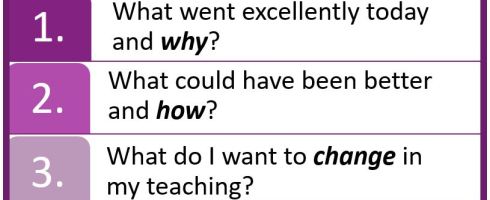
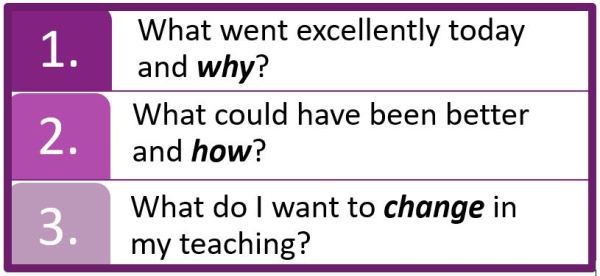
This is the easiest, fastest, everyday reflection process I know about:

Everyday reflection

Thinking about these three things and making a note about the change will help in future planning sessions. I often email myself things to be remembered, and I have a separate email account just for the notes from myself. Doesn’t matter whether you want record your reflections in a notebook. Just do it!

Reflection gets even better if we get to do it with a colleague. They may have insight into why students behaved differently, or a suggestion for what we might want to change in our teaching practice. Maybe they have tried different instructional strategy in a similar situation, or maybe they have diverse insight into learning process.

Joint reflection requires lots of trust. Exposing our own (perceived) weakness to a colleague requires a safe and collaborative working environment. While the advice from friends and colleagues is very helpful, the ultimate instructional choices must be our own and align with our personal values and dispositions. Thinking about our own pedagogical knowledge and pedagogical content knowledge is the base for making value judgments about instructional strategies and how we support students’ learning process. Instruction must fit into the classroom culture. (This is also the reason why exporting Finnish education as a product is not possible – learning is always situational and contextual.)

As teachers we are engaging in lifelong learning. Not only because education changes when culture changes, but also to update our own competence.  I don’t know any teacher whose thinking about the profession has not changed since the day they started teaching.

If you haven’t made a New Years resolution yet, why not give reflective practice a try?


—————————————————–

[1] p. 255 in Guerriero, S., & Révai, N. (2017). Knowledge-based teaching and the evolution of a profession. In S. Guerriero (Ed.). (2017). Educational Research and Innovation: Pedagogical Knowledge and the Changing Nature of the Teaching Profession (pp. 253-269). OECD Publishing.

This whole book and many others about recent educational research are freely available for online reading  on OECD site:  Centre for Educational Research and Innovation


Teachers’ Pedagogical Knowledge

8 Sep

Sometimes we have too narrow view of the teaching profession. Successful teaching is so much more than just deigvering the curriculum or course, or lecturing about the content. It really is about designing good learnign experiences.

There are several necessary competencies for anyone who wants to teach – whether in early learning, K-12, higher ed, or in the training department of a business.  In OECD Teacher Knowledge Survey (TKS) these competencies were divided into three dimensions: instructional process, learning process, and assessment [1]. It makes very much sense to keep these three separate from each other, because they relate to different aspects of teaching-learning interaction. Instructional process is the part of delivering information, learning process is where the learning actually happens, and assessment is where the results of the learning process are measured. The table below shows the competencies in their respective dimensions.

TPK Sonmark JPG

It is important to remember that the instructional process and learning process are two different things: instruction is about delivering information and learning is about acquiring it and elaborating [2], so that the information becomes learners’ subjective knowledge, which obviously is different for each individual student. This is why we should consider learning objectives to be just guidelines showing us what is the basic competency level.

The “real” learning often happens after studying has been done, and the newly gained knowledge is used in real-life settings and combined with all existing knowledge and experiences of the student. This is what “deep learning” means: reconstructed personal understanding of the topic.

While it is great to have excellent content knowledge about the topic you are teaching, it is only one part of the pedagogical (or andragogical) knowledge needed for good teaching. Building skills to design good learning experiences and support students’ learning process are crucial parts of teachers’ professional development. Acquiring and updating the scientific knowledge of learning process, attributions, dispositions and human development is a major part of keeping teaching competency updated. I beleive this professional learning is the only way to avoid falling into minimazing learning to become an one-time evenr or a product to be displayed.

When learning is predominantly perceived to be a product (essay, test, project, exam, etc.), the emphasis lies on instruction/infrotmation delivery instead of individual learning experience, and (standardized) measurements of “learning” where each student is expected to  possess the same knowledge as evidence of teaching-learning interaction being effective. What if student X already possessed the knowledge before starting the class/course/training? What are we really measuring in this case? Certainly not the quality of learning or teaching!

Effective use of teachers’ pedagogical knowledge starts with planning for students’ learning experiences. The next part is to decide the information delivery (whether flipped, direct instruction or some other form of exposing students to the content), construction of safe and supportive learning environment where students can self-regulate and focus on the acquisition and elaboration process of their new knowledge, and non-punitive assessment methods to measure students’ individual learning processes. This certainly is NOT a one-size-fits-all-approach for education or training, but much more effective and enjoyable learning experience for both students and teachers.

The knowledge dynamics of teaching profession have already changed when the infromation era began. Today teacher learning should focus on all areas of pedagogical knowledge, emphasize connecting reseearch to practice, and support teachers’ ownership of their practice [3].

Please see the other blog posts about this topic:

Deep Learning   focuses on understanding connections in the contect, and aims to create permanent knowledge studenture by relating new information with existing one. This is a learning approach that can be fostered among learers of all ages.

Learning: Process or product?  Learning happens all the time, everywhere, yet we try to make formal learning different from all other learning experiences. Maybe we shouldn’t.

Self-Determination in Learning  is like SDT in any other situation: it requires autonomy, relatedness and competency. This is also the premise of gamification to work in education.

Importance of Choices Having choices is the prerequisite for ownership. Optimal level of structure and choicesin classroom increases meaningful learning experiences and teacher-student interactions.

Learner Agency  improves the quality of students’ engagement in their own learning process. Without engagemnt there is not much learning happening.

[1] Sonmark, K. et al. (2017), “Understanding teachers’ pedagogical knowledge: report on an international pilot study”, OECD Education Working Papers, No. 159, OECD Publishing, Paris. http://dx.doi.org/10.1787/43332ebd-en

[2] Illeris, K. (2003). Towards a contemporary and comprehensive theory of learning. International journal of lifelong education22(4), 396-406.

[3] Révai, N., & Guerriero, S. (2017). Knowledge dynamics in the teaching profession.  In S. Guerrera (Ed.).  Pedagogical knowledge and the changing nature of the teaching profession, 37-72.  OECD Publishing  (the whole book is available for download)

3 Core Concepts of Meaningful Learning

15 Sep

Meaningful learning is contextual and situational, and it greatly helps students to be more interested and more successful in their studies. The concept of meaningful learning is not new: already in 1978 researchers empahsized how important it is for students to engage in active learning and purposefully construct their own knowledge and understanding[1].  Meaningfulness of learning content and instructional delivery support students’ motivation and engagement.

Contemporary educational research recognizes the importance of students’ intrinsic motivation and self-concepts as means for improving their academic performance[2].  The first premise for any deep learning to occur is to introduce the new information in a way that makes students interested in acquiring it (buy-in from students’ part improves the effect teaching has).

The three core concepts that help making learning more meaningful are:

Cognitive approach – to create the foundation, because students’ thinking needs to change, not just their behaviour.

Constructive tools  – to focus on supporting students’ learning process and create the real-life connections

Cooperative tools  – to guide the classroom management decision and help students engage int heir learning goals

Learning new things in a way that makes them useful in the future, and also seeing that connection while learning occurs, makes acquiring new information more interesting.  When new information is added to our existing knowledge it needs to have as many connections as possible to ensure fast and easy retrieval from memory.

The more retrieval paths we create and use while learning, the deeper the new knowledge becomes (this is one part explaining why multilingual students can learn more easily), and the more confidence we have about our own learning competence.  It is really hard to find something that forces us to struggle  every day to be meaningful and interesting to do.

As teaching and learning are two very different phenomena that occur in the same physical space, I want to discuss the 3Cs first from the students’ point of view and then form the teachers’ point of view.

The Three Cs for Students

Cognitive learning (developing knowledge) means that the student is an active participant in the learning process, and focuses on understanding concepts, not just remembering facts. Cognitive learning is also is about using reasoning skills and finding logical solutions for problems, as well as about the student knowing how s/he learns, and being confident that s/he has an effect on how her/his learning happens (self-efficacy).

Constructive learning (integrating knowledge) is about building on previous experiences and using time spent in the classroom in a productive manner, so that students don’t engage with busywork, but get to learn on their own level (regardless being above of below the standards).  Constructive learning is not shallow or superficial, but creates meaningful experiences that help students become successful in life.

Cooperative learning (externalizing knowledge) makes learning a pleasant journey shared with friends. It is about getting and giving help, and being collaborative instead of competitive. Classroom organization and behavior management also fall under the label of cooperative learning, because it is important to accommodate everyone’s needs equally. This builds an emotionally safe learning environment where everyone feels accepted. In such environments, students won’t hesitate to ask for help from the teacher or from each other if they don’t understand something.


The Three Cs for Teachers

Cognitive teaching means catering to students’ intellectual needs and providing opportunities for students to process what they have learned.  We must increase our understanding of individual learning and make opportunities for students to negotiate meanings (i.e. have them get answers to a common question: “what’s in it for me?”). It is also important to teach different learning strategies (e.g. concept mapping, other graphic organizers, ways to chunk details, how to practice recalling, etc.)  to help students engage in active learning.  Learning motivation carries the baggage of beliefs about personal learning competence and also the family’s beliefs about being able to learn. These are often called to “causal attributions”, the most common of which is the theory of learned helplessness, the belief that individuals have no control over events that have an effect on them.

Constructive teaching means handing the tools of learning over to the student. In the classroom, this is visible in the form of students being provided with choices. Having choices strengthens students’ executive functions, as they are able to plan for their actions and carry out their plans with the teacher’s support. Constructive teaching focuses more on experiential and  problem based learning and engaging students in the complete learning cycle (Kolb) than just delivering a bunch of facts [3]. When used in conjunction, constructive and cognitive teaching emphasize the process of learning and guide the individual learning process.

Cooperative teaching means that the teacher doesn’t want to use unnecessary power over students, but strives to create a solid structure in the classroom so that everybody knows what to do and how to behave. Rules should be created in cooperation with students, because following rules that you have helped create is much easier than following externally imposed rules. Cooperative teaching also means that students are held accountable for their own learning, and the teacher is there to help students achieve their individual learning goals.

Makes sense, anyone?

Education changes the life of our students, so in a way it is always transformative.  In the worst case student drops out of the educational system believing that s/he is a failure, that s/he cannot learn. Choosing to teach in a way that enhances meaningful learning helps every student towards the positive transformation. Our knowledge and beliefs are references to the life we live, so living and learning cannot be separated from each other, no matter how old or young  the students are.


[1] Ausubel, D. P., Novak, J. D. & Hanesian, H. 1978. Educational psychology a
cognitive view. 2. painos. New York: Holt, Rinehart and Winston.

[2] Green, J., Liem, G. A. D., Martin, A. J., Colmar, S., Marsh, H. W., & McInerney, D. (2012). Academic motivation, self-concept, engagement, and performance in high school: Key processes from a longitudinal perspective.Journal of adolescence35(5), 1111-1122.

Veermans, M., & Tapola, A. (2004). Primary school students’ motivational profiles in longitudinal settings. Scandinavian journal of educational research,48(4), 373-395.

[3] Kolb, D. A. (1984). Experiential learning: Experience as the source of learning and development (Vol. 1). Englewood Cliffs, NJ: Prentice-Hall


Great teachers

25 Aug

Good teachers have strong organizational skills. Good teachers have solid decision-making skills. Good teachers get important things done.

Exceptional teachers do all of the above–and more. Sure, they care about their school and students, their principals and administrators. But most importantly, they care to an exceptional degree about the people who work for them, their students.

That’s why extraordinary teachers give every student:

1. Autonomy and independence

Great organizations are built on optimizing processes and procedures. Still, every task doesn’t deserve a best practice or a micro-managed approach. Engagement and satisfaction are largely based on autonomy and independence. I care when it’s “mine.” I care when I’m in charge and feel empowered to do what’s right.

Plus, freedom breeds innovation: Even heavily product-oriented assignments have room for different approaches.

Whenever possible, give your students the autonomy and independence to work the way they work best. When you do, they almost always find ways to do their jobs better than you imagined possible.

2. Clear expectations

While every assignment should include some degree of independence, every assignment does also need basic expectations for how specific situations should be handled.

Criticize a student for writing an opinion today even though yesterday that was standard practice and you make that student’s learning impossible.  Few things are more stressful than not knowing what is expected from one day to the next.

When an exceptional teacher changes a standard or guideline, s/hes  communicates those changes first–and when that is not possible, s/he takes the time to explain why s/he made the decision s/he made, and what she expects in the future.

3. Meaningful objectives

Almost everyone is competitive; often the best students are extremely competitive–especially with themselves. Meaningful targets can create a sense of purpose and add a little meaning to even the most repetitive tasks.

Plus, goals are fun. Without a meaningful goal to shoot for, studying is just work.

No one likes work.

4. A true sense of purpose

Everyone likes to feel a part of something bigger. Everyone loves to feel that sense of teamwork and esprit de corps that turns a group of individuals into a real team.

The best courses involve making a real impact on the lives of the students you teach. Let students know what you want to achieve for your class, for your school, and even your community. And if you can, let them create a few lessons of their own.

Feeling a true purpose starts with knowing what to care about and, more importantly, why to care.

5. Opportunities to provide significant input

Engaged students have ideas; take away opportunities for them to make suggestions, or instantly disregard their ideas without consideration, and they immediately disengage.

That’s why exceptional teachers make it incredibly easy for students to offer suggestions. They ask leading questions. They probe gently. They help students feel comfortable proposing new ways to get things done. When an idea isn’t feasible, they always take the time to explain why.

Great teachers know that students who make suggestions care about their learning, so they ensure those students know their input is valued–and appreciated.

6. A real sense of connection

Every student works for a grade (otherwise they would bring you more of their work than just assignments), but every student wants to work for more than a grade: They want to study with and for people they respect and admire–and with and for people who respect and admire them.

That’s why a kind word, a quick discussion about family, an informal conversation to ask if an student needs any help–those moments are much more important than group meetings or formal evaluations.

A true sense of connection is personal. That’s why exceptional teachers show they see and appreciate the person, not just the student.

7. Reliable consistency

Most people don’t mind a teacher who is strict, demanding, and quick to offer (not always positive) feedback, as long as s/he treats every student fairly.

(Great teachers treat each student differently but they also treat every student fairly. There’s a big difference.)

Exceptional teachers know the key to showing students they are consistent and fair is communication: The more students understand why a decision was made, the less likely they are to assume unfair treatment or favoritism.

8. Private criticism

No student is perfect. Every student needs constructive feedback. Every student deserves constructive feedback. Good teachers give that feedback.  Great teachers always do it in private.

9. Public praise

Every student–even a relatively poor performer–does something well. Every student deserves appreciation. It’s easy to recognize some of your best students because they’re consistently doing awesome things.  (Maybe consistent recognition is a reason they’re your best students? Something to think about.)

You might have to work hard to find reasons to recognize a student who simply (or barely) meets standards, but that’s okay: A few words of recognition–especially public recognition–may be the nudge an average performer needs to start becoming a great performer.

10. A chance for a meaningful future.

Every course should have the potential to lead to greater things. Exceptional teachers take the time to develop students for the course they someday hope to take, even if that course is in another school.

How can you know what a student hopes to do someday? Ask.

Students will only care about your course after you first show you care about them. One of the best ways is to show that while you certainly have hopes for your school’s future, you also have hopes for your students’ futures.


Good advice, isn’t it?  Let me confess: these are not my words.

I owe this article to Jeff Haden, who published it in Inc. under the title of extraordinary bosses.  I just couldn’t pass the uncanny resemblance between being an awesome boss and being an awesome teacher. So, what I did was just to change words like boss, company, customer and employee to teacher, school and student.  With small adaptation it would fit well as a parenting advice, too. It made me think about the best places where I have worked and felt like a valued member of the team.

We have all this good knowledge about leadership (which resembles teaching much more than management does), and how to put it into practice.

Imagine how different education would look like if we treated our students like best companies treat their employees?

Or,

better yet,

if we treated students like valued customers??


How do YOU want to teach?

27 Apr

Being a teacher makes our core values become visible. All the small (and bigger) choices we make in the classroom talk about our beliefs of good learning and teaching: how we place our students, what kind of questions we ask, what is valued in our class, etc., and they all also contribute to our students’ perception of education. Improving learning and teaching becomes easier when we empower every teacher with the knowledge of choices. Please watch and share:

CHT video

Taking time to think HOW exactly YOU want to teach makes all your choices become more conscious. It is easier to choose wisely when you have better understanding about the consequences of your choices.  Walking the talk of making well-informed choices is important for everyone who wants to teach. Fortunately choosing is a skill that grows with use, just like language fluency.

The same principles apply to our students:  they need to have opportunities to practice choosing in an emotionally safe learning environment.   The first step is to make students aware that there is a choice. So, how exactly do we help our students to make wise choices? This thinking process led me to write the book:

Nina's book

My own belief, based on experiences, is that independent and autonomous students are also the most successful ones. I think this happens because they have so good control over their own learning processes, and also use several different learning strategies.  Guiding all students towards being self-sufficient and having more successful learning experiences can be done if we let go of some unnecessary control and start providing more choices in the daily classroom situations.

Please note that I am not talking about students running wild in the class. The best environment to improve learning and practice choosing is where we can allow students to make mistakes without penalties. This of course means having informal and non-punitive assessment and self-evaluation systems in place.  Student accountability is built on the foundation of their autonomy. How could you be accountable for something you cannot control?

How can you help students practice choosing and become more independent in their learning?