Tag Archives: Learning Process

Dad – an important co-creator of academic success

17 Jun

Researchers at Brigham Young University[1] have found how dads are in a unique position to help their adolescent children develop persistence, which is seen as one factor for academic success. I am not surprised – tapping into dads’ (or another significant adult’s) life experience helps children to understand how the real world works. Persistence also relates to the “growth mindset”[2] which is Carol Dweck’s concept of becoming successful with hard work, instead of solely relying on basic qualities of being talented.

In their study researchers viewed persistence as a teachable trait, and explained how father’s involvement in good quality interactions increased the academic success:

The key is for dads to practice what’s called “authoritative” parenting – not to be confused with authoritarian. Here are the three basic ingredients:

  • Children feel warmth and love from their father
  • Accountability and the reasons behind rules are emphasized
  • Children are granted an appropriate level of autonomy

Authoritative parenting and teaching employ the very best strategies which, of course, from my point of view look very similar to the 3Cs: co-operation in the form of acceptance (warmth and love), cognitive learning tools in emphasizing reasons and accountability, and constructive upbringing – or teaching- in trusting children with age appropriate level of autonomy.

There are many other studies showing how authoritative parenting style significantly predicts academic performance, while no relations can be found for permissive or authoritarian styles (Turner, Chandler et al 2009)[3]. In teaching profession we don’t usually speak about authoritative, permissive or authoritarian teaching styles – but maybe we should?

Children, whose dads employ the “basic ingredients” of authoritative parenting, become more successful in their learning. In the same way students, who are treated at school with co-operative, cognitive and constructive principles, are more likely to grow to become respectful, accountable and determined adults.

What happens to learning when school year ends?

10 Jun

In an ideal situation?  Nothing – learning goes on because students are curious about their physical and social environment and want to keep on interacting with it.  Of course we don’t call it formally “learning” when they are exploring the shores, forests, parks, malls or streets of their hometown or holiday destination.  We call it free time or vacation. Yet, if your students have learned how appropriate and important the question Why? is, they will make the most of their free time as well and keep on learning while wondering and reflecting upon the things they notice. (Please, read more about Why? in this excellent post:  http://3diassociates.wordpress.com/2012/06/05/curiosity-questions-and-learning/)

In a less than ideal situation students refuse to wonder or ask questions about anything.  These students are so fed up with school that they try to avoid all learning activities at any cost when they get out of school. Why does education do that?! How does education do that? John Holt (American author and educator  http://en.wikipedia.org/wiki/John_Holt_(educator)) had fairly strong ideas about how this disconnect happens:

“We destroy the love of learning in children, which is so strong when they are small, by encouraging and compelling them to work for petty and contemptible rewards, gold stars, or papers marked 100 and tacked to the wall, or A’s on report cards, or honor rolls, or dean’s lists, or Phi Beta Kappa keys, in short, for the ignoble satisfaction of feeling that they are better than someone else.”  — John Holt

Killing the intrinsic curiosity children are born with is the worst side effect of an educational system.  This is no news, scientists and educators have known that for decades. Learning starts from wondering.  Science is all about wondering, and asking questions why and how.  As long as you know how to wonder, you are also learning as you go.

“Every kid starts out as a natural-born scientist, and then we beat it out of them. A few trickle through the system with their wonder and enthusiasm for science intact.”  — Carl Sagan

We adults as parents and teachers can prevent the worst from happening by communicating the expectations of education with our students, and also verbalizing how learning does not only happen in school. Every child knows that games have rules, and that the rules must be obeyed so that everybody can play. So, instead of automatically trying to instill into students the idea of school being for fun, we probably should have a very honest talk with kids, and explain how school may not be fun – but how learning certainly is – and help them to understand the difference between learning and  going to school. Learning is what you do for yourself. Graduating is what you do for the society/culture as a part of the game of life.

Detaching learning from going to school and restoring the intrinsic curiosity by encouraging the question Why? is the first step on building autonomy as a learner. This also helps children to take a personal approach to their learning, and also assume more responsibility over it.

The question for you as a parent or teacher is: Do you want your student to be tricked into learning involuntarily (or because of the extrinsic rewards), or do you want them to choose  learning as their own choice?


Receptive or Expressive?

23 Apr

Learning a new language is always both fascinating and frustrating at the same time. Fascinating because a whole new world opens up, and new connections are made. Frustrating because even though I am soon starting to understand some sentences in the new language, I am still far away from speaking fluency, and I know from experience that it will take a looong time before I get there.

It occurred to me that learning always seems to follow the same pattern, no matter what we are learning, language or something else. First you gain some basic ideas about the topic (or language), and try to wrap your mind around it. Then you try to produce something  from you newly learned knowledge. In language learning we call these receptive and expressive language skills. And language teachers have long time known how important it is to get students started with speaking on the target language from the day one, to keep the expressive threshold low for them.

Already in elementary school we are introducing several new “languages” to students: math has a large vocabulary, so does science…not to talk about linguistics, and learning all the names of different features in language. If these “new vocabulary requirements” are not discussed openly with students, they will remain as parts of the hidden expectations. Encouraging students to learn these new vocabularies and use them in everyday speech is a single teaching strategy that will carry for years and years in the future.

Language teachers also know how important students’ talking in the class is,  when we want to help them get fluent.  It is equally important for students to externalize their thoughts and individual understanding about other school subjects to gain the necessary depth of learning. This is easily done by providing every student an opportunity to verbalize their understanding – and because we have limited time in the classroom, it must be done in short pair or group discussions. Every day. In every subject.

Why do we still seem to think teachers’ talking being more important than students’ talking? When the teacher is talking  students are building  only their receptive skills.  Of course, this is the same truth as in learning being more important than teaching.

Only when your expressive skills are adequate  (i.e. you know what you are talking about) you can master the subject.

What is your expectation for your students? Do you wish them to become “fluent” enough with your subject, or are you happy if they have limited receptive understanding about it?

Teaching How to Choose

20 Jan

Making good choices seems to come naturally for some students while others need deliberate coaching to become successful learners navigating the educational systems. By allowing choices we support our students’ self-efficacy. With choices we are communicating our confidence in our students. It is letting our students know that we believe they can learn, and that we are always happy to help them.

There are things in the classroom that must be done without getting into negotiations about how and why, and we truly cannot let students rule and do whatever they please in the classroom. However, allowing choices makes it emotionally easier for students to agree with the mandatory things. Yet, this is not the main benefit of teaching how to choose. Only through making choices we can train our executive functions and create accountability for our own learning [1]. Learning to make good choices is a just another skill to learn. Knowing how to make choices contributes to our higher-level thinking.  We should not deny our students this opportunity by having too rigid rules that allow no choices.

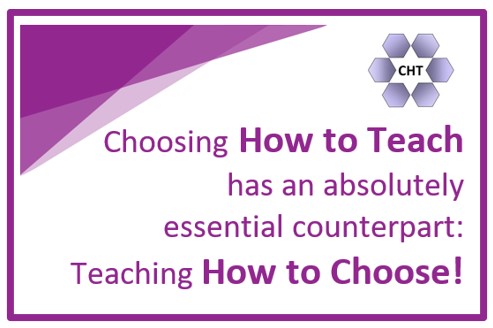
Choosing how to teach has an absolutely essential counterpart: teaching how to choose!

How to add more choices into your classroom?  During a regular day we have many opportunities to allow choices, starting from choosing whom to work with. By asking students to choose a partner who can help them in this assignment you are also encouraging students to recognize the good study habits of others. By providing a variety of assignments to choose from helps students to better articulate their competencies. By letting students choose which task they want to start with helps them understand their personal preferences.  By unpacking how decisions can be made and what we might want to think before choosing is a foundational skill in early grades. By asking students verbalize the steps they took while making a decision makes the process of choosing more visible. I think the ways of introducing more choices in learning environments are virtually infinite, if there is the will to make the change to happen.

Balance is important. If there are too many choices, students may become overwhelmed [2]. Embedding all three parts of Teachers’ Pedagogical Knowledge (TPK) framework to teacher training or PD is a way to ensure the necessary skills for fostering learning process by designing supportive instruction and assessment [2].When educators have enough knowledge of how to support students’ individual learning processes, embedding choices becomes much easier.

My personal credo about the best teacher being the one who makes herself unnecessary by empowering students become autonomous learners carries my values within it.  Our job is to help students to learn on their own, so that they can become life-long learners.

I believe, that only by allowing students to practice making good choices in an emotionally safe learning environment where their opinions or beliefs are never ridiculed, we can help the next generation reach their full potential and become critical thinkers. There is no shortcut to wisdom.

Other posts about choices:

Why choices are so important for learning process

Self-efficacy for deeper learning

Self-deternmination and learning process

Learner agency

🙂

Nina

[1] Patall, E. A., Cooper, H., & Robinson, J. C. (2008). The effects of choice on intrinsic motivation and related outcomes: a meta-analysis of research findings. Psychological bulletin, 134(2), 270.

[2] Iyengar, S. S., & Lepper, M. R. (2000). When choice is demotivating: Can one desire too much of a good thing?. Journal of personality and social psychology79(6), 995.

[3] Sonmark, K. et al. (2017), “Understanding teachers’ pedagogical knowledge: report on an international pilot study”, OECD Education Working Papers, No. 159, OECD Publishing, Paris. http://dx.doi.org/10.1787/43332ebd-en

Perspectives

31 Dec

You know how we don’t see things as they are, but how we are?  And sometimes we have hard time understanding, because the new information doesn’t seem to fit in? The same goes with your students, of course, and even more so because they have not yet learned to recognize their own filters.

Being able to help students create their own worldview is quite amazing. We as teachers are trusted with great responsibility! Being significant adults in our students’ lives we are also co-creators of their futures, and that makes me feel very humble and honoured, indeed.

One essential thing to teach your students as an all round survival skill is the ability to choose some of your own filters.

My current chosen filter is the 3C – approach for learning and teaching. It stands for cognitive, constructive and cooperative learning, and it empowers students to become autonomous learners. It places the student into the nexus of learning and helps them understand what and why they learn and become accountable for their own learning.

I strongly believe that these three components are also essential for good quality teaching.

Without cognitive part your students will never become critical thinkers – because there is nothing for them to think about, they are just asked to pass and perform.

Without constructive part students will never understand their own learning and become active learners – because knowledge is imparted to them, and someone else decides about the truth.

Without co-operational part students will never find learning meaningful and important – because they are objects in their own learning, performing learning tasks dictated by others.

Looking forward into the future (on this last day of 2011), and wondering what today’s students will grow into.  But that is the teacher’s job always: prepare students for the unknown future.

How do you want to equip your students for their journey?