Tag Archives: pedagogy

The problem with strategic learning approach

20 Sep

In any given situation where we need to learn something new – whether formal (at school) or informal (anywhere) – we have a choice to make about our own approach to learning it. This approach can be either engaging in deep learning (immersing ourselves to learning for life) or surface learning (memorizing disconnected pieces of information). When we are in formal education (school, college, university) there is also a third approach: strategic learning, which means that we are aiming for a good grade without caring about the content, and forgetting the information as soon as we pass the assessment.

Deep and deeper learning both refer to acquiring transferable knowledge through classroom experiences.  The emphasis is in supporting students’ lifelong learning process.  The term “deep learning” resulted from the original phenomenograhpic research where researchers found out students having different approaches to learning [1]. These approaches describe how learners perceive tasks – either as disconnected pieces of information to be memorized in order to pass the exam (surface learning), or as knowledge to be constructed and understood in order to create new meanings (deep learning).

Deeper learning has been defined by American Institutes for Research as “a set of competencies students must master in order to develop a keen understanding of academic content and apply their knowledge to problems in the classroom and on the job” [2]

We all use the deep and surface learning approaches in different situations. When presented with a learning task, we appraise the value of it, and then decide about our approach. This usually happens very quickly and automatically. What worries me, is that I have met students whose only learning approach seems to be the strategic learning – meaning that they want high grades, but don’t want to really learn the content. These can be very “good” students – always submitting their assignments and assessments in time, often doing extra work to ensure a good grade. But what about the quality of their learning?

Most grading systems appear to reward the strategic approach, which is very problematic because it focuses on extrinsic motivation and external rewards. Students are taught to complete their worksheets and other tasks and pass their tests so that they can get good grades. But why don’t we talk about learning? And being able to use what they learned?

After moving overseas from Finland, I was so surprised to see that my children had homework that was graded. That made no sense to me! As a teacher, how would I know who actually completed that homework assignment, or how much help the student received in completing it? While teaching in Finland the rule for homework was that it must be something that allows students to revisit what they learned at school. Because the idea of homework is to support students’ learning. Not to have them demonstrate their competency.

Making learning more meaningful for students and decreasing the obsession with grading is more important in 2020 than ever before.

Learner-centered instructional strategies will help. Providing choices for students – they can learn same competencies with different tasks, and getting to choose increases intrinsic motivation (game builders know this, btw, and have mastered the ACR – autonomy, competence, and relatedness). TeachThought also has a collection of more learning-centered strategies for instruction.

To make a leap further into learner-centered practices, ask students’ input for planning their learning experiences. Express positive regard. Try competency-based education. Change the assessment to be student-centered and non-punitive!


[1] Marton, F., & Säljö, R. (1976). On Qualitative Differences in Learning: I—Outcome and
process. British journal of educational psychology, 46(1), 4-11.

[2] Huberman, M., Bitter, C., Anthony, J., & O’Day, J. (2014). The shape of deeper learning: strategies, structures, and cultures in deeper learning network high schools. Findings from the study of deeper learning opportunities and outcomes: Report 1. American Institutes for Research. Retrieved from: http://www.air.org/resource/spotlight-deeper-learning

[3] Bain, K. (2013). Introduction: Growing Deep Learning. Teaching and Learning Together in Higher Education1(8), 1.

3Cs for 2020

2 Aug

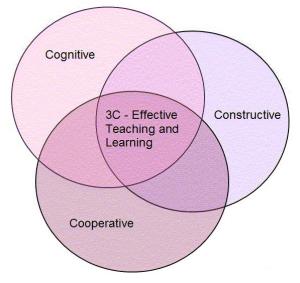
Cooperative learning environment with constructive learning design and cognitive learning approach is more important in schoolyear 2020 than ever before! I wish to empower every teacher to choose how they teach!

The new normal requires every school and every teacher to reconsider how we educate the next generation. It is quite simple: just focus on emphasizing learning instead of instruction. We can’t afford failing to engage ALL students in their own learning process, because it is the best way to support students’ intrinsic motivation and mastery goal orientation that leads to deeper learning (check this [1] APA site).

Helping students self-engage with voice and agency increases their academic performance, because just pushing for completing tasks or worksheets leads to very limited engagement and learning (check this [2] ASCD blog). Deep learning is about students acquiring transferable knowledge and skills through their learning experiences – therefore it is crucial to make differentiation and indvidualization a standard practice in every classroom (not just in special education!).

Instruction that is not personalized leads to students choosing the less beneficial engagement approaches: surface approach (participating enough to pass the test/getting an acceptable grade, not interested in learning) or strategic approach (ace the test to get straight A’s, then forget it all). Both of these are focusing on compliance and participation, instead of engagement on personal level. Engaging students in their own learning process requires a paradigm shift, but it IS possible to do. The 3Cs provide the roadmap for switching from focusing on instruction to focusing on learning.

C1 – Cooperation is the foundation for successful online learning – we just can’t hold people accountable over the distance, so spending time in trying to do that is wasted effort and time. Students always have agency: a choice about their own beliefs and actions. But, we can support students’ learning process and help them learn (instead of focusing on teaching). Getting rid of the “sage on the stage” thinking and becoming the “guide on the side” is a great way to start building a cooperative practice. Cooperation in the beginning of a school year looks like this: Provide emotional support for students by validating concerns and offering indivualized help, continuously showing positive regard. Offer help every day. Repeat offering help and support every day. Emotionally safe learning environment is the first premise for effective learning. If students are scared or worried, learning is not their highest mental priority, surviving is.  3C-framework is built on cooperation, and uses constructive and cognitive instructional approaches.Constructive learning design supports students’ learning process. Make sure to balance the three dimensions of teachers’ pedagogical knowledge: instructional process, learning process and assessment – in physical classroon the instructional process can easily become overemphasized. Now is the time to change that! Build flexible learning entities from the curricula that make sense to students and remember that these can easily integrate two subjects! Build ongoing feedback to keep the learning process going – shared documents, portfolios, blog posts, presentations, videos, etc., emphasizing the open-ended nature of students’ learning. Remember to share a clear rubric with students! [Check this post about student-centerd assessment practices!]

Focus on cognitive learning approach by supporting students’ metacognition (or, thinking about thinking/learning about learning). Teaching metacognitive knowledge and skills is an important part of supporting deep learning in all levels of education! It just looks different: for very young students we try to help them on a path of self-efficacy and positive academic self-concept by supporting self-regulation and concept development; for grad students we offer support in managing the self-regulated learning process and self-evaluation/self-judgment.

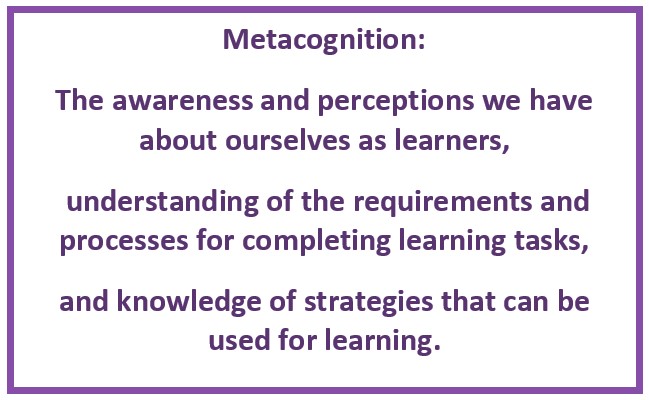
Metacognition: The awareness and perceptions we have about ourselves as learners, understanding of the requirements and processes for completing learning tasks, and knowledge of strategies that can be used for learning.

Help students by discussing Growth Mindset as an important part of understanding one’s own learning process. Provide various ways to organize one’s own thinking: graphic organizers, mindmaps, taxonomies, color coding, etc., and emphasize that there are many different ways to learn something new. Make a list of shareable learning strategies you can recommend to students at any time. Include self-reflection as a standard practice – model it by thinking aloud, help students verbalize what they have learned, help them think what they might do differently or how they could make their schoolwork (stories, presentations, videos, etc) better. Always emphasize learning being a process!

Fostering learning process is actually very simple. In addition to open-endedness there are some other qualities in my mind I decided to name as  CAFÉ

Communicate. Have a dialogue with your students, the most effective communication is reciprocal and includes negotiations of meaning.

Acknowledge their competence, and help to add into it. Validate their knowledge and understanding.

Feedback early and often. Provide feedback about the process (think of mapping the ground that lies ahead them, it is easier to steer clear when you know where the pitfalls are).

Encourage and empower. Support their choices. Point out other possible directions (make sure not to choose for students).

And just like coffee, or life in general, also learning is best when we can enjoy it!

CAFÉ: Communicate. Have a dialogue with your students, the most effective communication is reciprocal and includes negotiations of meaning. Acknowledge their competence, and help to add into it. Validate their knowledge and understanding. Feedback early and often. Provide feedback about the process (think of mapping the ground that lies ahead them, it is easier to steer clear when you know where the pitfalls are). Encourage and empower. Support their choices. Point out other possible directions (make sure not to choose for students).

I hope you enjoy!

🙂

Nina

Other posts about 3Cs and supporting learning process:

3 Superior online strategies

Is learning process or product

Teaching dispositions

Self-determination

Learning-centered education

References:

[1]McCombs, B. L. (2010, February 16). Developing responsible and autonomous learners: A key to motivating students. American Psychological Association. http://www.apa.org/education/k12/learners

[2] Seif, E. (2018, November 16 )Dimensions Of Deep Learning: Levels Of Engagement And Learning. Association for Supervision and Curriculum Development. https://inservice.ascd.org/dimensions-of-deep-learning-levels-of-engagement-and-learning/

Add 5 Elements to Online Education

29 Mar

Creating a productive teaching-learning relationship vial regular interaction is crucial in online education. While communicating in person we use non-verbal cues to understand each other, but over the phone or video we must be more explicit and truly engage in dialogue.  Constructing knowledge cannot occur in a vacuum, and spoken language is much less formal than written language! Engaging in dialogue is essential for learning.

To make online learning better for our students, we must 1) express care, 2) challenge growth, and 3) provide support in our regular interactions. These are the easier, more familiar parts of 5 elements. Just make sure to be available to help via phone, email or video to provide consistent support. But, we also must remember to 4) share power and 5) expand possibilities to fully support the development of our students! These two require deeper dialogues between students and educators because dialogue is collaborative meaning-making by nature. Explanation of these 5 Elements is attached to the bottom of this post.

Teaching is SO MUCH MORE than just handing out worksheets or delivering information. It is taking time to have a dialogue about learning and helping students to engage in their own learning process! In classroom the dialogue happens more easily, while in distance education we must actively seek opportunities for engaging in these crucially important interactions, and ask non-threatening questions to better understand our students’ experiences.

As educators we all want to help and support our students’ development, regardless of their age (here is a quick view of adult development). One way for adding these 5 Elements is to use the learner-centered approach.

The Learner-Centered Principles (as definded by APA) apply to all learners, in and outside of school, young and old.  Learner-centered is also related to the beliefs, characteristics, dispositions, and practices of teachers – practices primarily created by the teacher. When teachers and their practices function from an understanding of the knowledge base delineated in the Principles, they:

(a) include learners in decisions about how and what they learn and how that learning is assessed

(b) value each learner’s unique perspectives

(c) respect and accommodate individual differences in learners’ backgrounds, interests, abilities, and experiences, and

(d) treat learners as co-creators and partners in the teaching and learning process. [1]

Treating students with repect and providing choices is the important 4th element (share power), often underused in education, and crucially important in online learning. We cannot hold people accountable over the distance, so the better approach is to empower students to lead their own learning process (self-regulated learning is a great!). Students must be treated as the co-creators and experts of their own learning process. This doesn’t mean we shouldn’t offer help for example choosing the most suitable learning strategies, because that is our area of expertise as educators.

Expanding possibilities as the 5th element means connecting students with additional resources (even beyond the curriculum). It is helping students to pursue their individual interests and perceive themselves as unbound learners, truly life-long learners who are curious about new things and seek knowledge for their own enjoyment. This obviously looks very different for each individual student.

Online education has the potential to become students’ best or worst learning experience. We can make it to become the best one, by adapting practices that focus on supporting each individual student’s learning process.

Embedding the 5 elements of developmental relationships framework to our everyday communications with students increases the chance of online education becoming a great learning experience!


The following is from Search Institute’s website, and written from the viewpoint of a young person:

Express Care

Show me that I matter to you.

    • Be dependable—Be someone I can trust.
    • Listen—Really pay attention when we are together.
    • Believe in me—Make me feel known and valued.
    • Be warm—Show me you enjoy being with me.
    • Encourage—Praise me for my efforts and achievements.

Challenge Growth

Push me to keep getting better.

    • Expect my best—Expect me to live up to my potential.
    • Stretch—Push me to go further.
    • Hold me accountable—Insist I take responsibility for my actions.
    • Reflect on failures—Help me learn from mistakes and setbacks.

Provide Support

Help me complete tasks and achieve goals.

    • Navigate—Guide me through hard situations and systems.
    • Empower—Build my confidence to take charge of my life.
    • Advocate—Stand up for me when I need it.
    • Set boundaries—Put in place limits that keep me on track.

Share Power

Treat me with respect and give me a say.

    • Respect me—Take me seriously and treat me fairly.
    • Include me—Involve me in decisions that affect me.
    • Collaborate—Work with me to solve problems and reach goals.
    • Let me lead—Create opportunities for me to take action and lead.

Expand possibilities

Connect me with people and places that broaden my world.

    • Inspire—Inspire me to see possibilities for my future.
    • Broaden horizons—Expose me to new ideas, experiences, and places.
    • Connect—Introduce me to people who can help me grow.

Copyright © 2018 by Search Institute®, 3001 Broadway Street NE, Suite 310, Minneapolis MN 55413; 800-888-7828; http://www.search-institute.org. Used with permission.

[1] https://www.apa.org/ed/governance/bea/learner-centered.pdf and http://www.jodypaul.com/LCT/LCT.PsychPrinc.html

3 Superior Strategies for Supporting Online Learning

22 Mar

Learning happens in interactions.  It is not an event, but an ongoing process (Stahl et al., 2010). Online learning presents great opportunities for individual and productive learning interactions. therefore learning experience design should be built around intereactions. Obviously, there may be some serious problems, too, such as not noticing when students are struggling. Most problems get solved when we focus on supporting students’ learning process and build our communications around that support.

When we consider the first part of learning process to be interactions between the learner, content, and environment, and the second part being internal acquisition and elaboration (Illeris, 2003, p. 398), it seems obvious that the core strategies for great online education focus on supporting these two processes. I have found the following three superior strategies to be the most helpful ones during the last 8 years of my online practice.

  1. Strive for user-friendly content delivery – make it easy for students to know what to do and where to find necessary information.
  2. Decidedly support students’ self-regulated learning – the learning process is very individual and we can help students to design better learning experiences for themselves.
  3. Favor asynchronous learning activities – we want to differentiate students learning experiences, and accommodate differnet needs and previous knowledge with asynchronous activities.

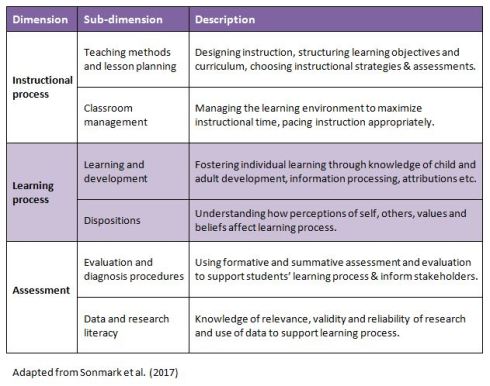
Learning is such a personal experience. When our students have successful learning experiences they are more likely to want to learn more. The three strategies above agree with the framework of Teacher’s Pedagogical Knowledge (Sonmark, et al., 2017), addressing all three areas of our necessary professional competence: Instructional Process (teaching methods, lesson planning and classroom management), Learning Process (learning & development and dispositions), and Assessment (evaluation and diagnosis procedures & data and research literacy). More about the strategies below!

3 Superior Strategies for Supporting Online Learning: 1.	Strive for user-friendly content delivery 2.	Decidedly support students’ self-regulated learning 3.	Favor asynchronous learning activities

First strategy: make learning easier by providing choices for engaging with the content. Curriculum usually dictates the content to be learned. Delivering content is the easiest problem to solve while transferring to online learning. We can share documents and record presentations, provide worksheets and self-assessments. It is important to honor students’ different preferences for obtaining information, some prefer watching videos, others like to read or listen. Keep videos short. Make sure to provide a transcript for a video or podcast – especially when instructing adults. We read much faster than anyone can talk.

Often online learning includes using a Learning Management System, LMS. As educators we have to become proficient users of the LMS, in addition to the foundational competencies of Teachers’ Pedagogical Knowledge, otherwise online teaching becomes very cumbersome. Obviously, students have different previous exposure to online environments, so remembering to offer help for navigation is the crucially important first step. Series of walk through documents or short videos is better than one or two long videos. We want to be sure to provide just-in-time support to make it easy for students to navigate the syllabus and their learning materials.

Online learning environment can sometimes become a barrier for learning. Therefore, it is important to step out of our own comfort zone with the LMS, and try to see it with the eyes of someone who encounters it for the first time. Are learning materials organized in a user-friendly way? Does the navigation make implicit sense to a person who encounters it for the first time? How can we help all students to navigate their new learning environment? These questions are equally important if we are just providing the learning materials over a website. In situations with great learner diversity it may be best to create a checklist for required activities and another list for additional supporting documents. And, most importantly: make sure to be willing and available to help.

Second strategy: Support self-regulated learning (Zimmerman, 2000). The greatest mistake while switching to online learning is the attempt of mimicking seat-based education where instructor talks and students sit and listen (an approach created without modern knowledge of how learning happens and how it can best supported). First rule of effective education is this: learning process is individual – so, focus your efforts on supporting students’ learning process. While we all DO learn the same way, through acquisition and elaboration, our concept development and preferred constructs for connecting new information to our existing knowledge are very diverse. We all have our own mental models of the world and keep adding information to our own knowledge base. Information that is not personally assimilated or accommodated will simply be forgotten, as it doesn’t become a part of our knowledge structure. Therefore, supporting students’ learning process and being available to answer questions IS the path for effective online education.

Self-regulated learning cycle guides students through the three crucial parts of learning: Planning – Performance – Reflection. The planning phase (forethought) includes analyzing the tasks and setting the process and completion goals. Planning for our own learning is an advanced skill, and we cannot expect students to master it immediately. Providing support for planning is crucially important in the beginning!, because students may not have any experience of designing their own learning experiences. The performance phase relies on self-monitoring, so that we are aware of our own learning process and can compare it to the expected outcomes. Rubrics are the best possible formative assessment tool for online learning, because they show students the criteria for grading. The use of rubrics in formative assessments has been shown to support students’ learning in recent educational research (eg. Panadero, Jonsson & Botella, 2017; Kasimatis, Kouloumpis, & Papageorgiou, 2019; Ajjawi, Bearman & Boud, 2019). The third phase of learning process also relies on rubrics because looking back to the choices made in the current cycle, and having an open dialogue about choices for the next learning cycle, is the very moment for effective self-regulated learning to emerge. Engaging in individual discussions about the rubric with each student is easier in the online learning environment than in the classroom. It can be a chat or a phone/webcam discussion with online collaboration over the documents comparing the rubric and student’s performance. The important part for the instructor is to listen and learn more about how the student thinks, to best support them during the next learning cycle. The planning part in the next learning cycle benefits from the foundation a dialogue provides. So, make sure to be available to help.

The third strategy: favoring asynchronous learning is great! We all learn in different pace, depending on our previous knowledge and thinking patterns. Learning doesn’t happen like manufacturing items on a conveyor belt. Learning process has spurts and halts, and sometimes looping back to already learned content is necessary, because we need to review or relearn things. The great thing about online learning is that we all can take as much time as we need to complete a learning activity – and students don’t have to feel bored or anxious because they need more or less time for the task than others. Yes, there can and should be times when the whole class checks in, or when a sub task must be ready for a small group assignment. But it doesn’t mean everyone have to sit still if they have already completed it, they can go for a short walk before engaging the next session, or do something else to invigorate themselves. Encouraging students to take several short breaks during the day is very important. I still believe that Finnish model of taking a 15-minute break after every 45-minute lesson was a great way to keep my students engaged and ready to learn. Favoring asynchronous learning activities allows us to support students’ individual needs. So, make sure to be available to help.

Bottom line: Online education has the potential to become students’ best or worst learning experience. We can make it to become the best one, by adapting practices that focus on supporting each individual student’s learning process. Therefore, make sure to be available to help.

😊

Nina

Ajjawi, R., Bearman, M., & Boud, D. (2019). Performing standards: a critical perspective on the contemporary use of standards in assessment. Teaching in Higher Education, 1-14.

Illeris, K. (2003). Towards a contemporary and comprehensive theory of learning. International journal of lifelong education22(4), 396-406.

Kasimatis, K., Kouloumpis, D. & Papageorgiou, T. (2019). Cultivation of 21st-century skills: Creating and implementing rubrics for assessing projects. New Trends and Issues Proceedings on Humanities and Social Sciences. [Online]. 6(7), pp 180-188. Available from: www.prosoc.eu

Panadero, E., Jonsson, A., & Botella, J. (2017). Effects of self-assessment on self-regulated learning and self-efficacy: Four meta-analyses. Educational Research Review22, 74-98.

Stahl, S. M., Davis, R. L., Kim, D. H., Lowe, N. G., Carlson, R. E., Fountain, K., & Grady, M. M. (2010). Play it again: the master psychopharmacology program as an example of interval learning in bite-sized portions. CNS spectrums15(8), 491-504.

Sonmark, K. et al. (2017), “Understanding teachers’ pedagogical knowledge: report on an international pilot study”, OECD Education Working Papers, No. 159, OECD Publishing, Paris. http://dx.doi.org/10.1787/43332ebd-en

Zimmerman, B. J. (2000). Attaining self-regulated learning: a social-cognitive
perspective, in M. Boekaerts, P. Pintrich, and M. Zeidner (Eds.) Handbook of Self-regulation (pp. 13–39). San Diego, CA: Academic Press.

Learning Strategies – part 1

22 Jul

One important part of Teachers’ Pedagogical Knowledge is the skill of supporting students’ individual learning processes. For Learning and Development this means fostering each student’s individual learning through knowledge of human development, information processing, attributions and other theories that relate to how we learn. For Dispositions it means understanding how perceptions of self, others, values and beliefs affect learning process.

Remember, these are our professional competencies! Sometimes we forget that our students don’t have the same knowledge and insight into learning as we do. This is why we must explicitely teach appropriate and effective learning strategies to our students.

While the strategies themselves – ways to pace learning, to memorize and recall, make connections and aim for deeper learning – remain pretty much the same throughout our educational experiences, the way we use them is directly related to our subjective learning needs.  These needs depend on our personal preferences, developmental age, knowledge structure, and the perception of why we are learning. Discussing learning strategies and helping students to choose the best ones for the purpose is an easy way to make the everyday learning experiences more personal.

Today there are various initiatives to personalize learning, ranging from software programs to truly learner-centered design for instruction. Teaching students about different learning strategies is an excellent way to make learning more personal and help students have more ownership over their own learning process.

Personalized learning is tailoring learning for each student’s strengths, needs and interests — including enabling student voice and choice in what, how, when and where they learn — to provide flexibility and support to ensure mastery of the highest standards possible.[1]

I am always a little worried with the -ized ending in the words when we discuss education because it often implies someone (or something) else than the student to make decisions about their learning. My biggest take-away from the quote is the increased student voice and choice, because it IS their learning experience we are talking about.  Experience is such a subjective phenomenon that it can’t be standardized. What we can do as teachers, is to empower, help and support the learning process, and provide more choices and more tools for our students. Learning is a personal endeavour. The strategies we recommend to our students should reflect that fact!

Emphasizing personal learning approach is not a new fad. APA has emphasized the importance of personal learning since 1990 by highlighting the learner-centered approach and 2015 updating the approach to Top 20 principles for PreK-12 education. I wish every teacher had a copy of that document!

The Learner-Centered Principles apply to all learners, in and outside of school, young and old.  Learner-centered is also related to the beliefs, characteristics, dispositions, and practices of teachers – practices primarily created by the teacher.When teachers and their practices function from an understanding of the knowledge base delineated in the Principles, they:

(a) include learners in decisions about how and what they learn and how that learning is assessed

(b) value each learner’s unique perspectives

(c) respect and accommodate individual differences in learners’ backgrounds, interests, abilities, and experiences, and

(d) treat learners as co-creators and partners in the teaching and learning process.

Changing the focus from universal delivery of information (i.e. traditional teacher-centered educational model) to learner-centered or personal learning approach (i.e. learning facilitation) is the first step.  Then, changing assessment and grading to reflect students’ learning process and engaging in non-punitive assessment model is the second step.

This is the beginning of Learning Strategies blog posts. I hope these learning strategies will help you to help your students.


🙂

Nina


—–

[1] Patrick, S., Kennedy, K., & Powell, A. (2013). Mean what you say: Defining and integrating personalized, blended and competency education. Report, October.

[2] https://www.apa.org/ed/governance/bea/learner-centered.pdf and http://www.jodypaul.com/LCT/LCT.PsychPrinc.html


Learning process and contextual wellbeing

4 Jan

My last blog post was about the importance of reflection, and how it is the best tool for anyone who wants to teach. I try to take my own advice and engage in reflection during my workdays. Supporting adult students’ learning is sometimes harder than supporting the learning of younger students. As adults we have stronger preconceptions about our learning abilities and preferences, based on the previous educational experiences. Sometimes these unwritten rules make effective learning harder.

Today I red about an amazing book and found their website: Contextual Wellbeing is such an important concept for education today! Focusing on important (instead of urgent) improves the outcomes of most processes. Learning process is no exception of this rule. Shifting focus from competitive educational model to equitable educational communities that emphasize contextual wellbeing is the challenge.

Making education better requires a systematic change, and changing focus from learning products to learning process. However, we all can make small changes in our own instructional settings and improve the learning experiences our students have. My common request for my students is that they pay forward the learner-centered education with non-punitive assessment system they have experienced. It is much harder to to change to learning- and learner-centered education if you have not experienced it. We all tend to instruct in the way we were instructed, unless we reflect on our dispositions and practices. Yet, as teachers and faculty we all can take small steps towards this direction by focusing on supporting learners autonomy, relatedness and copetency.

Supporting adult learners includes the same components of respect and compassion as all other teaching, and builds similarly on 3Cs: The cognitive learning approach combined with constructive and cooperative practices that enable effective teaching and meaningful learning.

N3C


C1 – Cognitive approach makes supporting adults’ learning easy and effective. Viewing learning as a student-centered and dynamic process where learners are active participants, it strives to understand the reasons behind behavioral patterns. Discussing values and mental models is the first step. Talking about forethought, performance control, and self-reflection helps students to improve their academic performance by learning how to self-regulate their behavior, engagement and learning. Having conversations about the hierarchy of concepts in learning material and providing support to create graphic organizes and mental models is an important part of the learning support. Establishing and resetting process goals and completion goals, as well as discussing conditional goal setting is important!

C2 – Constructive practice emphasizes the learning process and students’ need to construct their own understanding.  Interactions are the basic fabric of learning! Delivered or transmitted knowledge does not have the same emotional and intellectual value. New learning depends on prior understanding and is interpreted in the context of current understanding, not first as isolated information that is later related to existing knowledge. Constructive learning helps students to understand their own learning process and self-regulate and co-regulate their learning in the classroom and beyond. Regular feedback, self-reflection and joint reflection with respect and compassion are important! Teachers’ strong pedagogical content knowledge is a prerequisite for successful constructive practice.

C3 – Cooperative learning is about holistic engagement in the learning process. The guiding principle is to have learning-centered orientation in instruction and support. Students learn from each other and engage in collaborative meaning-making. Every student has their own strengths and areas to grow, and growth mindset is openly discussed in class. Teaching and learning become meaningful for both teacher and students, because there is no need for the power struggle when interactions are based on respect and compassion. From students’ perspective cooperative learning is about respecting the views of others and behaving responsibly while being accountable for your own learning. At best this leads to learning enjoyment, which is a prerequisite for life-long learning: why would we keep on doing something we don’t like? In 21st Century nobody can afford to stop learning.

The discussions I have with my grad students are amazing. Every day I talk with teachers who have so much passion for their work, so strong dedication for making learning better for their students, and such a drive to gain more professional knowledge.  I am privileged to support my students’ learning process by engaging in dialogue with them. Of course, there are also teachers whose goal is just to pass their courses and earn their degree by demonstrating their existing competencies, and the dialogue with these students is different. As a faculty member I respect their strategic learning approach, but also offer opportunities to engage in deeper learning discussions and support their learning process and wellbeing.

The best tool I have found for supporting adult students’ learning process and contextual wellbeing is open and honest communication.  I try to open the dialogue by listening what my students are thinking, and expanding their knowledge of curriculum, instruction and research by communicative interactions. This is what I think pedagogy and andragogy are really about: supporting students’ deeper learning in dialogue.

Reflection is teachers’ best tool

30 Dec

As teachers we know the mechanisms of teaching and learning. In classroom we must choose which instructional practice to use to help our students to learn. What worked yesterday may or may not work today or tomorrow, because learning depends on the classroom situation and context. These decisions are often value judgments. This is why reflection is so crucially important!

Knowledge of the instructional process, learning process, and assessment are the three cornerstones of teaching practice. However, these three create a tad wobbly foundation if we omit the importance of personal and professional reflection. Teaching is work done with our personalities – there is no denying this! Students perceive us as a part of the learning environment, no matter what we do.

How we engage in the instructional process and learning process are the most important things to reflect upon after every workday. (Yes, these are two VERY different processes!) Reflection doesn’t have to be anything very time consuming or fancy (I know how busy teachers can be), but you shouldn’t walk away from your class or lesson without spending a minute thinking about it. Skipping reflection is like closing a word processing program without saving your work!

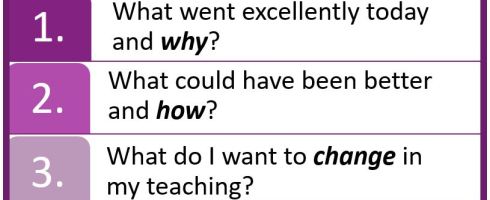
This is the easiest, fastest, everyday reflection process I know about:

Everyday reflection

Thinking about these three things and making a note about the change will help in future planning sessions. I often email myself things to be remembered, and I have a separate email account just for the notes from myself. Doesn’t matter whether you want record your reflections in a notebook. Just do it!

Reflection gets even better if we get to do it with a colleague. They may have insight into why students behaved differently, or a suggestion for what we might want to change in our teaching practice. Maybe they have tried different instructional strategy in a similar situation, or maybe they have diverse insight into learning process.

Joint reflection requires lots of trust. Exposing our own (perceived) weakness to a colleague requires a safe and collaborative working environment. While the advice from friends and colleagues is very helpful, the ultimate instructional choices must be our own and align with our personal values and dispositions. Thinking about our own pedagogical knowledge and pedagogical content knowledge is the base for making value judgments about instructional strategies and how we support students’ learning process. Instruction must fit into the classroom culture. (This is also the reason why exporting Finnish education as a product is not possible – learning is always situational and contextual.)

As teachers we are engaging in lifelong learning. Not only because education changes when culture changes, but also to update our own competence.  I don’t know any teacher whose thinking about the profession has not changed since the day they started teaching.

If you haven’t made a New Years resolution yet, why not give reflective practice a try?


—————————————————–

[1] p. 255 in Guerriero, S., & Révai, N. (2017). Knowledge-based teaching and the evolution of a profession. In S. Guerriero (Ed.). (2017). Educational Research and Innovation: Pedagogical Knowledge and the Changing Nature of the Teaching Profession (pp. 253-269). OECD Publishing.

This whole book and many others about recent educational research are freely available for online reading  on OECD site:  Centre for Educational Research and Innovation


Teachers’ Pedagogical Knowledge

8 Sep

Sometimes we have too narrow view of the teaching profession. Successful teaching is so much more than just deigvering the curriculum or course, or lecturing about the content. It really is about designing good learnign experiences.

There are several necessary competencies for anyone who wants to teach – whether in early learning, K-12, higher ed, or in the training department of a business.  In OECD Teacher Knowledge Survey (TKS) these competencies were divided into three dimensions: instructional process, learning process, and assessment [1]. It makes very much sense to keep these three separate from each other, because they relate to different aspects of teaching-learning interaction. Instructional process is the part of delivering information, learning process is where the learning actually happens, and assessment is where the results of the learning process are measured. The table below shows the competencies in their respective dimensions.

TPK Sonmark JPG

It is important to remember that the instructional process and learning process are two different things: instruction is about delivering information and learning is about acquiring it and elaborating [2], so that the information becomes learners’ subjective knowledge, which obviously is different for each individual student. This is why we should consider learning objectives to be just guidelines showing us what is the basic competency level.

The “real” learning often happens after studying has been done, and the newly gained knowledge is used in real-life settings and combined with all existing knowledge and experiences of the student. This is what “deep learning” means: reconstructed personal understanding of the topic.

While it is great to have excellent content knowledge about the topic you are teaching, it is only one part of the pedagogical (or andragogical) knowledge needed for good teaching. Building skills to design good learning experiences and support students’ learning process are crucial parts of teachers’ professional development. Acquiring and updating the scientific knowledge of learning process, attributions, dispositions and human development is a major part of keeping teaching competency updated. I beleive this professional learning is the only way to avoid falling into minimazing learning to become an one-time evenr or a product to be displayed.

When learning is predominantly perceived to be a product (essay, test, project, exam, etc.), the emphasis lies on instruction/infrotmation delivery instead of individual learning experience, and (standardized) measurements of “learning” where each student is expected to  possess the same knowledge as evidence of teaching-learning interaction being effective. What if student X already possessed the knowledge before starting the class/course/training? What are we really measuring in this case? Certainly not the quality of learning or teaching!

Effective use of teachers’ pedagogical knowledge starts with planning for students’ learning experiences. The next part is to decide the information delivery (whether flipped, direct instruction or some other form of exposing students to the content), construction of safe and supportive learning environment where students can self-regulate and focus on the acquisition and elaboration process of their new knowledge, and non-punitive assessment methods to measure students’ individual learning processes. This certainly is NOT a one-size-fits-all-approach for education or training, but much more effective and enjoyable learning experience for both students and teachers.

The knowledge dynamics of teaching profession have already changed when the infromation era began. Today teacher learning should focus on all areas of pedagogical knowledge, emphasize connecting reseearch to practice, and support teachers’ ownership of their practice [3].

Please see the other blog posts about this topic:

Deep Learning   focuses on understanding connections in the contect, and aims to create permanent knowledge studenture by relating new information with existing one. This is a learning approach that can be fostered among learers of all ages.

Learning: Process or product?  Learning happens all the time, everywhere, yet we try to make formal learning different from all other learning experiences. Maybe we shouldn’t.

Self-Determination in Learning  is like SDT in any other situation: it requires autonomy, relatedness and competency. This is also the premise of gamification to work in education.

Importance of Choices Having choices is the prerequisite for ownership. Optimal level of structure and choicesin classroom increases meaningful learning experiences and teacher-student interactions.

Learner Agency  improves the quality of students’ engagement in their own learning process. Without engagemnt there is not much learning happening.

[1] Sonmark, K. et al. (2017), “Understanding teachers’ pedagogical knowledge: report on an international pilot study”, OECD Education Working Papers, No. 159, OECD Publishing, Paris. http://dx.doi.org/10.1787/43332ebd-en

[2] Illeris, K. (2003). Towards a contemporary and comprehensive theory of learning. International journal of lifelong education22(4), 396-406.

[3] Révai, N., & Guerriero, S. (2017). Knowledge dynamics in the teaching profession.  In S. Guerrera (Ed.).  Pedagogical knowledge and the changing nature of the teaching profession, 37-72.  OECD Publishing  (the whole book is available for download)

Why choices are SO important for learning process

14 Jun


While doing my research about learner agency, I interviewed high school seniors about their learning experiences. Students’ common perception regarding learner agency was that they do not have enough choices to engage in their learning during their school days. This makes no sense! Students must learn how to make good choices during their K-12 experiences. That is a major part of human development.

So why don’t we offer enough choices in classroom?

I believe there are many answers to this question. The first that comes to mind is scary: we teach the way we were taught. There is a great chance for behaviorism being the predominant learning theory used in that classroom.  Yet, it is generally accepted that intrinsic motivation is important for successful learning [1]. Trying to build effective instruction is very hard, if we keep on ignoring what research shows about teaching and learning!

Teachers who have experimented with letting students decide which tasks they would work on in the classroom report results of students finishing more tasks and being more engaged. Furthermore, we have decades of educational research about benefits of learner-centered classroom practices being superior to operant conditioning and rote memorization. Students need autonomy to build critical and creative thinking skills that will enable them to practice perspective-taking as a part of their everyday learning experiences [2]. Having choices allows students to perceive that they have control over their own learning – which makes the work they put in to feel a little less of a requirement and a little more personally rewarding.

The other possibility for choices missing from the classroom is that providing choices can be intimidating for the teacher:  it changes the power structure in classroom and shifts some of the responsibility from teacher to the students.

Especially accountability-based educational models tend to vest the power to teachers instead of students, and keep on focusing on instructional effectiveness instead of individual learning process. Often the effectiveness is measured with standardized tests, which easily leads “teaching to the test”, and only measuring the end result of instruction. Yet, even in such educational environment it is possible to embed choices into classroom practices and support students’ interest in learning – which ultimately improves the test scores. This is not a quick fix. But changing the approach to embed individual choices for students is supported by contemporary research finding curiosity being associated with academic achievement [3].

Third common reson for missing choices is the missing vertical alignment from one grade to the next one. Most often in this situation students have less autonomy than their developmental age and stage require. It is logical that kindergarteners need different rules nad less independence than 6 graders or high school students.

In such case students’ developmental stage and classroom environment are incompatible. The theory of stage-environment fit [4] describes the conflict between increased need for learner autonomy (during adolescence) and a rigid learning environment. This can be avoided by helping teachers to collaborate and work together to build a continuum from one grade level to another. Supporting this vertical alignment is important both for the curriculum, so that teachers know what happens in other grade levels, but also for plannig the gradual release of student autonomy throughout school years.

The fourth reason for missing choices stems from viewing students as a group instead of individuals.

I understand, and know from my own experience, how hard it can be to make the learning experience personal for each individual student. But, when we apply the one-size-fits-all approach in instruction based on students’ chronological age, we are grossly ignoring their personal characteristics. Some students are more mature than others. Certainly there are milestones in development, some of those built into legislation, like getting your dricers license. What has always surprised me is the lack of autonomy in classroom for students who get to drive their own cars! I would rather see students learning to make good choices in the classroom than behind the wheel. Optimal level of structure and choices in classroom increases meaningful learning experiences and teacher-student interactions.

Having choices is the prerequisite for ownership.

Self-determination is part of being a human [5]. We can see that in toddlers who suddenly disagree with everything. When my 4 kids were young and exhibited very stroing will, I tried to remind myself how great it is that they know what they want, because that is such an important step in development.  🙂  Self-determination relates directly to intrinsic motivation (here is an image of the continuum).  Students tend to learn better when they are intrinsically interested in their studies, hence the need to provide autonomy and choices within the classroom structure. When students have choices they have lesser need to rebel against learning. And, quite frankly, students more often rebel against teaching than learning. During the K-12 students are still in the age where they are learning everything, all the time – and using what they learn to build their worldviews. School is –or shouldn’t be – an exception of this!

Learning to make good choices is one of the very important parts of growing up. As teachers we cannot step back and think that our everyday interactions with students wouldn’t matter in the way they perceive their ability of making good choices. Like everything else in the maturation process, choosing is a skill that can and must be practiced and learned. But, we cannot punish students harshly for the mistakes they make during learning, because that will stop their interest of engaging in their own learning process. Therefore, it is important to use a non-punitive assessment system that supports learning and trying to learn.

Encouraging and empowering students to learn more on their own can create trajectories where classroom learning is extended to students’ lives outside of the formal education. Being interested in one’s own learning is crucially important for deeper learning!


[1] Patall, E. A., Cooper, H., & Robinson, J. C. (2008). The effects of choice on intrinsic motivation and related outcomes: a meta-analysis of research findings. Psychological bulletin134(2), 270.

[2]  American Psychological Association. Coalition for Psychology in Schools and Education.(2015). Top 20 principles from psychology for preK–12 teaching and learninghttps://www.apa.org/ed/schools/teaching-learning/top-twenty-principles.pdf

[3] Shah, P.E., Weeks, H.M. Richrds, B & Kaciroti, N.(2018) Early childhood curiosity and kindergarten reading and math academic achievement. Pediatric Research doi:10.1038/s41390-018-0039-3

[4] Eccles, J. S., Midgley, C., Wigfield, A., Buchanan, C. M., Reuman, D., Flanagan, C., & Mac Iver, D. (1993). Development during adolescence: The impact of stage-environment fit on young adolescents’ experiences in schools and in families. American psychologist48(2), 90.  and   Bollmer, J., Cronin, R., Brauen, M., Howell, B., Fletcher, P., & Gonin, R. (2016). stage–environment fit theory. AZ of Transitions, 160.

[5] Deci, E. L., & Ryan, R. M. (2000). The” what” and” why” of goal pursuits: Human needs and the self-determination of behavior. Psychological inquiry11(4), 227-268.

Feedback for deeper learning

13 Dec

There are times when successful learning requires interactions between the student and the teacher/instructor.  Often this is done in the form of feedback.  As educators we should cherish these moments, because at best feedback is an opportunity to have an authentic dialogue with the student, which easily leads to a deeper learning experience.  At the worst case scenario, receiving feedback makes the student think s/he was unfairly judged, which is an experience that may lead students to hate learning.

Feedback for deeper learning is information about students’ learning process and meeting the goal.  In all levels of education feedback is an essential element in guiding students’ knowledge construction. Transparent feedback and assessment practices increase the quality of cognitive learning and help students to have better understanding their own learning process. According to APA, effective feedback must be clear, explanatory, and timely (2015, p. 12).  Engaging in dialogue with students about feedback is an important – but often forgotten –  part of of teaching-learning interactions.  This dialogue is the magic ingredient that supports deep learning in all levels of education, from preK to higher education and professional development.

Feedback for deeper learning is not evaluation, assessment, labels, praise, or providing advice. Evaluation is a formal judgment about students’ work, often summative, and as such doesn’t function as feedback and supporting the learning process. Feedback is not assessment, either, because assessments focus on meeting competencies or goals/objectives, whereas feedback must focus on learning and guiding students to take action to meet the goals and build the competencies.  Good and timely feedback enables students to “seek better strategies to complete the task” (Hattie & Timperley, 2007, p. 86). Grades, therefore, should never be considered to be feedback, because they are given after the learning is done, and there is nothing students can do to improve their learning.

Feedback is not about labeling students’ work   with attributes like “good job”, “nice work”, “sloppy”, or “needs more” – weather in person or as written on students’ product (typically in the margin of an essay?).  To enhance learning, feedback must be provided during the learning process, instead of only measuring the end result, the product (task, paper, project, etc.). Whether the label is positive (praise) or negative is irrelevant, because labels in education may have a detrimental effect of students’ academic self-concept and their self-efficacy. This is exactly why it is essential to have a strong informal feedback system to support the meaningfulness of learning and teaching. Bandura and Locke emphasize the importance of self-reflection and agency as a theory that by “embodying feed-forward self-regulation differs from control theories rooted solely in a negative feedback control system aimed at error correction” (2003, p. 87).

Feedback is an essential part of the learning process. Constructing learning environments and feedback around the fact that your students can affect their own learning helps them to become better learners for the rest of their lives. I cannot emphasize this enough! Regardless of the level of education, preK-12, college, university, workplace, or anything else, supportive feedback changes the way students think about their own learning process. Zimmerman call this “calibration” while talking about self-regulated learning (2013. p. 145).  Both agency and self-regulation grow stronger with timely feedback, because it helps students to adjust their expectations and modify the plan to learn.

Giving effective feedback is not always easy. However, it is a skill that can (and should) be learned and taught. The basic principle in effective feedback is: Mistakes are a proof of trying. Acknowledging the positive in students’ attempts to learn gives the appropriate kind of feedback to keep students willing to try new things, and make new choices. Being afraid of making the wrong choice prevents students (or employees) from learning anything meaningful.

Moving away from labeling students or their skills, and starting to point out the progress they show in their learning process is a great way to start changing the feedback practices and emphasize deeper learning. Non-punitive assessment system is a requirement for feedback to support deeper learning.

The first step is to have a clear idea of the most important target for the feedback and an understanding of the desired outcome of the dialogue. Using open ended questions to get students’ input on how they see their own progress helps to figure out where and why they may struggle. Sometimes just inquiring about the next steps the student is planning to take and verbally situating those into the bigger picture of their learning experience or task completion is enough. When students are thinking about their own learning plan they are already engaging in deeper learning.

Please remember: only those mistakes that are allowed to be corrected can help students to learn more!


American Psychological Association, Coalition for Psychology in Schools and Education. (2015). Top 20 principles from psychology for pre K–12 teaching and learning. Retrieved from http:// http://www.apa.org/ed/schools/cpse/top-twenty-principles.pdf

Bandura, A., & Locke, E. A. (2003). Negative self-efficacy and goal effects revisited. Journal of applied psychology, 88(1), 87.

Hattie, J., & Timperley, H. (2007). The power of feedback. Review of educational research, 77(1), 81-112.

Zimmerman, B. J. (2013). From cognitive modeling to self-regulation: A social cognitive career path. Educational psychologist, 48(3), 135-147.  Available at researchgate.