Tag Archives: SEL

Empower students to learn!

15 Nov

Social-emotional learning (SEL) is here to stay. And that is a great thing! As learning is such a holistic phenomenon, we educators must be aware of the emotional and social parts of it, and encourage students to collaborate and make most of their learning experience. In other words: instead of just teaching/ providing information, we must empower our students to learn.

There is a huge difference between these two approaches to education.

I personally believe that student empowerment is one major superpower of Finnish education. I know I experienced it throughout my own education in Finland, more in some classes and less in some others, througout the basic education (K-12). My deepest and most profound experiences of learner empowerment happened during my M. Ed. studies and teacher training at University of Jyväskylä. So, I am happily exporting student empowerment and making it an integral part of my own practice.

The easiest way to empower learning is to provide choices for students and discuss learning being an iterative process. We generally have stronger emotional attachment to things we get to choose – and that emotional connection increases the likelihood of deeper learning to happen. It’s because ownership, engagement and intrinsic motivation amplify each other. Empowered students have more ownership over what they learn.

Having choices is the prerequisite for ownership!

Empowering students to learn autonomously can be scary in the beginning. I am not suggesting that you should let go of all the classroom rules and allowing students to do whatever they please. That would not be education. But starting to add choices for students to support their self-direction, and embedding SEL into every lesson is a great start. CASEL has awesome resources for relationship skills, social and self-awareness, self-management and responsible decision-making. The only way students can learn to make good decisions is to have choices and get to practice choosing in safe environments. Making good choices is just one skill among other life skills and we should foster it in all possible ways we can. Because that’s how we support students’ critical thinking!

It is important to remember that SEL is so much more than just training students to use their “power skills” like executive functions or relationship skills – SEL is an integral part of human development and needs to be embedded into curriculum and instruction instead of being taught as another school subject.

Teaching with empowerment changes the power dynamics in a classroom, and communications between faculty and students. We teachers and faculty want to assume the role of a guide, not the leader. And we do this to support learner agency which is “perhaps the most higher-order, emergent, abstractly defined, and most cherished of human functions” [1]. This is why empowerment is so important! Learner agency is all about the choices and degree of freedom students have about their learning! Teaching how to choose is an integral part of education.

Empowering students to learn means striving to provide ample opportunities for students to have autonomy (choose readings, assignments, assessments, partners, projects, etc.) so that they can grow their competencies and relate with the teacher and each other. These three (A, C, and R) are parts of self-determination in life and learning. More information under this link. It is crucially important for us as educators to realize that the gaming industry has already harnessed the ACRs and benefit from the motivational pull to play [2]. The three elements are:

  • Autonomy – have choices and be an agent of one’s own life and learning
  • Competence – feel capable in own learning and growing skills
  • Relatedness – accceptance, feeling connected and interacting with others

We can empower students to learn by emphasizing ACRs. Alas, it is harder for students to learn to use their self- determination in compliance-driven learning environments. It is harder for teachers, too, because in the beginning it may not be easy to figure out what kind of choices students could have. Fortunately we have contemporary research to support our choices for empowerment.

APA – Top 20 principles for k-12

Choice and Intricnsic motivation – Patall et al. meta-analysis

Meaningful learning: essential factor – Novak article

Motivation and Self-Regulated Learning – Book

References:

[1] Zelazo, P. D. (2020). Executive Function and Psychopathology: A Neurodevelopmental Perspective. Annual Review of Clinical Psychology16. (citation is from page 443)

[2] Niemiec, C. P., & Ryan, R. M. (2009). Autonomy, competence, and relatedness in the classroom: Applying self-determination theory to educational practice. Theory and research in Education7(2), 133-144.

The problem with strategic learning approach

20 Sep

In any given situation where we need to learn something new – whether formal (at school) or informal (anywhere) – we have a choice to make about our own approach to learning it. This approach can be either engaging in deep learning (immersing ourselves to learning for life) or surface learning (memorizing disconnected pieces of information). When we are in formal education (school, college, university) there is also a third approach: strategic learning, which means that we are aiming for a good grade without caring about the content, and forgetting the information as soon as we pass the assessment.

Deep and deeper learning both refer to acquiring transferable knowledge through classroom experiences.  The emphasis is in supporting students’ lifelong learning process.  The term “deep learning” resulted from the original phenomenograhpic research where researchers found out students having different approaches to learning [1]. These approaches describe how learners perceive tasks – either as disconnected pieces of information to be memorized in order to pass the exam (surface learning), or as knowledge to be constructed and understood in order to create new meanings (deep learning).

Deeper learning has been defined by American Institutes for Research as “a set of competencies students must master in order to develop a keen understanding of academic content and apply their knowledge to problems in the classroom and on the job” [2]

We all use the deep and surface learning approaches in different situations. When presented with a learning task, we appraise the value of it, and then decide about our approach. This usually happens very quickly and automatically. What worries me, is that I have met students whose only learning approach seems to be the strategic learning – meaning that they want high grades, but don’t want to really learn the content. These can be very “good” students – always submitting their assignments and assessments in time, often doing extra work to ensure a good grade. But what about the quality of their learning?

Most grading systems appear to reward the strategic approach, which is very problematic because it focuses on extrinsic motivation and external rewards. Students are taught to complete their worksheets and other tasks and pass their tests so that they can get good grades. But why don’t we talk about learning? And being able to use what they learned?

After moving overseas from Finland, I was so surprised to see that my children had homework that was graded. That made no sense to me! As a teacher, how would I know who actually completed that homework assignment, or how much help the student received in completing it? While teaching in Finland the rule for homework was that it must be something that allows students to revisit what they learned at school. Because the idea of homework is to support students’ learning. Not to have them demonstrate their competency.

Making learning more meaningful for students and decreasing the obsession with grading is more important in 2020 than ever before.

Learner-centered instructional strategies will help. Providing choices for students – they can learn same competencies with different tasks, and getting to choose increases intrinsic motivation (game builders know this, btw, and have mastered the ACR – autonomy, competence, and relatedness). TeachThought also has a collection of more learning-centered strategies for instruction.

To make a leap further into learner-centered practices, ask students’ input for planning their learning experiences. Express positive regard. Try competency-based education. Change the assessment to be student-centered and non-punitive!


[1] Marton, F., & Säljö, R. (1976). On Qualitative Differences in Learning: I—Outcome and
process. British journal of educational psychology, 46(1), 4-11.

[2] Huberman, M., Bitter, C., Anthony, J., & O’Day, J. (2014). The shape of deeper learning: strategies, structures, and cultures in deeper learning network high schools. Findings from the study of deeper learning opportunities and outcomes: Report 1. American Institutes for Research. Retrieved from: http://www.air.org/resource/spotlight-deeper-learning

[3] Bain, K. (2013). Introduction: Growing Deep Learning. Teaching and Learning Together in Higher Education1(8), 1.

3 Superior Strategies for Supporting Online Learning

22 Mar

Learning happens in interactions.  It is not an event, but an ongoing process (Stahl et al., 2010). Online learning presents great opportunities for individual and productive learning interactions. therefore learning experience design should be built around intereactions. Obviously, there may be some serious problems, too, such as not noticing when students are struggling. Most problems get solved when we focus on supporting students’ learning process and build our communications around that support.

When we consider the first part of learning process to be interactions between the learner, content, and environment, and the second part being internal acquisition and elaboration (Illeris, 2003, p. 398), it seems obvious that the core strategies for great online education focus on supporting these two processes. I have found the following three superior strategies to be the most helpful ones during the last 8 years of my online practice.

  1. Strive for user-friendly content delivery – make it easy for students to know what to do and where to find necessary information.
  2. Decidedly support students’ self-regulated learning – the learning process is very individual and we can help students to design better learning experiences for themselves.
  3. Favor asynchronous learning activities – we want to differentiate students learning experiences, and accommodate differnet needs and previous knowledge with asynchronous activities.

Learning is such a personal experience. When our students have successful learning experiences they are more likely to want to learn more. The three strategies above agree with the framework of Teacher’s Pedagogical Knowledge (Sonmark, et al., 2017), addressing all three areas of our necessary professional competence: Instructional Process (teaching methods, lesson planning and classroom management), Learning Process (learning & development and dispositions), and Assessment (evaluation and diagnosis procedures & data and research literacy). More about the strategies below!

3 Superior Strategies for Supporting Online Learning: 1.	Strive for user-friendly content delivery 2.	Decidedly support students’ self-regulated learning 3.	Favor asynchronous learning activities

First strategy: make learning easier by providing choices for engaging with the content. Curriculum usually dictates the content to be learned. Delivering content is the easiest problem to solve while transferring to online learning. We can share documents and record presentations, provide worksheets and self-assessments. It is important to honor students’ different preferences for obtaining information, some prefer watching videos, others like to read or listen. Keep videos short. Make sure to provide a transcript for a video or podcast – especially when instructing adults. We read much faster than anyone can talk.

Often online learning includes using a Learning Management System, LMS. As educators we have to become proficient users of the LMS, in addition to the foundational competencies of Teachers’ Pedagogical Knowledge, otherwise online teaching becomes very cumbersome. Obviously, students have different previous exposure to online environments, so remembering to offer help for navigation is the crucially important first step. Series of walk through documents or short videos is better than one or two long videos. We want to be sure to provide just-in-time support to make it easy for students to navigate the syllabus and their learning materials.

Online learning environment can sometimes become a barrier for learning. Therefore, it is important to step out of our own comfort zone with the LMS, and try to see it with the eyes of someone who encounters it for the first time. Are learning materials organized in a user-friendly way? Does the navigation make implicit sense to a person who encounters it for the first time? How can we help all students to navigate their new learning environment? These questions are equally important if we are just providing the learning materials over a website. In situations with great learner diversity it may be best to create a checklist for required activities and another list for additional supporting documents. And, most importantly: make sure to be willing and available to help.

Second strategy: Support self-regulated learning (Zimmerman, 2000). The greatest mistake while switching to online learning is the attempt of mimicking seat-based education where instructor talks and students sit and listen (an approach created without modern knowledge of how learning happens and how it can best supported). First rule of effective education is this: learning process is individual – so, focus your efforts on supporting students’ learning process. While we all DO learn the same way, through acquisition and elaboration, our concept development and preferred constructs for connecting new information to our existing knowledge are very diverse. We all have our own mental models of the world and keep adding information to our own knowledge base. Information that is not personally assimilated or accommodated will simply be forgotten, as it doesn’t become a part of our knowledge structure. Therefore, supporting students’ learning process and being available to answer questions IS the path for effective online education.

Self-regulated learning cycle guides students through the three crucial parts of learning: Planning – Performance – Reflection. The planning phase (forethought) includes analyzing the tasks and setting the process and completion goals. Planning for our own learning is an advanced skill, and we cannot expect students to master it immediately. Providing support for planning is crucially important in the beginning!, because students may not have any experience of designing their own learning experiences. The performance phase relies on self-monitoring, so that we are aware of our own learning process and can compare it to the expected outcomes. Rubrics are the best possible formative assessment tool for online learning, because they show students the criteria for grading. The use of rubrics in formative assessments has been shown to support students’ learning in recent educational research (eg. Panadero, Jonsson & Botella, 2017; Kasimatis, Kouloumpis, & Papageorgiou, 2019; Ajjawi, Bearman & Boud, 2019). The third phase of learning process also relies on rubrics because looking back to the choices made in the current cycle, and having an open dialogue about choices for the next learning cycle, is the very moment for effective self-regulated learning to emerge. Engaging in individual discussions about the rubric with each student is easier in the online learning environment than in the classroom. It can be a chat or a phone/webcam discussion with online collaboration over the documents comparing the rubric and student’s performance. The important part for the instructor is to listen and learn more about how the student thinks, to best support them during the next learning cycle. The planning part in the next learning cycle benefits from the foundation a dialogue provides. So, make sure to be available to help.

The third strategy: favoring asynchronous learning is great! We all learn in different pace, depending on our previous knowledge and thinking patterns. Learning doesn’t happen like manufacturing items on a conveyor belt. Learning process has spurts and halts, and sometimes looping back to already learned content is necessary, because we need to review or relearn things. The great thing about online learning is that we all can take as much time as we need to complete a learning activity – and students don’t have to feel bored or anxious because they need more or less time for the task than others. Yes, there can and should be times when the whole class checks in, or when a sub task must be ready for a small group assignment. But it doesn’t mean everyone have to sit still if they have already completed it, they can go for a short walk before engaging the next session, or do something else to invigorate themselves. Encouraging students to take several short breaks during the day is very important. I still believe that Finnish model of taking a 15-minute break after every 45-minute lesson was a great way to keep my students engaged and ready to learn. Favoring asynchronous learning activities allows us to support students’ individual needs. So, make sure to be available to help.

Bottom line: Online education has the potential to become students’ best or worst learning experience. We can make it to become the best one, by adapting practices that focus on supporting each individual student’s learning process. Therefore, make sure to be available to help.

😊

Nina

Ajjawi, R., Bearman, M., & Boud, D. (2019). Performing standards: a critical perspective on the contemporary use of standards in assessment. Teaching in Higher Education, 1-14.

Illeris, K. (2003). Towards a contemporary and comprehensive theory of learning. International journal of lifelong education22(4), 396-406.

Kasimatis, K., Kouloumpis, D. & Papageorgiou, T. (2019). Cultivation of 21st-century skills: Creating and implementing rubrics for assessing projects. New Trends and Issues Proceedings on Humanities and Social Sciences. [Online]. 6(7), pp 180-188. Available from: www.prosoc.eu

Panadero, E., Jonsson, A., & Botella, J. (2017). Effects of self-assessment on self-regulated learning and self-efficacy: Four meta-analyses. Educational Research Review22, 74-98.

Stahl, S. M., Davis, R. L., Kim, D. H., Lowe, N. G., Carlson, R. E., Fountain, K., & Grady, M. M. (2010). Play it again: the master psychopharmacology program as an example of interval learning in bite-sized portions. CNS spectrums15(8), 491-504.

Sonmark, K. et al. (2017), “Understanding teachers’ pedagogical knowledge: report on an international pilot study”, OECD Education Working Papers, No. 159, OECD Publishing, Paris. http://dx.doi.org/10.1787/43332ebd-en

Zimmerman, B. J. (2000). Attaining self-regulated learning: a social-cognitive
perspective, in M. Boekaerts, P. Pintrich, and M. Zeidner (Eds.) Handbook of Self-regulation (pp. 13–39). San Diego, CA: Academic Press.

The Power of Positive Regard

1 Mar

There are lots and lots of expectations for teachers today, one of them being our teaching dispositions. We are asked to check our own biases, exhibit the belief that everyone can learn and be ready and willing to differentiate to support our students’ individual needs. In addition to everything else.

The singlehandedly easiest way for me to keep my sanity while supporting my students, is to have an Unconditional Positive Regard towards each  and every one of them. It simply means isolating the behavior from the person and accepting and supporting people as they are, instead of expecting them to be what I wanted them to be.

The practical way is to always assume that the student had a good intention, whatever the results, or whatever they say or do. It has required practice to start and keep on using it, and withhold my thoughts of judgment. Even today, while engaging in discussion with students, I keep on reminding myself that I do not know what are my students’ lived realities and how they perceive their own learning. My only choice is to ask them to share their thoughts with me, and try my hardest not to assume things. I first learned about the uncoditional positive regard while earning my masters/teaching degree in Finland.

The concept of unconditional positive regard was developed by psychologist Carl Rogers, who emphasized individual choices in his person-centered counseling practice. The learner-centered educational practice carries the same ideas of supporting students’ congruence (self-image being similar to ideal self) by showing genuine interest towards learners and practicing unconditional posive regard in teaching-learning interactions. The learner-centered philosphy builds on the humanist worldview emphasizing construction of meaning and knowledge from individual experiences. I have found following learner-centered approach to be an easy and productive practice in my work as an educator.

The table below displays the three main categories of my learner-centered practice. The categories (following Rogers’ theory) are: striving to be genuine in order to build authentic dialogues, practicing unconditional positive regard to remind students that they do not have to achieve to be accepted, and using empathetic understanding to communicate my attempt in understanding student’s situation. After these basic needs are met, it is easier to discuss the academic questions my students have.

A tabledisplaying Genuineness, Unconditional Positive Regard and Empathetic Understanding as Learner-centered practices adopted from person-centered therapy.


The table is not meant to be a walkthrough of a disussion. It is just a collection of examples from my discussions with my students, and my recent  aha!-moments, like the difference between being kind instead of being nice (I learned this from my colleague’s presentation, and my mind was blown!). I had never before considered the difference! 🙂 Here is the short explanation: While being kind I engage in the important (but hard) dialogue about learning, helping my students to understand their own learning process and how they can either help or hinder their own learning. If I were to be just nice, I could say “Good job!” and move on – but that would not help my student to learn more.

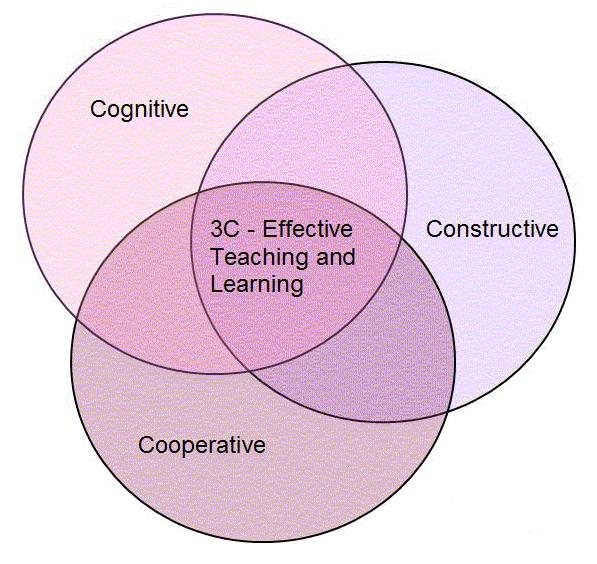
The table categories (genuineness, unconditional positive regard and empathetic understanding) are also important parts to my 3C- approach to learning and teaching.  The way I do it combines the cognitive and constructive practices in a cooperative learning environment. Cognitive practice includes helping students to learn about learning, but also become more knowledgeable of their own worldview, thinking and metacognitive skills.  Constructive learning and teaching focus on collaborative meaning-making, gaining skills and understanding concepts. Cooperative teaching and learning build the emotionally safe learning environment, where interactions are held in high value, students can ask questions and engage in non-punitive assessments that support the learning process

Cognitive, constructive and cooperative learning in a Venn diagram.

Engaging in dialogue is essential for learning because dialogue is collaborative meaning-making by nature. It is about equal participants engaging in an attempt to understand the viewpoint of other(s) and defining the meaning in the social setting. Such dialogue is about creating new understanding together, and in that sense it denotes very constructive ideas of learning. The essential condition for dialogue to happen is equality. My truth cannot be better than your truth. In a safe learning environment, where students dare to ask questions and challenge their own beliefs, dialogue can be a very powerful tool for deep learning.

The power of positive regard lies in building trust between teachers and students, which then enables the dialogue to happen. If I don’t listen what my student is saying, I am just lecturing to a captive audience, wasting my opportunity to make a difference.


—–

American Psychological Association, Coalition for Psychology in Schools and Education. (2015). Top 20 principles from psychology for pre K–12 teaching and learning. Retrieved from http:// http://www.apa.org/ed/schools/cpse/top-twenty-principles.pdf

Client-centered therapy: https://dictionary.apa.org/client-centered-therapy

Kindness indicates an ethical significane:  https://www.scu.edu/the-big-q/being-nice-vs-being-kind/

McLeod, S. A. (2014, Feb 05). Carl Rogers. Simply psychology: https://www.simplypsychology.org/carl-rogers.html

Rogers, C. (1959). A theory of therapy, personality and interpersonal relationships as developed in the client-centered framework. In (ed.) S. Koch, Psychology: A study of a science. Vol. 3: Formulations of the person and the social context. New York: McGraw Hill.


Self-efficacy for deeper learning

28 Apr

While trying to think how to best support my adult learners and help them to have stronger self-efficacy beliefs, I realized that I had to figure out the differences and similarities between efficacy and other similar concepts.

We all have an academic self-concept. Often this is an aggregated judgment of our perceived ability in an academic domain, based on our past learning performance. [1]  I am thinking of all the times when I have heard a student say that they are not good at math or languages, or that they are poor test-takers. Academic self-concept is our self-perception of our skills and competencies.  These beliefs can be either empowering or restrictive for deeper learning.

Learning achievement is firmly tied into learning dispositions, which is the way we all as students engage in and relate to the learning process. Sometimes dispositions are shrunk to the word “attitude”, which seems quite inadequate to describe all the different processes related to how we choose engage in learning experiences. Deep engagement in learning is a function of a complex combination of learners’ identities, dispositions, values, attitudes and skills [2].

The American Psychological Association uses the concept of emotional well-being to describe parts of school satisfaction and being successful in learning [3]:

The components of emotional well-being include sense of self (self-concept, self-esteem), a sense of control over oneself and one’s environment (self-efficacy, locus of control), general feelings of well-being (happiness, contentment, calm), and capacity for responding in healthy ways to everyday stresses (coping skills).

Fortunately, self-efficacy develops throughout our lives. It is not as an isolated construct, but as an important part of our development, dispositions and agency.  It seems that by focusing on strengthening learner agency, we also support other components of deep learning engagement. Students’ subjective learning experiences in the everyday classroom context are the building blocks of their academic self-images and self-efficacy beliefs.

Emphasizing and increasing learner agency is easy: listen to students and provide them with choices for deep learning engagement – no busywork! Distinguishing learning experiences from the experience of being taught is an important starting point. When students have meaningful learning experiences, this contributes to their school satisfaction, in addition to supporting their self-efficacy.

In a knowledge society learning cannot end with a graduation ceremony. It has to become a personal process of growth in order to engage with the change that constantly occurs in the modern world.  To achieve this, the role of engagement in one’s own learning cannot be overemphasized.

Fortunately, as educators we can support our students’ agency and self-efficacy beliefs. Every day and in every classroom. If we choose to do so. I hope we all do!


[1] Bong, M., & Skaalvik, E. M. (2003). Academic self-concept and self-efficacy: How different are they really?. Educational psychology review15(1), 1-40.

[2] Shum, S. B., & Crick, R. D. (2012, April). Learning dispositions and transferable competencies: pedagogy, modelling and learning analytics. In Proceedings of the 2nd international conference on learning analytics and knowledge (pp. 92-101). ACM.

[3] Coalition for Psychology in Schools and Education. (2015). Top 20 principles from psychology for preK-12 teaching and learning. American Psychological Association

Learning process and contextual wellbeing

4 Jan

My last blog post was about the importance of reflection, and how it is the best tool for anyone who wants to teach. I try to take my own advice and engage in reflection during my workdays. Supporting adult students’ learning is sometimes harder than supporting the learning of younger students. As adults we have stronger preconceptions about our learning abilities and preferences, based on the previous educational experiences. Sometimes these unwritten rules make effective learning harder.

Today I red about an amazing book and found their website: Contextual Wellbeing is such an important concept for education today! Focusing on important (instead of urgent) improves the outcomes of most processes. Learning process is no exception of this rule. Shifting focus from competitive educational model to equitable educational communities that emphasize contextual wellbeing is the challenge.

Making education better requires a systematic change, and changing focus from learning products to learning process. However, we all can make small changes in our own instructional settings and improve the learning experiences our students have. My common request for my students is that they pay forward the learner-centered education with non-punitive assessment system they have experienced. It is much harder to to change to learning- and learner-centered education if you have not experienced it. We all tend to instruct in the way we were instructed, unless we reflect on our dispositions and practices. Yet, as teachers and faculty we all can take small steps towards this direction by focusing on supporting learners autonomy, relatedness and copetency.

Supporting adult learners includes the same components of respect and compassion as all other teaching, and builds similarly on 3Cs: The cognitive learning approach combined with constructive and cooperative practices that enable effective teaching and meaningful learning.

N3C


C1 – Cognitive approach makes supporting adults’ learning easy and effective. Viewing learning as a student-centered and dynamic process where learners are active participants, it strives to understand the reasons behind behavioral patterns. Discussing values and mental models is the first step. Talking about forethought, performance control, and self-reflection helps students to improve their academic performance by learning how to self-regulate their behavior, engagement and learning. Having conversations about the hierarchy of concepts in learning material and providing support to create graphic organizes and mental models is an important part of the learning support. Establishing and resetting process goals and completion goals, as well as discussing conditional goal setting is important!

C2 – Constructive practice emphasizes the learning process and students’ need to construct their own understanding.  Interactions are the basic fabric of learning! Delivered or transmitted knowledge does not have the same emotional and intellectual value. New learning depends on prior understanding and is interpreted in the context of current understanding, not first as isolated information that is later related to existing knowledge. Constructive learning helps students to understand their own learning process and self-regulate and co-regulate their learning in the classroom and beyond. Regular feedback, self-reflection and joint reflection with respect and compassion are important! Teachers’ strong pedagogical content knowledge is a prerequisite for successful constructive practice.

C3 – Cooperative learning is about holistic engagement in the learning process. The guiding principle is to have learning-centered orientation in instruction and support. Students learn from each other and engage in collaborative meaning-making. Every student has their own strengths and areas to grow, and growth mindset is openly discussed in class. Teaching and learning become meaningful for both teacher and students, because there is no need for the power struggle when interactions are based on respect and compassion. From students’ perspective cooperative learning is about respecting the views of others and behaving responsibly while being accountable for your own learning. At best this leads to learning enjoyment, which is a prerequisite for life-long learning: why would we keep on doing something we don’t like? In 21st Century nobody can afford to stop learning.

The discussions I have with my grad students are amazing. Every day I talk with teachers who have so much passion for their work, so strong dedication for making learning better for their students, and such a drive to gain more professional knowledge.  I am privileged to support my students’ learning process by engaging in dialogue with them. Of course, there are also teachers whose goal is just to pass their courses and earn their degree by demonstrating their existing competencies, and the dialogue with these students is different. As a faculty member I respect their strategic learning approach, but also offer opportunities to engage in deeper learning discussions and support their learning process and wellbeing.

The best tool I have found for supporting adult students’ learning process and contextual wellbeing is open and honest communication.  I try to open the dialogue by listening what my students are thinking, and expanding their knowledge of curriculum, instruction and research by communicative interactions. This is what I think pedagogy and andragogy are really about: supporting students’ deeper learning in dialogue.

Self-determination and learning process

12 Aug

People are curious by nature. This curiosity is a great reason for learning something new. Sometimes, we as teachers, work against this natural flow of learning and end up in a situation where students resist learning. Here are 5 rules for avoiding this mistake:

  1. Build a classroom climate that supports learning. This can be done by engaging in frequent discussion about how subjective learning is, and how everyone learns and understands in a unique way – based on their previous knowledge and experiences. Provide choices for students to engage in learning and demonstrate their competence.
  2. Help students to choose to learn. Often students are mandated to attend school, which doesn’t create a great starting point for cooperation, however, providing opportunities for autonomy, competence and relatedness fosters engagement and motivation to learn (as argued in SDT – self determination theory). Validating students’ concerns and opinions helps to engage in open and honest communications. Students are in your class to learn. You are there to help them to learn. You didn’t mandate them to attend school. Try to step away from the power struggle of why, to making the classtime as meaningful as possible.
  3. Avoid rewards and punishments. They reduce the intrinsic motivation to learn and point students’ focus towards getting a reward or avoiding a punishment. All time and effort placed in creating a fair rewarding system is time away from the most important thing in classroom: learning. External regulation leads to external locus of control – and what we really want is for students to become self-regulated learners.
  4. Emphasize cooperation. Learning doesn’t happen in a vacuum, it is situational and contextual, which only emphasizes the importance of the rule number 1. Plan for plenty of students’ talking in your lessons. Students learn from each other, and sometimes it is easier for them to understand a concept when another student explains it, just because their vocabulary is similar (as academics we often have lots of teaching jargon in our sentences).
  5. Recognize competence and help the student to move forward. Everyone is on their own learning path, therefore expecting all students to have exactly the same competence is foolish. Provide feedback to influence the outcomes of students’ learning actions towards meaningful growth – this is the essence of Growth Mindset! “Effective teachers who actually have classrooms full of children with a growth mindset are always supporting children’s learning strategies and showing how strategies created that success.” [1]

Self-determination theory discusses motivation, emotion and development. Intrinsic motivation (e.g. doing something because we are interested in doing it) is much stronger predictor for future educational success than extrinsic motivation, which is associated with surface and strategic learning approaches.  The three principles in SDT are:

  • Autonomy – have choices and be an agent of one’s own life and learning
  • Competence – reach goals and move towards meaningful growth
  • Relatedness – connect and interact with others

These are basic human needs. Providing ample opportunities for students to choose, grow and relate – every day, in every class – makes learning easier and teaching more successful.


References:

[1] Niemiec, C. P., & Ryan, R. M. (2009). Autonomy, competence, and relatedness in the classroom: Applying self-determination theory to educational practice. School Field7(2), 133-144.

[2] Zimmerman, B. J. (2013). From cognitive modeling to self-regulation: A social cognitive career path. Educational psychologist48(3), 135-147.  Available at researchgate.

[3] Dr. Dweck, 2016,  in an interview with Christine Gross-Loh  https://www.theatlantic.com/education/archive/2016/12/how-praise-became-a-consolation-prize/510845/

Why choices are SO important for learning process

14 Jun


While doing my research about learner agency, I interviewed high school seniors about their learning experiences. Students’ common perception regarding learner agency was that they do not have enough choices to engage in their learning during their school days. This makes no sense! Students must learn how to make good choices during their K-12 experiences. That is a major part of human development.

So why don’t we offer enough choices in classroom?

I believe there are many answers to this question. The first that comes to mind is scary: we teach the way we were taught. There is a great chance for behaviorism being the predominant learning theory used in that classroom.  Yet, it is generally accepted that intrinsic motivation is important for successful learning [1]. Trying to build effective instruction is very hard, if we keep on ignoring what research shows about teaching and learning!

Teachers who have experimented with letting students decide which tasks they would work on in the classroom report results of students finishing more tasks and being more engaged. Furthermore, we have decades of educational research about benefits of learner-centered classroom practices being superior to operant conditioning and rote memorization. Students need autonomy to build critical and creative thinking skills that will enable them to practice perspective-taking as a part of their everyday learning experiences [2]. Having choices allows students to perceive that they have control over their own learning – which makes the work they put in to feel a little less of a requirement and a little more personally rewarding.

The other possibility for choices missing from the classroom is that providing choices can be intimidating for the teacher:  it changes the power structure in classroom and shifts some of the responsibility from teacher to the students.

Especially accountability-based educational models tend to vest the power to teachers instead of students, and keep on focusing on instructional effectiveness instead of individual learning process. Often the effectiveness is measured with standardized tests, which easily leads “teaching to the test”, and only measuring the end result of instruction. Yet, even in such educational environment it is possible to embed choices into classroom practices and support students’ interest in learning – which ultimately improves the test scores. This is not a quick fix. But changing the approach to embed individual choices for students is supported by contemporary research finding curiosity being associated with academic achievement [3].

Third common reson for missing choices is the missing vertical alignment from one grade to the next one. Most often in this situation students have less autonomy than their developmental age and stage require. It is logical that kindergarteners need different rules nad less independence than 6 graders or high school students.

In such case students’ developmental stage and classroom environment are incompatible. The theory of stage-environment fit [4] describes the conflict between increased need for learner autonomy (during adolescence) and a rigid learning environment. This can be avoided by helping teachers to collaborate and work together to build a continuum from one grade level to another. Supporting this vertical alignment is important both for the curriculum, so that teachers know what happens in other grade levels, but also for plannig the gradual release of student autonomy throughout school years.

The fourth reason for missing choices stems from viewing students as a group instead of individuals.

I understand, and know from my own experience, how hard it can be to make the learning experience personal for each individual student. But, when we apply the one-size-fits-all approach in instruction based on students’ chronological age, we are grossly ignoring their personal characteristics. Some students are more mature than others. Certainly there are milestones in development, some of those built into legislation, like getting your dricers license. What has always surprised me is the lack of autonomy in classroom for students who get to drive their own cars! I would rather see students learning to make good choices in the classroom than behind the wheel. Optimal level of structure and choices in classroom increases meaningful learning experiences and teacher-student interactions.

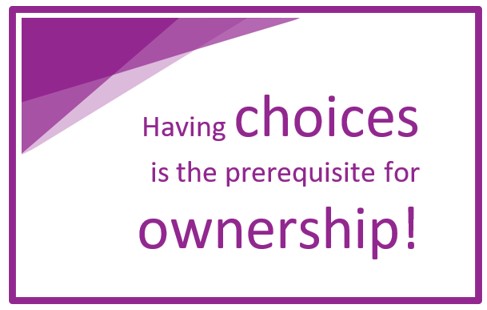
Having choices is the prerequisite for ownership.

Self-determination is part of being a human [5]. We can see that in toddlers who suddenly disagree with everything. When my 4 kids were young and exhibited very stroing will, I tried to remind myself how great it is that they know what they want, because that is such an important step in development.  🙂  Self-determination relates directly to intrinsic motivation (here is an image of the continuum).  Students tend to learn better when they are intrinsically interested in their studies, hence the need to provide autonomy and choices within the classroom structure. When students have choices they have lesser need to rebel against learning. And, quite frankly, students more often rebel against teaching than learning. During the K-12 students are still in the age where they are learning everything, all the time – and using what they learn to build their worldviews. School is –or shouldn’t be – an exception of this!

Learning to make good choices is one of the very important parts of growing up. As teachers we cannot step back and think that our everyday interactions with students wouldn’t matter in the way they perceive their ability of making good choices. Like everything else in the maturation process, choosing is a skill that can and must be practiced and learned. But, we cannot punish students harshly for the mistakes they make during learning, because that will stop their interest of engaging in their own learning process. Therefore, it is important to use a non-punitive assessment system that supports learning and trying to learn.

Encouraging and empowering students to learn more on their own can create trajectories where classroom learning is extended to students’ lives outside of the formal education. Being interested in one’s own learning is crucially important for deeper learning!


[1] Patall, E. A., Cooper, H., & Robinson, J. C. (2008). The effects of choice on intrinsic motivation and related outcomes: a meta-analysis of research findings. Psychological bulletin134(2), 270.

[2]  American Psychological Association. Coalition for Psychology in Schools and Education.(2015). Top 20 principles from psychology for preK–12 teaching and learninghttps://www.apa.org/ed/schools/teaching-learning/top-twenty-principles.pdf

[3] Shah, P.E., Weeks, H.M. Richrds, B & Kaciroti, N.(2018) Early childhood curiosity and kindergarten reading and math academic achievement. Pediatric Research doi:10.1038/s41390-018-0039-3

[4] Eccles, J. S., Midgley, C., Wigfield, A., Buchanan, C. M., Reuman, D., Flanagan, C., & Mac Iver, D. (1993). Development during adolescence: The impact of stage-environment fit on young adolescents’ experiences in schools and in families. American psychologist48(2), 90.  and   Bollmer, J., Cronin, R., Brauen, M., Howell, B., Fletcher, P., & Gonin, R. (2016). stage–environment fit theory. AZ of Transitions, 160.

[5] Deci, E. L., & Ryan, R. M. (2000). The” what” and” why” of goal pursuits: Human needs and the self-determination of behavior. Psychological inquiry11(4), 227-268.

Deep learning for teachers

4 Nov


It easier to teach something you have experienced firsthand. This is why teachers’ learning should reflect the ways we wish their students to learn. Instruction is situated in one’s own experiences.

I am not talking about activities in professional development, but those same elements that provide deeper learning experiences for students in classroom:

  • focusing on transferable understanding,
  • providing opportunities to reflect,
  • relating new information to previous knowledge, and
  • bridging theory with practice.

Truly focusing on life-long learning.

Teachers as learning professionals still need occasional reminders about how to support their own learning process, because in the professional world the expectations for showing competence by generating learning products (evidence, projects, artifacts, exams, etc.) sometimes take over the deep learning process, and thinking about how learning really happens, and how it can be supported on personal level. Knowledge of metacognitive skills is an essential tool for anyone who wants to teach.

Metacognitive awareness includes the knowledge and perceptions we have about ourselves, understanding the requirements and processes of completing learning tasks, and knowledge of strategies that can be used for learning.  Teaching metacognitive knowledge and skills is an important part of supporting deep learning. We as teachers should have extensive knowledge and skill to embed metacognitive strategies into our everyday practices.

Just like classroom learning experiences, also teacher learning should be designed to support self-regulated learning (SRL) practices.  SRL refers to students’ cognitive-constructive skills and empowering independent learning, focusing on strengthening the thoughts, feelings and actions that are used to reach personal goals (Zimmerman, 2000). This approach aligns well with the research of adult learning, which highlights the use of constructive-developmental theories (e.g. Mezirow, 2000; Jarvis, 2009; Stewart & Wolodko, 2016).

Supporting students’ SRL becomes easier to embed into instruction when we have first practiced in our own learning. This cannot be achieved by following a script or curriculum book, but situating the knowledge of pedagogy in classroom practice.

Using SRL as a chosen approach in professional development or other learning opportunities helps to recognize our own fundamental beliefs about learning. These beliefs, that either help or hurt learning process, are always present in both teaching and learning situations.

Following the three steps of SRL helps us to approach learning tasks within their context, and first create a functional plan and choose learning strategies to support learning process. Then, we will want to monitor our own performance and learning process during the second part, performance phase. This is where the knowledge of deep learning strategies is very important, because sometimes instruction and design reward surface processes, and we might want to change our strategies to still engage in deep learning. In the third phase, self-reflection, is the most important one, but often forgotten. Without engaging in self-assessment about our own learning process, it would be hard to do things differently next time, if needed. Yet, the whole idea of using metacognitive knowledge to improve deep learning relies in dealing with our own perception and managing our emotional responses, so that our beliefs about deep learning are strengthened. Some beliefs are detrimental for deep learning, and for example mentally punishing ourselves (for failure, procrastination, etc.) leads toward using surface learning processes.

Instructional approaches that emphasize choice, learning ownership, knowledge construction, and making connections are more likely to facilitate deep learning and understanding – for teachers and students alike.


Here is more information about SRL for adult online learners  in a PDF form.


Jarvis, P. (2009). Learning to be a person in society. In K. Illeris (Ed.) Contemporary theories of learning: learning theorists… in their own words. London: Routledge.

Mezirow, J. (2000). Learning as Transformation: Critical Perspectives on a Theory in Progress. The Jossey-Bass Higher and Adult Education Series. San Francisco: Jossey-Bass

Stewart, C., & Wolodko, B. (2016). University Educator Mindsets: How Might Adult Constructive‐Developmental Theory Support Design of Adaptive Learning?. Mind, Brain, and Education10(4), 247-255.

Zimmerman, B. J. (2000). Attaining self-regulated learning: a social-cognitive
perspective, in M. Boekaerts, P. Pintrich, and M. Zeidner (Eds.) Handbook of Self-regulation (pp. 13–39). San Diego, CA: Academic Press.


Praise and punishment – two sides of control

17 Nov

It is surprising how often people, who think punishments to be detrimental for learning, still approve praise as an effective tool in education.  How is this possible? Both are based on the concept of superiority and having control over other human beings. Often this power is just artificial authority. Please understand that I am not against classroom management, just the behaviorist regime of it! Using SEL (social-emotional learning) and ensuring student-centered management practices is important!

I know this may sound like semantics, but hear me out! Praise always carries a value judgment, an evaluation, and is based on our personal/professional opinion. Encouragement in the form of feedback is non-judgmental. It points out facts. And in education we want to point out all the things students have learned because we have names for them and also know the big picture of how competencies relate to each other. We know what students need to learn to be successful. Hence: no praise, just facts, please. Alfie Kohn has written much about this!

My current position as a mentor for graduate students pursuing their M.Ed. degrees is delightful: I spend my days supporting my students’ understanding and learning process, but I don’t have to be a gatekeeper (and I don’t have to do any grading, yay!). Mentoring requires a specific disposition: the belief that everyone can learn, and that learning cannot be enhanced by praise and punishment. Now, please don’t get me wrong. Performance can be increased (up to a point) by praising and punishing and pushing students to complete their products, but engaging in one’s own learning process and deeper learning requires self-regulation and self-reflection. We can lead students to that path but we cannot force them to walk it. External control cannot help students forward in the path to self-transformation.

I do remember the time when I still believed in praise and punishment.  I am sure my children remember that, too. And for that I want to apologize to them, wishing that I knew more about learning and development when they were young. Fortunately it is never too later for additional development.  Kegan and Drago-Severson have an excellent framework of adult development.

It hurts my ears when I hear someone talk about praise and growth mindset in the same sentence. The two could not possibly fit together. Praising someone means that they have met an invisible standard, for which we want to extend our approvals as superiors. Rewards and gold stars are just a tangible form of praise. Growth mindset carries the same notion of self-transformation as engaging in the personal learning process. As educators it is important to offer timely feedback for students about their learning. However, praise and feedback should not be mixed. Feedback focuses on the achievement and based on transparent criterion of expectations. Praise is based on hidden expectations or personal opinions. It is a value judgement about the behavior or qualities of another human being.

Every educational institution has their own hidden curriculum – the expectations that are not voiced or written. Often these appear in the form of practices and traditions. Hidden objectives are the hardest to meet. A common coping mechanism to meet hidden expectations is the attempt of pleasing the person at control – whether teacher, professor, boss, or anyone else in the position of power. The damage for the organization gets doubled: the person in control only hears the voice of pleasers and cheerleaders, and the structure becomes skewed with the lack of open and honest dialogue. This can easily lead to cliques in classroom (or workplace) and decreased collaboration.

Those who remember Berne’s Transactional Analysis (TA) will probably recognize the roles of Parent and Child in the praise and punishment situations.  Engaging in dialogue on Adult-Adult level is the most important tool for every educator. Students often fall into the trap of playing the child role, especially if their learning process gets reduced to creating learning products that may have no real-life connections, and if they often face praise and punishments in their learning environment. This can happen to adult students too, especially when their learning motivation is externalized. On the positive side it is fascinating to observe young children to behave with maturity above their years when the human dignity is extended to them and they are offered opportunities to self-regulate.