Tag Archives: SEL

Instruction that supports learning process

30 Apr

Education is about looking both into the past and into the future, which is why it also has two opposite purposes: to ensure cultural progression and to prepare students for their unknown future.

Cultural progression is necessary for societies to have members who will know about the past (history) and the traditions (culture), but emphasizing the traditional ways of doing things may cause difficulties for students to learn for the future. Yet, not knowing the history could cause us to repeat the mistakes of the past generations. For anyone engaging in instruction this is just one of the many dichotomies of the teaching-learning situation. Finding balance is important because both past and future are necessary in understanding the process.

Modern educational theory and practice are built on the premise of education being the process for students to “develop their rational faculties so that they become capable of independent judgement”(1). This requires for students to engage in three-dimensional learning process and grow their skills, knowledge and understanding.

It is important for every teacher to know the values and ideas behind the instructional practice they use in helping students to learn. I tend to move towards the humanist worldview of learning and teaching, where knowledge is seen subjectively constructed.  I have hard time believing in knowledge being measurable, objective or free of values. Data can be that, and some information may be objective, but those only become knowledge when they have been processed through our own experiences and understanding, i.e. personally constructed during the learning process.


Humanist vs Mechanist

Also, learning can be so much more than just a change in one’s behaviour,  as it is seen in the mechanist worldview! To fully support the learning process, and to improve students’ academic performance, it is important to combine all three teaching paradigms in the humanist worldview.

The way I do it combines the cognitive and constructive practices in a cooperative learning environment. Cognitive practice includes helping students to learn about learning, but also becoming more knowledgeable of their own worldview, thinking and metacognitive skills.  Constructive learning and teaching  focus on collaborative meaning-making, gaining skills and understanding concepts. Cooperative teaching and learning build the emotionally safe learning environment, where interactions are held in high value, students can ask questions and engage in non-punitive assessments that support the learning process.
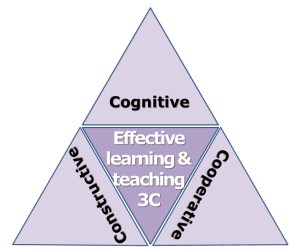
3C triangle

Instruction that supports the learning process helps students to become skillful and nimble life-long learners. Skillful learners understand the past and are able to reflect on their own learning, but they are also able to adjust their knowledge to meet the requirements of the future.


________________________________________________

[1] Biesta, G., & Tedder, M. (2006). How is agency possible? Towards an ecological understanding of agency-as-achievement. University of Exeter School of Education and Lifelong Learning, Working Paper, 5.

Engaging students in learning, not just schooling

9 Sep

Learning is such a fascinating thing! It happens everywhere, all the time, but in the school settings we are trying to somehow box it in, so that the objectives are met and standards covered. Yet, despite of the standardized approach, each and every student has a different experience of the very same class or lesson.

In any given lesson or class, some students are engaged in their own learning process because they are inherently interested in the topic.  Other students may just be attending to get it over with. These are the students we are losing, because they are only engaging in their schooling, not in their personal learning. The biggest question is: how to help all students to engage in their own learning?  One obvious answer is to make learning more personally enjoyable. Individual instruction is inclusive by its nature, and built from appreciation for diverse identities, dispositions, values, attitudes and skills. Finding space for all these in the classroom is challenging! But one size can never fit all! Providing choices for students is an excellent tool for emphasizing the learning process, because it allows students to apply their personal preferences, which most likely results in increased interest in the activity at hands.

The learning process has two components that must be integrated for deep learning to happen: interaction (with the materials and peers) and elaboration of the content [1].  A successful integration of content and interaction leads to personal construction of understanding, i.e. deep learning, because the student has situated the new knowledge into her/his existing understanding.  Another student, who is just engaged in schooling not learning, may miss out the both components, and just be physically present in the classroom while being mentally and emotionally elsewhere. Yet in today’s world, more than ever before, we must help students to become lifelong learners, who learn because they can and want to, not because someone tells them to do so.

Here is a list of 15 steps to cultivate lifelong learning in our own lives. As teachers we of course want to walk our talk. Right? So keeping on learning and checking our assumptions are very inmportant daily activities! They are also part of the SEL – Social Emotional Learning. Read more about it here:  CASEL 

In addition to the two components of learning process (interaction and elaboration), we also want to think about the dimensions of cognition, emotion and environment [2], because they create the frames of each individual learning experience.  In school settings the focus of learning is too often very narrow, and only aims to transfer the content knowledge. But the way we acquire the content  has a straightforward effect on how durable the resulted learning is. Shallow learning aims to passing the class or just getting out of it. Deep learning aims for understanding, and using the learned content in the future. What is problematic, is strategic learning, which aims to have good grades, without any interest in the content itself. This creates the phenomenon we know as summer learning loss.

My own application of this learning theory is to use the 3Cs that help students to engage in their own learning. Students’ learning motivation is based on their perceptions of learning and education in general, so it would be very shortsighted to aim for plain knowledge acquisition, and only focus on one of the three dimensions of learning.  The successful learning motivation seems to require all three dimensions: cognition, emotion and environment.

3C-framework is built on cooperation, and uses constructive and cognitive instructional approaches.

Cooperative foundation – to create the learning environment and guide students’ behaviors, discuss the classroom management decisions and help students engage in meeting their learning goals.  Every child is born with the intrinsic need to make sense of the world. This is why students WANT to learn even though they don’t know what they should learn. We have a better idea what they need, which is why we use curriculum, to have meaningful entities for explorations.

Constructive tools – to focus on supporting students’ learning process and create the real-life connections needed for deeper learning. This also helps learning  to become more meaningful and increases students’ motivation to learn the information we are offering. Remember to emphasize knowledge to be something that is internally constructed and situated in one’s existing knowledge structure. Students’ self-awareness (one of the SEL competencies) is an important part of their knowledge construction!

Cognitive approach – to create the foundation for deeper learning because students’ thinking needs to change – not just their behaviour. Metacognition is an integral part of learning. As teachers we also want to engage in modeling learning, so discussing our own thinking, learning experiences and struggles are important parts of building that sense of neverending learning.

As a teacher trainer I have discussions with my students about their own motivation to learn. For adults it of course is also related to external rewards – usually masters degree gives a nice increase in the salary.   But most of my teachers really want to learn more about learning and teaching. I believe that as professional educators we recognize the need to support personalized learning in the classroom.

[1] Illeris, K. (2004). Transformative learning in the perspective of a comprehensive learning theory. Journal of Transformative Education2(2), 79-89.

[2] Illeris, K. (Ed.). (2009). Contemporary theories of learning: learning theorists… in their own words. Routledge.

Is Learning a Product or Process – part 2

27 Feb

Best teacher is the one who makes herself unnecessary by

empowering students to become autonomous learners.

~Nina Smith

When learning is seen as a product, the emphasis of the learning-teaching interaction is in instruction – and the thinking behind comes from the idea of students only learning when the teacher is instructing them, and only what they have been taught.  The reality is different, as any curriculum leader can tell you. At any given moment of time any given classroom has several ongoing curricula: intended, written, taught, actualized, learned, etc., so we cannot simply look at the learning product.  This product may be a paper, worksheet, notes, homework, essay, grade, etc., that we use to measure the results of students’ learning.

Emphasizing learning products makes mistakes very undesirable phenomena in the classroom – after all a perfect product is the goal, right?  And often the grade only reflects the finished learning product, without paying attention to how the student got there.  Maybe s/he already knew the content or had the skill, and didn’t have to study  or practice at all?  If we pay too much attention to the product, we may miss the important part of the learning-teaching interaction: the individual students’ main gain,  her/his increase in knowledge/understanding/skills that has happened as the result of instruction.

Now, very seriously: which one is more important to you? What your students know/can do — or how much they improve in what they know/can do? 

There is a big difference.

Improving what students know/can do inevitably leads to different end results, because each student has her/his own starting point. And this improvement, the increase, of course, IS the result of the individual learning process of each student.  This is also why helping students to become independent learners is so important.

Independent learners tend to automatically (or by learned habits) engage in their own learning process.  While observing these students we can see them intentionally influencing their own learning behaviours, and Bandura  (2006, p.164-165) described the four following components in their engagement: the intentionality of their learning, the forethought of their actions, their self-reactiveness and self-reflectiveness. Of course, to be able to do all this, students must have certain amount of freedom in the classroom, which is why I am so fervently advocating for providing more choices in classrooms. Choosing is a skill that can (and should) be taught and learned, and it only grows when students have ample opportunities to try choosing in an emotionally safe learning environment, where mistakes are not only allowed but celebrated.

Just imagine how much more these students learn! They don’t need the teacher to motivate or engage them, because they are already “in the zone”. In the classroom these components apply straightforwardly to students’ engagement as intentional learning activity, and learning motivation and goal-setting as their forethought. Meta-cognitive knowledge is about knowing and understanding how I learn, knowing what is easy and what is hard for me, and where do I need to put in extra effort in learning. Independent learners, who engage in their own learning process already know these things. Wouldn’t it be important to help every student to possess this knowledge of themselves?

The third component in independent learning, self-reactiveness, relates to the way students control their own learning actions and regulate their own behaviour in classroom. As a teacher it is important for me to ask myself, how can I support my students’ self-regulation and  provide more autonomy for them. When students get to regulate their own learning process (pace, depth, breaks, note-taking, collaboration, additional information, etc) also the learning results, the visible and tangible products of learning, do improve.

Maybe the easiest way to support students’ learning process is to provide accurate and timely feedback. This strengthens the fourth component of independent learning, student self-reflection,  which is too often overlooked.  Feedback has been statistically identified as one of the  important teaching-learning factors (Hattie & Timperley, 2007), because it enhances both the learning process and the product we get as an end result of successful learning. Students self-evaluation is an important classroom practice, because it combines feedback and self-reflection.

To me it seems that too strong focus on the learning product leads to shallow learning (to just get by), and strategic learners  (to just get a good grade) instead of deep learning.  While independent students may have strategies to cope in product centered learning environment, the dependent students may not have a clue what they should do, or how they are supposed to do it – which further decreases their learning motivation.

Focusing on the learning process emphasizes the students’ responsibility in the learning-teaching interaction. It both enables and encourages students to engage in their own learning. This engagement helps both students and teachers to build learning up from standards and to achieve competencies needed in our modern world.


Bandura, A. (2006). Toward a psychology of human agency. Perspectives on psychological science1(2), 164-180.

Hattie, J., & Timperley, H. (2007). The power of feedback. Review of educational research77(1), 81-112.

Emotionally Safe Learning Environment

28 Dec

Student-centered and emotionally safe pedagogy is an attitude.  It is not a handbook of tips and tricks, to help us survive our days.  It is being physically and emotionally present when the student needs us. It is also thinking more about the process than the product. And in these classrooms the focus is in creating, not copying, no matter what the task is – this applies to art as well as note taking!

Emotionally safe classrooms are flexible by their nature and they have rules that are consistent and justified. Ordering other people arbitrarily around is only a way to show your power over them.  Being considerate is generally understood as a virtue, and showing the same politeness to children does not go without rewards. Treating students as individual human beings sounds like basic courtesy to me.

The central values of safety, co-operation, individuality, responsibility and building of realistic self image together create the foundation for an emotionally safe learning environment.  Most often these values are expressed in the classrooms and discussed with the students.  Ideally the wording of the rules is co-operationally created, and confirmed with the signatures of the teacher and students, and then posted on the wall for further reference.

Stress-free atmosphere is the first principle for creating an emotionally safe growing and learning environment. Creating the feeling of having enough time enables students to focus on their own learning instead of external factors that might disturb their concentration.  Knowing that their thoughts and ideas are valued helps students think and express their thoughts more freely. More thinking equals more learning.

The one situation when most of us feel threatened or unsafe is while we are receiving feedback.  In an emotionally safe classroom the feedback becomes a natural part of the learning process, and thus stops being scary.  While utilizing students’ daily self-evaluation and teacher’s verbal comments, the feedback system actually becomes a tool for the students to control their own learning.  This system also automatically holds students accountable for their own learning and helps them realize how much they already have learned.