One could say that a teacher’s job is never done, but I would like to politely disagree. I believe this depends on how we define “teaching” and “teacher’s work“. Full confession: I work in higher education, been doing that for more than a decade – and I love is SO much! In that sense I agree that we absolutely need teachers, and we as teachers (in any given level of education) have so much work to do. But…
My very strong educational belief is that our first duty is to help our students to learn how to learn. I know, this is kind of a “teaching philosophy statement”. And it is. But in our current reality it also is so much more! When students are able to support and self-regulate their own learning, the hardest part of out work has been done. Yes, there is still content to cover and assessments to use to measure learning, but equipping people to steer their own learning is the most important quest ever! Simply because the skills of life-long learning [1] carry on years and decades after we have met the student.
Helping every student to have a strong Learner Agency is my favorite tool. I love Bandura’s theory about agency [1] because with the four components it is so relatable: we all need intentionality, forethought, self-reactiveness and self-reflectiveness to guide our learning process. Therefore, learning how to help and support our own learning is the crucial quest for all humans.
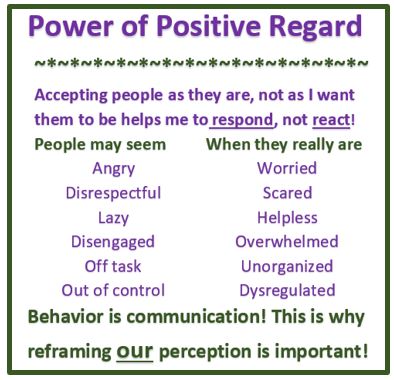
As teachers, how can we make this happen? We make sure that our students have choices! Apart from classroom teaching (or teaching online or in higher ed) I believe we have ample opportunities to support other people in our everyday encounters and encourage them to learn more. We can choose to support people agency – instead of pushing too rigid rules – and help people to enjoy learning new things! For years I have purposefully used Positive Regard so that I can choose to reframe my perception!
We can choose to volunteer in our communities to help others to learn. My current favorite is volunteering to support local resilience project to increase the awareness of ACEs (adverse childhood experiences) [2] and how to mitigate those with Trauma-Informed Practices [3], helping our local agencies to use the same language to discuss trauma, and foster resiliency of all our residents.
How do you want to use your expertise to support your students and your community?
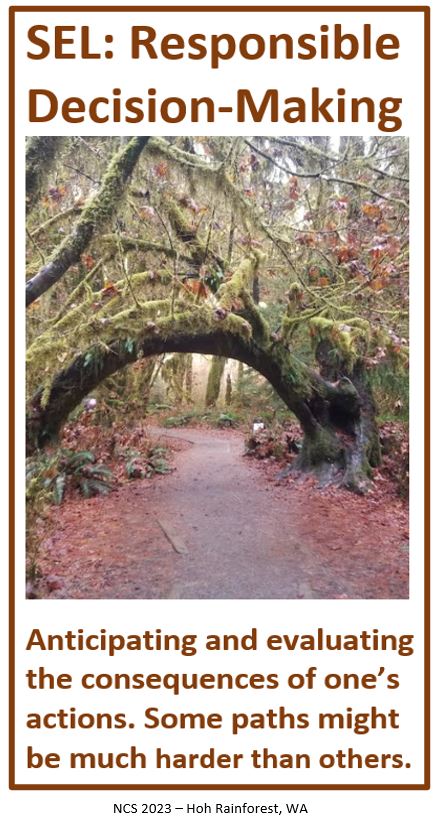
My students are teachers and instructors earning their M.Ed. degrees. I discuss adult SEL every day in my calls with my students to support their learner agency, and also share SEL images in my emails to students. I do this to ensure we are creating a safe learning environment – because we all need that safety to practice responsible decision-making. And truly effective teaching that supports students’ deep learning (not just shallow memorization of facts until passing the test) requires using all three main learning theories – cognitive, constructive and cooperative.
Adult SEL is an integral part of human development – and the day when we stop learning is also the day when we need to stop teaching. Simply because education is an ever-evolving profession, and we need to adjust to the change. I am not talking about “learning a new curriculum”, but how support students’ individual learning. The first part is checking our own assumptions so that we can respond to students’ needs instead of just reacting to their behaviors. This is not always easy to learn! Yet, today when we know so much more about Adverse Childhood Experiences (ACEs) [1] we also understand that students need help in managing their need and emotions. This is also why I believe that learning about Trauma-Informed Practices (TIP) [2] is extremely helpful for teachers, instructors, and educators in all capacities.
Learning to use Positive Regard is easier when our Adult SEL competencies increase. While Relationship skills are essential for being a teacher, the two other important competencies for responding to the needs are self-awareness and self-management – because misbehavior can seriously push our buttons, and we all know that sometimes students are (malevolently) smart to do exactly that! It can become almost like a game – we could call it the “who can derail the teacher from teaching the intended lesson” – game.
When teachers’ adult SEL needs are supported, the whole school community gets enhanced. Simply because we cannot support students if we as professionals are not learning about the toolkit we can use – and I am talking about the the “toolkit” in a broad sense, because different environments, different populations and even different curricula may require different tools. This is the situational aspect of teacher PD (and the reason why “canned” solutions seldom work). Teaching is always, ALWAYS situational and contextual.
If your district is not providing Adult SEL as a PD option, please consider focusing on Adult SEL in your PLN (Professional Learning Network) or PLC (Professional Learning Community)! There is a great Linked In group “Teachers who Coach” with a wealth of information about helpful teaching strategies to build connections with students!
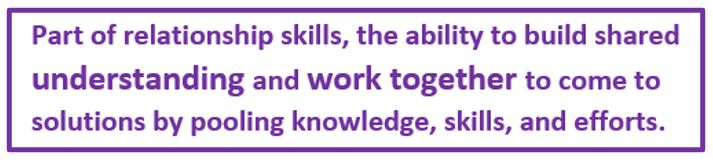
Collaborative problem-solving (CPS) is an important #SEL relationship skill we start learning during early childhood while learning to play with others and share our toys, and later the same skill is also used in scientific problem-solving. The first step to support collaboration is to help participants self-regulate – just because we cannot use higher-order thinking while upset or distracted. #traumainformed I am sure we all have witnessed some melt-downs in playgrounds.
For us adults the collaborative problem solving often means having to learn how to respond, instead of reacting to the situation or behavior – otherwise we are not collaborating, but directing or explaining. Learning the skill of choosing our responses matches the definition of resilience: “the process and outcome of successfully adapting to difficult or challenging situations”[1]. As educators we face these situations every day. To support students’ learning process, it is important to discuss why and how we collaborate and the benefits of learning from each other. The SEL competencies of self-awareness and self-management are priceless skills for anyone who wants to teach.
This is the CASEL definition for Collaborative Problem-Solvingas a component of Transformative SEL #tSEL which means adults and students collaborating and learning from each other.
The other parts of Transformative SEL are Identity, Agency, Belonging and Curiosity to build “strong, respectful, and lasting relationships to engage in co-learning” [2] The learning process begins by starting a new path – trying something new or different. Often our curricula dictates the directions and outcomes of learning, yet in an emotionally safe learning environment they can reach the goal. We as educators, embark on learning paths to increase out competencies and to learn something new. And at this point I need to state this very clearly: learning is a different experience from being taught something – it really is a process, not product.
Collaborating and helping others to self-regulate to support their learning process is not always easy. And, quite honestly, learning to help myself to self-regulate has been a long journey, and there are still times when I need to remind myself to take a breath and make sure that I am self-regulated before I respond. Most of the self-management happens outside of our work hours because we all have very personal needs. I have always known that walking on the beach makes me feel better. Now I also know why, and can use it to manage my stress, which then enables me to engage in collaboration with others on the following day.
Collaborating with others to solve a problem is an important 21st century life skill – we are not likely to be successful in our relationships without it. In workplace communication and collaboration skills are important to avoid interpersonal conflicts and keep teams functional. Being able to gather the information related to the problem, use visuals to represent the problem, device a strategy to solve it and complete it together, while reacting appropriately to feedback during the process is one way to measure it. PISA introduced a CPS assessment in 2015 [4].
Fortunately, we often have daily opportunities for honing our CPS skills – these may be present at work, or with family and friends. We just need to choose to start the learning path and see where it takes us.
(It is not the visually appealing design or charisma of the teacher/instructor, even though both of these can make learning experiences nicer.)
The answer lies in the “a-ha!!” moment when we realize something new and connect the dots. This is the magical ingredient that makes learning meaningful by combining the cognitive understanding with an emotional awareness (SEL – identifying personal assets and emotions).
Now, how to lead more students into these a-ha!! moments – this is the realquestion we need to ask. And part of the answer is that one size can never fit all. To me, this makes teaching such a wonderful profession! Every day is a discovery day to understand how to support an individual student. We are trusted with great responsibility! However, being a teacher is not easy. Especially when mandated to “teach to the test” or “cover so and so much of curricula” – because these expectations have very little to do with learning. They are only focusing on teaching – and every teacher knows that what is taught is not necessarily learned!
Learning and teaching are two different things. They are two different processes that are often put into the same frame of reference (education) and sometimes even happen in the same physical or virtual space (classroom). Sometime we think that students are not motivated to learn new things, but this is a huge misconception! Children are natural born learners; it is our ultimate survival skill. But – for a variety of different reasons – we may not enjoy the experience of being taught.
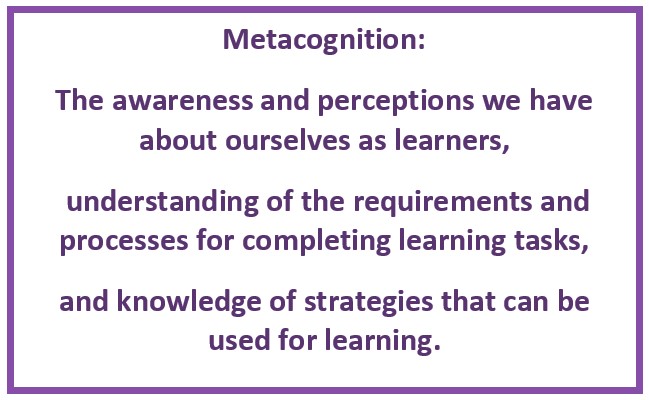
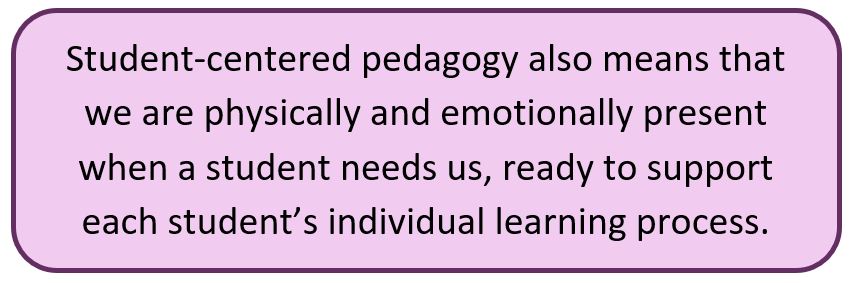
When learning is seen as an in-built force within your students, the teaching job became easier. By becoming a facilitator for learning and guiding students to build their own knowledge, the teacher has taken a huge step towards supporting learners’ agency and autonomy. Starting with learning outcomes (what students will be able to know or do) we choose the information needed and plan for a selection of activities and assessments to help our students to learn what is needed. Then we add support for metacognition and a selection of recommended learning strategies.
With current technology this can be very easy to do! Lecturing is unnecessary as we have countless (better) ways for providing the information and concepts for students (books, videos, podcasts, walkthroughs, glossaries, wikis, etc.). The most important part of instruction is to share useful frameworks with learners to help them understand the context and connections (within the topic and its’ relations to other learning). These connections are vitally important, because learning process starts with external interactions and is completed with internal elaboration. [1] Learning facilitation means exactly this: supporting each student’s individual learning process and providing choices (within pedagogically/andragogically appropriate boundaries) for constructing their own understanding. Metacognitive skills are crucial tools for everyone because:
it really is about reflecting higher order learning (often described as critical thinking and problem solving)
we need the ability to monitor and regulate our own learning
in information societies learning cannot stop in graduation
Another important part of experiencing a meaningful learning experience comes from getting support when needed – not for finding the correct answers, but for strengthening our individual learning processes. While we all learn in the similar way by interacting with environment and then internally elaborating to make sense of the new information and fit into our own existing knowledge structures, we also have individual differences like the quality and amount of our previous knowledge. Understanding and supporting these personal processes [2] is the key to fostering lifle-long learning, which is why teachers need to be proficient with both SEL and Trauma-Informed Practices.
Making sure that we focus on learning as an individual process makes it possible to keep on supporting students throughout k12 education and beyond. To take this one step further, remember: Truly learner-centered experiences are designed with students, acknowledging their previous knowledge, and providing different learning modalities and assessments to choose from. Here is more about learner-centered design, which obviously makes learning engagement much more meaningful for participants. APA (American Psychological Association) has this great resource about creating meaningful learning experiences!
After SO many years in education, my favorite question still is: “How can I support your learning today?”
[1] Illeris, K. (2003). Towards a contemporary and comprehensive theory of learning. International journal of lifelong education, 22(4), 396-406.
[2] Bransford, J. D., Brown, A. L., & Cocking, R. R. (2000). How people learn: Brain, mind, experience, and school. Washington, D.C.: National Academies Press
I was re-re-reading one of my very favorite education books: Contemporary Theories of Learning (Illeris, 2018) and thinking about how to support all different learners. Obviously, we must provide experiences that meet the needs of our learners and helps them to learn. But how do we actually learn? What does the learning process look like? How do we make sense of all the data and information surrounding us? For clarity, I like to use the definition of learning as a two-step progression containing the processes of external interaction and internal elaboration. [1] Interacting with data is just the first step in the learning process, gathering the information. The second step, elaboration, transforms the information to become a part of our personal knowledge structure.
Exactly how do we react to the bits of data in our environment and change it to become information that can be stored in our minds? In early learning this is easy to observe – young children actively try to make sense of the surrounding world. They are accumulating new words and concepts with a remarkable pace! Their intrinsic motivation to learn is a continuous source of inspiration, and I often wish we as adults could approach new things with the same amazing curiosity. When we organize the information, we are constructing our own knowledge – which sometimes is accurate, but most often needs some fine-tuning. This elaboration part is exactly why we need educators to provide some structural support. Otherwise, we might still call every four-legged animal a dog. A very important part of instruction (in any level of education) is helping students to understand the connections for new information and showing how to build concept hierarchies and categorize information in a meaningful way.
So, when we consider how learning happens, there appears to be 4 different learning processes to keep in mind while designing learning experiences: cumulative, assimilative, accommodative and transformative. These all are natural processes, and the first one we use is the cumulative process where we learn something that is not connected to anything else that we already know. This mostly happens during the first years of our lives because everything is new, and we just mechanically observe the world and add the data as information to our minds. In addition to early learning, we sometimes use cumulative learning process when we need to memorize something without a context. This is why passwords are sometimes hard to remember: without personal meaning the information is easily discarded especially if it isn’t used often.
The most common type of learning is termed assimilative or learning by addition. [2] When we assimilate data, we add new information into something we have previously learned. This is very common type of classroom learning, but may still lead to quite shallow or strategic learning approaches, especially if the application is only for the test or quiz, instead of extending the new knowledge beyond classroom context [3]. Some examples are new words and concepts, like learning a new language and just memorizing the words or rote learning the multiplication tables or important dates of history. Hence the common (and very valid) question heard from students: “When will we ever use this?” However, we don’t have to stay within the plain behaviorist learning paradigm with assimilative learning. To design better learning experiences for students in any levels of education, we will want to use learner-centered practices and provide learning strategies like mindmap templates to support students’ individual meaning-making activities during assimilative learning. This also leads to the deeper level of learning – accommodating new information.
Accommodative learning process takes us to a place where we must challenge and change our existing thinking patterns. This problem can lead to a productive struggle: when new information doesn’t fit into our existing scheme, we need to figure out why. This deeper learning can be hard, and it can be extremely rewarding. Alas, without Growth Mindset it may lead learners to a dead end of believing they cannot learn, which is why anyone who wants to teach, must know how to offer support for productive learning struggles. Designing learning experiences with expansive framing in mind (ways to support learning reflection, encouraging collaborative learning, discussing self-explaining strategies, etc.) instead of assuming that students already know how to do this is a great starting point. Here is a link to learning strategies at NinasNotes. Accommodative learning process happens within ZPD–the Zone of Proximal Development–where learners need support and scaffolding to successfully acquire new information and skills. Accommodating new information is a prerequisite for Transformational Learning, which requires a great deal of learner agency. Agency as a concept refers to self-awareness and degree of freedom. [4]
When learning experience is transformational it means that our thinking or even personality changes–transforms–into something new, requiring the previous schemes, structures and categories to change. This change in our frame of reference challenges both our habits of mind and viewpoints that are constructed from our beliefs, values, attitudes and feelings. [5] Designing transformative learning experiences therefore requires creating a safe space for learners to explore their beliefs and take risks of trying something different, something new. Excellent ways to facilitate the transformational learning process is to explicitly teach about metacognitive strategies, embed Social-Emotional Learning into instructional practice, engage in a dialogue with students and use a coaching approach in the classroom.
To sum it up: We need to be very mindful when designing learning experiences for our students, keeping in mind that the same instructional content will most likely evoke 2-4 different learning processes among the learner population, depending on their previous knowledge and exposure to the content. We should never assume our learners know how to choose successful learning strategies; and we must always be ready to offer metacognitive support.
References:
[1] Illeris, K. (2018). Contemporary theories of learning: Learning theorists … in their own words. Routledge, Taylor & Francis Group.
[2] Illeris, K. (2009). Contemporary theories of learning: learning theorists—in their own words. London: Routledge / edited by Knud Illeris
[3] Huberman, M., Bitter, C., Anthony, J., & O’Day, J. (2014). The shape of deeper learning: strategies, structures, and cultures in deeper learning network high schools. Findings from the study of deeper learning opportunities and outcomes: Report 1. American Institutes for Research. Retrieved from: http://www.air.org/resource/spotlight-deeper-learning
[4] Smith, N.C. (2017). Students’ perceptions of learner agency: A phenomenographic inquiry into the lived learning experiences of high school students. (Doctoral Dissertation). Northeastern Repository
[5] Mezirow, J. (1997). Transformative learning: Theory to practice. New directions for adult and continuing education, 1997(74), 5-12.
Learner agency (students’ voice and choice in their own learning) has gained wonderfully much interest in education around the world during the past few years.
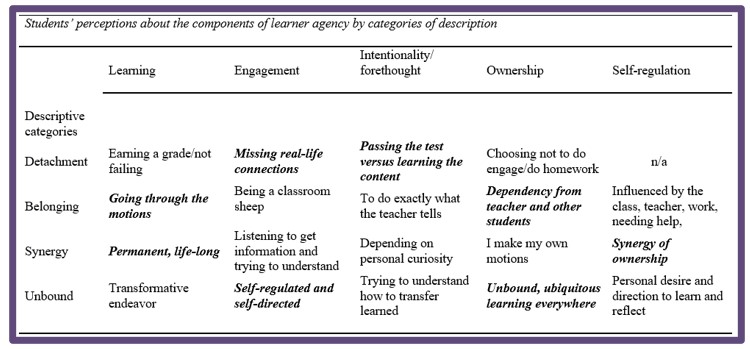
Alas, sometimes I see learner agency being expressed as something students either have or don’t have – yet, agency is truly the capacity to choose our responses to problematic situations [1]. It is not up to us as educators to start scoring learner agency, or dividing students based of whether they have agency or not. And, according to my research, learner agency may sometimes appear negative, especially when students choose to disengage – often to object the structure of instruction.
Students can perceive their learner agency as Detachment, Belonging, Synergy or Unbound.
Detachment can happen more easily when students perceive that their learning has no real-life connections, or when they are just going through the motions to earn a grade. There is very little or no learning going on, and students may engage in surface learning strategies.
The good news is that we CAN support learner agency with our instruction and classroom management and help students to belong, find synergy and become unbound learners. Choosing to teach with respect towards students and support students’ ownership of their own learning is a good start! Social- emotional learning (SEL) provides great tools for supporting learner agency. CASEL framework has identified 5 areas in SEL:
self-awareness
self-management
social awareness
relationship skills
responsible decision making
These are not something new and surprising, teachers throughout the time have focused on supporting these areas in their classrooms. And we know from decades of research how successful students already use all these skills – I am thinking all the research about self-regulation and co-regulation, engagement and participation, executive functions, metacognitive skills, and so forth. All SEL skills are necessary for successful learning, but too often they are not taught throughout formal education. And children arrive to school with different skillsets of SEL, some will need more help than others.
By embedding the SEL skills to our instruction and classroom management we are helping students to better engage in their own, individual learning process. And this is why embedding SEL is so crucially important! They should not be an additional curriculum, but learned within every school subject and project. The classroom applications for embedding SEL are quite self-evident:
Supporting students’ self-awareness means that we address their thoughts, beliefs, emotions and motivations regarding the learning experiences students have.
Providing information is just one part of the teaching-learning exchange
Addressing students’ questions and validating their thoughts immediately deepens the learning experience
Helping students to deal with their emotions during learning process further improves the learning experience – getting new or contradicting information is hard for all of us!
Supporting students’ self-management means that we help students to take initiative and cope with their emotions and thoughts, and we also provide guidance for stressful situations.
We have all had students with advanced self-management skills, and also students who haven’t really been exposed what self-management means. Balancing different student needs is always challenging, and it will always be challenging because we are individuals with different personal histories. Supporting students’ self-regulation is just a part of being an educator!
Some students need more support in taking initiative than others, it may be a part of their personality. Too often I see extroversion being rewarded over introversion – even though one is not a better personality trait than the other!
Supporting students’ social awareness means that we model empathy and compassion, recognize (and verbalize) situational demands and opportunities, and help all students to take perspective
Understanding the perspective of another person is a fundamental skill in the society, and we can choose to teach this with all classroom interactions. Think-pair-share is a great start!
Discussing why some things are harder to learn than others is important, because it relates directly to the mindsets we have. And verbalizing that we all struggle with something builds better communication and learning skills for the future.
Supporting students’ relationship skills means that we emphasize cooperation, communication and proactively teach students to seek help and offer help to others
Engaging in dialogue is important. And dialogue is VERY different from discussion, because in dialogue we are actively trying to understand what the other person is trying to express (not focusing on building our own argument).
Cooperative education is learning-centered, meaning that everything we do is focused on supporting students’ learning process and understanding the big picture – instead of cramming tons of details to be forgotten after the test or engaging in busywork.
Learning happens in interactions – so providing more opportunities for meaningful interactions is important!
Supporting students’ responsible decision making means that we teach students how to make good decisions, first with smaller things and about personal behaviors and social interactions, but also increasingly more complex decisions.
Only through making choices we can train our own executive functions [2] – EF doesn’t develop if we are always told what we need to do.
Too many (and too big) choices can be detrimental – knowing students’ personal preferences will help us to support them learning to choose.
Adding choices also communicates to our students that we believe they can learn, and that we are there to help, if needed.
All the five SEL elements are organically present in our lives, in our societies. Classroom learning shouldn’t be an exception of this. Choosing to teach with the focus of supporting students’ learning process also helps us empower our students to learn more on their own.
Helping students to learn how to make responsible choices is a crucially important life skill. Let’s not waste our opportunity to support their agency by embedding SEL strategies to our instruction and adding more students’ voice and choice to every learning interaction!
Biesta, G., & Tedder, M. (2007). Agency and learning in the lifecourse: Towards an ecological perspective. Studies in the Education of Adults, 39(2), 132-149.
[2] Patall, E. A., Cooper, H., & Robinson, J. C. (2008). The effects of choice on intrinsic motivation and related outcomes: a meta-analysis of research findings. Psychological bulletin, 134(2), 270.
Smith, N.C. (2017). Students’ perceptions of learner agency: A phenomenographic inquiry into the lived learning experiences of high school students. (Doctoral Dissertation). Northeastern Repository
Social-emotional learning (SEL) is here to stay. And that is a great thing! As learning is such a holistic phenomenon, we educators must be aware of the emotional and social parts of it, and encourage students to collaborate and make most of their learning experience. In other words: instead of just teaching/ providing information, we must empower our students to learn.
There is a huge difference between these two approaches to education.
I personally believe that student empowerment is one major superpower of Finnish education. I know I experienced it throughout my own education in Finland, more in some classes and less in some others, througout the basic education (K-12). My deepest and most profound experiences of learner empowerment happened during my M. Ed. studies and teacher training at University of Jyväskylä. So, I am happily exporting student empowerment and making it an integral part of my own practice.
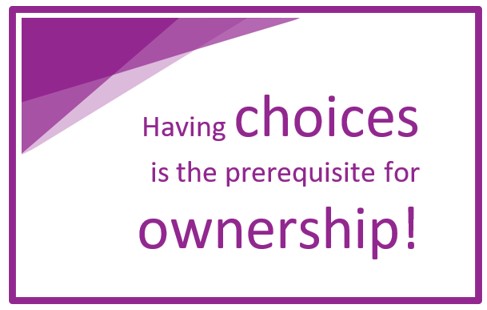
The easiest way to empower learning is to provide choices for students and discuss learning being an iterative process. We generally have stronger emotional attachment to things we get to choose – and that emotional connection increases the likelihood of deeper learning to happen. It’s because ownership, engagement and intrinsic motivation amplify each other. Empowered students have more ownership over what they learn.
Empowering students to learn autonomously can be scary in the beginning. I am not suggesting that you should let go of all the classroom rules and allowing students to do whatever they please. That would not be education. But starting to add choices for students to support their self-direction, and embedding SEL into every lesson is a great start. CASEL has awesome resources for relationship skills, social and self-awareness, self-management and responsible decision-making. The only way students can learn to make good decisions is to have choices and get to practice choosing in safe environments. Making good choices is just one skill among other life skills and we should foster it in all possible ways we can. Because that’s how we support students’ critical thinking!
It is important to remember that SEL is so much more than just training students to use their “power skills” like executive functions or relationship skills – SEL is an integral part of human development and needs to be embedded into curriculum and instruction instead of being taught as another school subject.
Teaching with empowerment changes the power dynamics in a classroom, and communications between faculty and students. We teachers and faculty want to assume the role of a guide, not the leader. And we do this to support learner agency which is “perhaps the most higher-order, emergent, abstractly defined, and most cherished of human functions” [1]. This is why empowerment is so important! Learner agency is all about the choices and degree of freedom students have about their learning! Teaching how to choose is an integral part of education.
Empowering students to learn means striving to provide ample opportunities for students to have autonomy (choose readings, assignments, assessments, partners, projects, etc.) so that they can grow their competencies and relate with the teacher and each other. These three (A, C, and R) are parts of self-determination in life and learning. More information under this link. It is crucially important for us as educators to realize that the gaming industry has already harnessed the ACRs and benefit from the motivational pull to play [2]. The three elements are:
Autonomy – have choices and be an agent of one’s own life and learning
Competence – feel capable in own learning and growing skills
Relatedness – accceptance, feeling connected and interacting with others
We can empower students to learn by emphasizing ACRs. Alas, it is harder for students to learn to use their self- determination in compliance-driven learning environments. It is harder for teachers, too, because in the beginning it may not be easy to figure out what kind of choices students could have. Fortunately we have contemporary research to support our choices for empowerment.
[1] Zelazo, P. D. (2020). Executive Function and Psychopathology: A Neurodevelopmental Perspective. Annual Review of Clinical Psychology, 16. (citation is from page 443)
[2] Niemiec, C. P., & Ryan, R. M. (2009). Autonomy, competence, and relatedness in the classroom: Applying self-determination theory to educational practice. Theory and research in Education, 7(2), 133-144.
In any given situation where we need to learn something new – whether formal (at school) or informal (anywhere) – we have a choice to make about our own approach to learning it. This approach can be either engaging in deep learning (immersing ourselves to learning for life) or surface learning (memorizing disconnected pieces of information). When we are in formal education (school, college, university) there is also a third approach: strategic learning, which means that we are aiming for a good grade without caring about the content, and forgetting the information as soon as we pass the assessment.
Deep and deeper learning both refer to acquiring transferable knowledge through classroom experiences. The emphasis is in supporting students’ lifelong learning process. The term “deep learning” resulted from the original phenomenograhpic research where researchers found out students having different approaches to learning [1]. These approaches describe how learners perceive tasks – either as disconnected pieces of information to be memorized in order to pass the exam (surface learning), or as knowledge to be constructed and understood in order to create new meanings (deep learning).
Deeper learning has been defined by American Institutes for Research as “a set of competencies students must master in order to develop a keen understanding of academic content and apply their knowledge to problems in the classroom and on the job” [2]
We all use the deep and surface learning approaches in different situations. When presented with a learning task, we appraise the value of it, and then decide about our approach. This usually happens very quickly and automatically. What worries me, is that I have met students whose only learning approach seems to be the strategic learning – meaning that they want high grades, but don’t want to really learn the content. These can be very “good” students – always submitting their assignments and assessments in time, often doing extra work to ensure a good grade. But what about the quality of their learning?
Most grading systems appear to reward the strategic approach, which is very problematic because it focuses on extrinsic motivation and external rewards. Students are taught to complete their worksheets and other tasks and pass their tests so that they can get good grades. But why don’t we talk about learning? And being able to use what they learned?
After moving overseas from Finland, I was so surprised to see that my children had homework that was graded. That made no sense to me! As a teacher, how would I know who actually completed that homework assignment, or how much help the student received in completing it? While teaching in Finland the rule for homework was that it must be something that allows students to revisit what they learned at school. Because the idea of homework is to support students’ learning. Not to have them demonstrate their competency.
Making learning more meaningful for students and decreasing the obsession with grading is more important in 2020 than ever before.
Learner-centered instructional strategies will help. Providing choices for students – they can learn same competencies with different tasks, and getting to choose increases intrinsic motivation (game builders know this, btw, and have mastered the ACR – autonomy, competence, and relatedness). TeachThought also has a collection of more learning-centered strategies for instruction.
To make a leap further into learner-centered practices, ask students’ input for planning their learning experiences. Express positive regard. Try competency-based education. Change the assessment to be student-centered and non-punitive!
[1] Marton, F., & Säljö, R. (1976). On Qualitative Differences in Learning: I—Outcome and
process. British journal of educational psychology, 46(1), 4-11.
[2] Huberman, M., Bitter, C., Anthony, J., & O’Day, J. (2014). The shape of deeper learning: strategies, structures, and cultures in deeper learning network high schools. Findings from the study of deeper learning opportunities and outcomes: Report 1. American Institutes for Research. Retrieved from: http://www.air.org/resource/spotlight-deeper-learning
[3] Bain, K. (2013). Introduction: Growing Deep Learning. Teaching and Learning Together in Higher Education, 1(8), 1.
Cooperative learningenvironment with constructive learning design and cognitive learning approach is more important in schoolyear 2020 than ever before! I wish to empower every teacher to choose how they teach!
The new normal requires every school and every teacher to reconsider how we educate the next generation. It is quite simple: just focus on emphasizing learning instead of instruction. We can’t afford failing to engage ALL students in their own learning process, because it is the best way to support students’ intrinsic motivation and mastery goal orientation that leads to deeper learning (check this [1] APA site).
Helping students self-engage with voice and agency increases their academic performance, because just pushing for completing tasks or worksheets leads to very limited engagement and learning (check this [2] ASCD blog). Deep learning is about students acquiring transferable knowledge and skills through their learning experiences – therefore it is crucial to make differentiation and indvidualization a standard practice in every classroom (not just in special education!).
Instruction that is not personalized leads to students choosing the less beneficial engagement approaches: surface approach (participating enough to pass the test/getting an acceptable grade, not interested in learning) or strategic approach (ace the test to get straight A’s, then forget it all). Both of these are focusing on compliance and participation, instead of engagement on personal level. Engaging students in their own learning process requires a paradigm shift, but it IS possible to do. The 3Cs provide the roadmap for switching from focusing on instruction to focusing on learning.
C1 – Cooperation is the foundation for successful online learning – we just can’t hold people accountable over the distance, so spending time in trying to do that is wasted effort and time. Students always have agency: a choice about their own beliefs and actions. But, we cansupport students’ learning process and help them learn (instead of focusing on teaching). Getting rid of the “sage on the stage” thinking and becoming the “guide on the side” is a great way to start building a cooperative practice. Cooperation in the beginning of a school year looks like this: Provide emotional support for students by validating concerns and offering indivualized help, continuously showing positive regard. Offer help every day. Repeat offering help and support every day. Emotionally safe learning environment is the first premise for effective learning. If students are scared or worried, learning is not their highest mental priority, surviving is. Constructive learning design supports students’ learning process. Make sure to balance the three dimensions of teachers’ pedagogical knowledge: instructional process, learning process and assessment – in physical classroon the instructional process can easily become overemphasized. Now is the time to change that! Build flexible learning entities from the curricula that make sense to students and remember that these can easily integrate two subjects! Build ongoing feedback to keep the learning process going – shared documents, portfolios, blog posts, presentations, videos, etc., emphasizing the open-ended nature of students’ learning. Remember to share a clear rubric with students! [Check this post about student-centerd assessment practices!]
Focus on cognitive learning approach by supporting students’ metacognition (or, thinking about thinking/learning about learning). Teaching metacognitive knowledge and skills is an important part of supporting deep learning in all levels of education! It just looks different: for very young students we try to help them on a path of self-efficacy and positive academic self-concept by supporting self-regulation and concept development; for grad students we offer support in managing the self-regulated learning process and self-evaluation/self-judgment.
Help students by discussing Growth Mindset as an important part of understanding one’s own learning process. Provide various ways to organize one’s own thinking: graphic organizers, mindmaps, taxonomies, color coding, etc., and emphasize that there are many different ways to learn something new. Make a list of shareable learning strategies you can recommend to students at any time. Include self-reflection as a standard practice – model it by thinking aloud, help students verbalize what they have learned, help them think what they might do differently or how they could make their schoolwork (stories, presentations, videos, etc) better. Always emphasize learning being a process!
Fostering learning process is actually very simple. In addition to open-endedness there are some other qualities in my mind I decided to name as CAFÉ
Communicate. Have a dialogue with your students, the most effective communication is reciprocal and includes negotiations of meaning.
Acknowledge their competence, and help to add into it. Validate their knowledge and understanding.
Feedback early and often. Provide feedback about the process (think of mapping the ground that lies ahead them, it is easier to steer clear when you know where the pitfalls are).
Encourage and empower. Support their choices. Point out other possible directions (make sure not to choose for students).
And just like coffee, or life in general, also learning is best when we can enjoy it!
I hope you enjoy!
🙂
Nina
Other posts about 3Cs and supporting learning process:
[1]McCombs, B. L. (2010, February 16). Developing responsible and autonomous learners: A key to motivating students. American Psychological Association. http://www.apa.org/education/k12/learners
As teachers we know the mechanisms of teaching and learning. In classroom we must choose which instructional practice to use to help our students to learn. What worked yesterday may or may not work today or tomorrow, because learning depends on the classroom situation and context. These decisions are often value judgments. This is why reflection is so crucially important!
Knowledge of the instructional process, learning process, and assessment are the three cornerstones of teaching practice. However, these three create a tad wobbly foundation if we omit the importance of personal and professional reflection. Teaching is work done with our personalities – there is no denying this! Students perceive us as a part of the learning environment, no matter what we do.
How we engage in the instructional process and learning process are the most important things to reflect upon after every workday. (Yes, these are two VERY different processes!) Reflection doesn’t have to be anything very time consuming or fancy (I know how busy teachers can be), but you shouldn’t walk away from your class or lesson without spending a minute thinking about it. Skipping reflection is like closing a word processing program without saving your work!
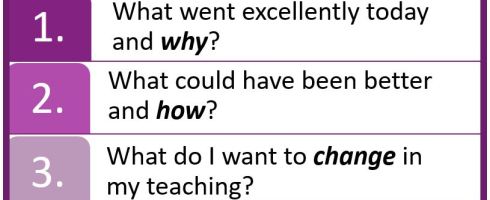
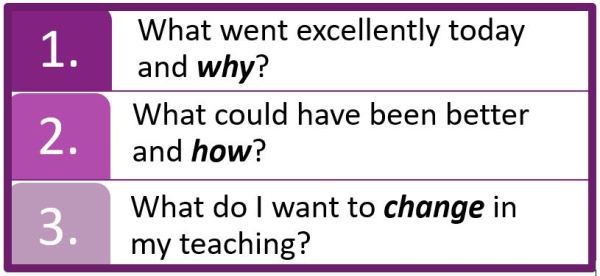
This is the easiest, fastest, everyday reflection process I know about:
Thinking about these three things and making a note about the change will help in future planning sessions. I often email myself things to be remembered, and I have a separate email account just for the notes from myself. Doesn’t matter whether you want record your reflections in a notebook. Just do it!
Reflection gets even better if we get to do it with a colleague. They may have insight into why students behaved differently, or a suggestion for what we might want to change in our teaching practice. Maybe they have tried different instructional strategy in a similar situation, or maybe they have diverse insight into learning process.
Joint reflection requires lots of trust. Exposing our own (perceived) weakness to a colleague requires a safe and collaborative working environment. While the advice from friends and colleagues is very helpful, the ultimate instructional choices must be our own and align with our personal values and dispositions. Thinking about our own pedagogical knowledge and pedagogical content knowledge is the base for making value judgments about instructional strategies and how we support students’ learning process. Instruction must fit into the classroom culture. (This is also the reason why exporting Finnish education as a product is not possible – learning is always situational and contextual.)
As teachers we are engaging in lifelong learning. Not only because education changes when culture changes, but also to update our own competence. I don’t know any teacher whose thinking about the profession has not changed since the day they started teaching.
If you haven’t made a New Years resolution yet, why not give reflective practice a try?
—————————————————–
[1] p. 255 in Guerriero, S., & Révai, N. (2017). Knowledge-based teaching and the evolution of a profession. In S. Guerriero (Ed.). (2017). Educational Research and Innovation: Pedagogical Knowledge and the Changing Nature of the Teaching Profession (pp. 253-269). OECD Publishing.
Passionate about learner agency. Firm believer in the best teacher being the one who makes herself unnecessary by empowering students to become autonomous learners.








 NotesFromNina