Tag Archives: teaching

Instruction that supports learning process

30 Apr

Education is about looking both into the past and into the future, which is why it also has two opposite purposes: to ensure cultural progression and to prepare students for their unknown future.

Cultural progression is necessary for societies to have members who will know about the past (history) and the traditions (culture), but emphasizing the traditional ways of doing things may cause difficulties for students to learn for the future. Yet, not knowing the history could cause us to repeat the mistakes of the past generations. For anyone engaging in instruction this is just one of the many dichotomies of the teaching-learning situation. Finding balance is important because both past and future are necessary in understanding the process.

Modern educational theory and practice are built on the premise of education being the process for students to “develop their rational faculties so that they become capable of independent judgement”(1). This requires for students to engage in three-dimensional learning process and grow their skills, knowledge and understanding.

It is important for every teacher to know the values and ideas behind the instructional practice they use in helping students to learn. I tend to move towards the humanist worldview of learning and teaching, where knowledge is seen subjectively constructed.  I have hard time believing in knowledge being measurable, objective or free of values. Data can be that, and some information may be objective, but those only become knowledge when they have been processed through our own experiences and understanding, i.e. personally constructed during the learning process.


Humanist vs Mechanist

Also, learning can be so much more than just a change in one’s behaviour,  as it is seen in the mechanist worldview! To fully support the learning process, and to improve students’ academic performance, it is important to combine all three teaching paradigms in the humanist worldview.

The way I do it combines the cognitive and constructive practices in a cooperative learning environment. Cognitive practice includes helping students to learn about learning, but also becoming more knowledgeable of their own worldview, thinking and metacognitive skills.  Constructive learning and teaching  focus on collaborative meaning-making, gaining skills and understanding concepts. Cooperative teaching and learning build the emotionally safe learning environment, where interactions are held in high value, students can ask questions and engage in non-punitive assessments that support the learning process.
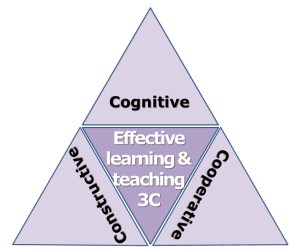
3C triangle

Instruction that supports the learning process helps students to become skillful and nimble life-long learners. Skillful learners understand the past and are able to reflect on their own learning, but they are also able to adjust their knowledge to meet the requirements of the future.


________________________________________________

[1] Biesta, G., & Tedder, M. (2006). How is agency possible? Towards an ecological understanding of agency-as-achievement. University of Exeter School of Education and Lifelong Learning, Working Paper, 5.
Is Learning a Product or Process – part 2

27 Feb

Best teacher is the one who makes herself unnecessary by

empowering students to become autonomous learners.

~Nina Smith

When learning is seen as a product, the emphasis of the learning-teaching interaction is in instruction – and the thinking behind comes from the idea of students only learning when the teacher is instructing them, and only what they have been taught.  The reality is different, as any curriculum leader can tell you. At any given moment of time any given classroom has several ongoing curricula: intended, written, taught, actualized, learned, etc., so we cannot simply look at the learning product.  This product may be a paper, worksheet, notes, homework, essay, grade, etc., that we use to measure the results of students’ learning.

Emphasizing learning products makes mistakes very undesirable phenomena in the classroom – after all a perfect product is the goal, right?  And often the grade only reflects the finished learning product, without paying attention to how the student got there.  Maybe s/he already knew the content or had the skill, and didn’t have to study  or practice at all?  If we pay too much attention to the product, we may miss the important part of the learning-teaching interaction: the individual students’ main gain,  her/his increase in knowledge/understanding/skills that has happened as the result of instruction.

Now, very seriously: which one is more important to you? What your students know/can do — or how much they improve in what they know/can do? 

There is a big difference.

Improving what students know/can do inevitably leads to different end results, because each student has her/his own starting point. And this improvement, the increase, of course, IS the result of the individual learning process of each student.  This is also why helping students to become independent learners is so important.

Independent learners tend to automatically (or by learned habits) engage in their own learning process.  While observing these students we can see them intentionally influencing their own learning behaviours, and Bandura  (2006, p.164-165) described the four following components in their engagement: the intentionality of their learning, the forethought of their actions, their self-reactiveness and self-reflectiveness. Of course, to be able to do all this, students must have certain amount of freedom in the classroom, which is why I am so fervently advocating for providing more choices in classrooms. Choosing is a skill that can (and should) be taught and learned, and it only grows when students have ample opportunities to try choosing in an emotionally safe learning environment, where mistakes are not only allowed but celebrated.

Just imagine how much more these students learn! They don’t need the teacher to motivate or engage them, because they are already “in the zone”. In the classroom these components apply straightforwardly to students’ engagement as intentional learning activity, and learning motivation and goal-setting as their forethought. Meta-cognitive knowledge is about knowing and understanding how I learn, knowing what is easy and what is hard for me, and where do I need to put in extra effort in learning. Independent learners, who engage in their own learning process already know these things. Wouldn’t it be important to help every student to possess this knowledge of themselves?

The third component in independent learning, self-reactiveness, relates to the way students control their own learning actions and regulate their own behaviour in classroom. As a teacher it is important for me to ask myself, how can I support my students’ self-regulation and  provide more autonomy for them. When students get to regulate their own learning process (pace, depth, breaks, note-taking, collaboration, additional information, etc) also the learning results, the visible and tangible products of learning, do improve.

Maybe the easiest way to support students’ learning process is to provide accurate and timely feedback. This strengthens the fourth component of independent learning, student self-reflection,  which is too often overlooked.  Feedback has been statistically identified as one of the  important teaching-learning factors (Hattie & Timperley, 2007), because it enhances both the learning process and the product we get as an end result of successful learning. Students self-evaluation is an important classroom practice, because it combines feedback and self-reflection.

To me it seems that too strong focus on the learning product leads to shallow learning (to just get by), and strategic learners  (to just get a good grade) instead of deep learning.  While independent students may have strategies to cope in product centered learning environment, the dependent students may not have a clue what they should do, or how they are supposed to do it – which further decreases their learning motivation.

Focusing on the learning process emphasizes the students’ responsibility in the learning-teaching interaction. It both enables and encourages students to engage in their own learning. This engagement helps both students and teachers to build learning up from standards and to achieve competencies needed in our modern world.


Bandura, A. (2006). Toward a psychology of human agency. Perspectives on psychological science1(2), 164-180.

Hattie, J., & Timperley, H. (2007). The power of feedback. Review of educational research77(1), 81-112.

Student-centered learning and teaching

16 Oct

I was working on one of my assignments for my doctoral studies and searching for a good definition of student-centered learning. Imagine my delight when I realized that APA provides a beautiful and comprehensive definition that is a real joy to read. What I see below fits perfectly well into my teaching/learning philosophy (emphasis and coloring mine):

This definition of learner-centered is based on an understanding of the Learner-Centered Psychological Principles as a representation of the current knowledge base on learners and learning.
The Principles apply to all learners, in and outside of school, young and old.  
Learner-centered is also related to the beliefs, characteristics, dispositions, and practices of teachers – practices primarily created by the teacher.
When teachers and their practices function from an understanding of the knowledge base delineated in the Principles, they
(a) include learners in decisions about how and what they learn and how that learning is assessed
(b) value each learner’s unique perspectives
(c) respect and accommodate individual differences in learners’ backgrounds, interests, abilities, and experiences, and
(d) treat learners as co-creators and partners in the teaching and learning process.
 

What else can I say?

This is exactly how I was taught during my own teacher education in Finland.  The teaching and learning process where teachers are learning facilitators and students intrinsically motivated and accountable for their own learning  should look like this in the classrooms everywhere in the world! And APA even provides more tools for  getting there!

Please read ahead:

COGNITIVE AND METACOGNITIVE FACTORS

Principle 1: Nature of the learning process.
The learning of complex subject matter is most effective when it is an intentional process of constructing meaning from information and experience.
Principle 2: Goals of the learning process. 
The successful learner, over time and with support and instructional guidance, can create meaningful, coherent representations of knowledge.
Principle 3: Construction of knowledge. 
The successful learner can link new information with existing knowledge in meaningful ways.
Principle 4: Strategic thinking
The successful learner can create and use a repertoire of thinking and reasoning strategies to achieve complex learning goals.
Principle 5: Thinking about thinking
Higher order strategies for selecting and monitoring mental operations facilitate creative and critical thinking.
Principle 6: Context of learning
Learning is influenced by environmental factors, including culture, technology, and instructional practices.


MOTIVATIONAL AND AFFECTIVE FACTORS

Principle 7: Motivational and emotional influences on learning
What and how much is learned is influenced by the learner’s motivation. Motivation to learn, in turn, is influenced by the individual’s emotional states, beliefs, interests and goals, and habits of thinking.
Principle 8: Intrinsic motivation to learn
The learner’s creativity, higher order thinking, and natural curiosity all contribute to motivation to learn.
Intrinsic motivation is stimulated by tasks of optimal novelty and difficulty, relevant to personal interests, and providing for personal choice and control.
Principle 9: Effects of motivation on effort
Acquisition of complex knowledge and skills requires extended learner effort and guided practice. Without learners’ motivation to learn, the willingness to exert this effort is unlikely without coercion.


DEVELOPMENTAL AND SOCIAL FACTORS

Principle 10: Developmental influence on learning
As individuals develop, they encounter different opportunities and experience different constraints for learning. Learning is most effective when differential development within and across physical, intellectual, emotional, and social domains is taken into account.
Principle 11: Social influences on learning 
Learning is influenced by social interactions, interpersonal relations, and communication with others.


INDIVIDUAL DIFFERENCES FACTORS

Principle 12: Individual differences in learning
Learners have different strategies, approaches, and capabilities for learning that are a function of prior experience and heredity.
Principle 13: Learning and diversity
Learning is most effective when differences in learners’ linguistic, cultural, and social backgrounds are taken into account.

Principle 14: Standards and assessment
Setting appropriately high and challenging standards and assessing the learner and learning progress-including diagnostic, process, and outcome assessment-are integral parts of the learning process.

How can we make this become reality in classrooms?  Please check the posts tagged with “student centered” for some tools!  And let’s keep on collaborating in highlighting the importance of student-centered practices!


Summarized from the APA Work Group of the Board of Educational Affairs (1997, November). Learner-centered psychological principles: Guidelines for school reform and redesign. Washington, DC: American Psychological Association. http://www.jodypaul.com/LCT/LCT.PsychPrinc.html

Also see:  http://www.apa.org/ed/governance/bea/learner-centered.pdf for more information about learner-centered practices and their importance to the field of contemporary education.  


Quality of learning, process vs. product

19 Jul

There are processes without defined products, play being probably the best example of it. Art and music don’t have a clear definitions of quality either, but we do recognize a masterpiece when we experience it. Learning works the same way. Each student has a unique learning experience, due to their diverse abilities and expectations, so the end result of learning must be open-ended, too. When students are forced into one definite learning outcome, i.e. product (think of 27 nearly identical pieces of “art work” on the classroom wall, copies of a model/template, provided by the teacher), something important of the learning quality is lost.

We already know how important play is for learning, as numerous studies show the positive effects of engaging in free play. One important part must be how play employs our creativity and curiosity. While guided play is sometimes important for concept development, it is necessary for anyone working with early childhood age students to be able to follow the child’s lead and verbally add new dimensions or elements to the play. Sitting the child down to perform a task an adult has planned has less effective learning components than enhancing the free play. Just because we will never create the same competence while  following the thinking of someone else, as we do while thinking  things through on  our own. Playing is the visual part of children’s thinking!  Helping students to engage with their own thoughts is a huge accomplishment.

There is also evidence about how social-emotional choices made during free play, like negotiating about taking turns, actually strengthen the same processes we need in scientific problem solving.  This makes me think how important it is to share our knowledge of learning and how it actually happens with students, so that they can be empowered to engage with their own learning process. Meaningfulness defines the quality of the play, as there is not an objective criteria for children how to conduct “good play”.  This is equally true with learning process, too, where meaningfulness perceived by the students drives their curiosity and engagement in class.

Measuring quality in education is hard, partly because there is not one universal definition what good quality learning looks like. People have different connotations about educational quality, and the cultural perceptions are also very diverse.  Learning, like play, is individual and very situational and contextual.

One way of approaching educational quality[1] is to see it as perfection of the learning process, where everybody involved is required to contribute to the quality of outcome, and can be held accountable for her/his own part. Isn’t this what we want for our students? For every student to be successful in their studies, and also have ownership over their achievements?

I bet every teacher knows about “teachable moments”, and those are the key components of a good quality learning process: to receive the information and inspiration at the right time, so that learning is perceived to be meaningful by the student. Learning quality in those moments is very high, due to engagement and ownership student experiences. These experiences are more likely to be saved in long term memory, because the ownership of learning process makes the transfer of learning to happen almost automatically.

In the classroom it looks pretty much as the following: We plan for optimal instruction, but students’ learning is something more than perfectly written, measurable performance objectives. Involving students in their own learning process helps them to become more accountable for their own learning. Teachers cater for students’ individual needs and preferences to make learning more meaningful for them.

Excellent educational quality emphasizes the transformative learning process that involves both cognitive and personal growth of students. It is learning for life, not just for school. This transformational type of learning happens in individual interactions. Teachers have very big role in supporting these interactions: the younger the student the more important it is to have a teacher as a trusted adult to facilitate these interactions between students and their learning environment and resources.


[1] Wittek, L., & Kvernbekk, T. (2011). On the Problems of Asking for a Definition of Quality in Education. Scandinavian Journal of Educational Research55(6), 671-684.


How do YOU want to teach?

27 Apr

Being a teacher makes our core values become visible. All the small (and bigger) choices we make in the classroom talk about our beliefs of good learning and teaching: how we place our students, what kind of questions we ask, what is valued in our class, etc., and they all also contribute to our students’ perception of education. Improving learning and teaching becomes easier when we empower every teacher with the knowledge of choices. Please watch and share:

CHT video

Taking time to think HOW exactly YOU want to teach makes all your choices become more conscious. It is easier to choose wisely when you have better understanding about the consequences of your choices.  Walking the talk of making well-informed choices is important for everyone who wants to teach. Fortunately choosing is a skill that grows with use, just like language fluency.

The same principles apply to our students:  they need to have opportunities to practice choosing in an emotionally safe learning environment.   The first step is to make students aware that there is a choice. So, how exactly do we help our students to make wise choices? This thinking process led me to write the book:

Nina's book

My own belief, based on experiences, is that independent and autonomous students are also the most successful ones. I think this happens because they have so good control over their own learning processes, and also use several different learning strategies.  Guiding all students towards being self-sufficient and having more successful learning experiences can be done if we let go of some unnecessary control and start providing more choices in the daily classroom situations.

Please note that I am not talking about students running wild in the class. The best environment to improve learning and practice choosing is where we can allow students to make mistakes without penalties. This of course means having informal and non-punitive assessment and self-evaluation systems in place.  Student accountability is built on the foundation of their autonomy. How could you be accountable for something you cannot control?

How can you help students practice choosing and become more independent in their learning?

12 Questions about Finnish Education answered

25 Mar

Two weeks ago I provided some answers to a colleague, Angela Watson, who maintains The Cornerstone for Teachers website and blog. She asked several questions about education in Finland and I am posting the Q&A here in my Notes as well:

1) Pay is not the answer. Teachers in Finland are not paid like doctors.  Starting salary for a teacher is not huge (around $40k-$50k), but when in a permanent contract they get paid for the summer, too. Doctors are paid more, but generally the salary gap between professionals is smaller in Finland.

2) Professional development is strongly emphasized in Finland and teachers are viewed as respected professionals.  Professional growth is viewed necessary for teachers, but usually they have much independence in deciding about their PD.  Elementary teachers must have a M.Ed. with major in education and a minor in multi-disciplinary school subjects and another minor in a chosen subject. Teachers are part of the academia, and their professional opinion about learning is respected. Usually teaching is the chosen career, not a stepping stone to something else.

3) Teachers in Finland get a great deal of freedom to meet students’ needs: the national curriculum is very short and non-prescriptive.  The national curriculum includes the objectives and core contents for different school subjects, but schools and districts create their own curricula within the framework of the national core curriculum. Teachers get to decide how they help their students to reach the objectives.

4) Students in Finland get more than one hour of recess a day.  The basic model in K-12 is to have 45 minutes of instruction/learning and then a 15 minute break. First and second grade students go to school for four hours per day and from that time they have 75 minutes of recess. During recess students go outside to play – and they are encouraged to be physically active.

5) There is no mandatory testing in Finland. Teachers are trusted to provide assessments they see best benefit their students’ learning. Feedback of individual learning process is emphasized over standardized testing.

6) School doesn’t start for Finnish children until age 7.  The year before school starts is called pre-school, and it is free for all students but not mandatory for 6-year-olds. Students are not expected to learn how to read in pre-school. They are learning how to learn and how to take part in group activities.

7) Pre-school (the year before school starts) belongs to formal education system, and is free. The same requirements that regulate the teaching of 6-year-olds in schools also are valid in daycare centers for 6-year-olds, and enrolling is parents’ choice, often depending on their employment. Every child has a subjective right for high quality early childhood education, but whether it is free depends on the income level of parents. ECE is heavily subsidized, so the highest monthly payment for childcare is 264 euros ($350) per child at a daycare center.

8)  About private schools: Finland has common legislation for both private (state subsidized) and public (city or state owned) schools.  Last year there were 85 private schools in Finland serving approximately 3% of the whole student population.

9) Parental involvement is not required. Parents are encouraged to be involved in their children’s education, but it is not a requirement. Students are very independent, including getting to school and back home when the distance is less than 5 km (~3miles). They walk or ride a bike, or parents transport them.

10) Teacher’s Unions:  more that 95% of teachers belong to the teachers’ union (OAJ) which is a member of the Confederation of Unions for Professional and Managerial Staff in Finland (AKAVA). But, the relationship between schools, education policy makers and union is constructive.

11) The often heard claim of Finnish children doing better in school than American students simply because the poverty rate is so much lower is a heavily loaded question and the answer is anything but simple.  The poverty rate in Finland is certainly lower, but what makes the difference in education is equity combined with quality. Instead of highlighting individual performance and competition of students in Finland the focus is on schools’ ability to provide equally good education for different learners. Basic education is completely free including instruction, school materials, school meals, health care, dental care, special needs education and remedial teaching. One Finnish specialty is the free hot lunch served to everyone every day. Hungry students cannot learn well.

12) The Finnish way of teaching could never be replicated in the United States because our population is so much more heterogeneous.  No educational system should ever be replicated in another culture as it is – just like no information should be accepted as it is, but must be assimilated and/or accommodated to become a perfect fit. The way of facilitating individual students’ learning by promoting cooperation and cognition with constructive practices could easily be replicated.

Successful learning experiences

24 Nov

Defining success is not easy, and sometimes we get tangled in details and want to define students’ success as mastery of a single subject or unit, or course. Often applying unnecessary power over students is also disguised as success – but do students really need to perform according to minor details, or should we emphasize understanding the concepts and entities, so that the learned skill is transferable? In contemporary education negotiating meaning is more important than ever before, just to be sure that we are talking about the same concept/word/idea – and the word “success” certainly has several different connotations.

To me student success means simply making myself unnecessary as a teacher by empowering my students become autonomous learners, who can work independently and who know where to find the information and guidance they need. This requires handing over the tools for learning to students, and trusting in their motivation and drive to get their learning done, but having open and honest interactions with students to be able to help if needed.

Many schools aspire to empower their students to become life-long learners, and that is great! This is the true paradigm shift we need in education! But, it is not enough if we say this aloud (or write it on the visions and missions of school, or publish it on the school website), this goal must be integrated into everyday teaching practices as well as to the assessments.  Students’ perception matters. We need open and honest communication to remain believable so that our students understand and feel their success and learning being important for us.

Students’ perception creates the emotional learning environment of the classroom or the entire school. Please note, though, that I am not talking about entertaining students. My intention is to describe a learning environment where students cooperate and are accountable for their own learning.  In Finland one measurement for successful education is “kouluviihtyvyys”, which approximately translates to school enjoyment, or school satisfaction, but actually has some deeper connotations[1]. School satisfaction is seen to be built of several components where  school conditions create one part, social relationships another part and means for self-fulfillment in school the third crucial part – following the categories of having, loving, being by Erik Allardt[2]. I cannot but see the equivalence to the 3Cs: constructive tools used in cooperative way to provide cognitive connections.

Classroom management and curricular choices belong to having/school conditions, and often are the most emphasized component in student success. However, no matter how constructively you build the conditions, the two other components must be present to complete the picture of successful learning experiences.

Cooperation falls into social relationships/loving – part of school enjoyment, and it covers school climate, teacher-student relationships and all interactions – also those with students’ homes and family members. Cooperation increases students’ success in all levels starting from informal peer tutoring among classmates, covering anything and everything that happens during a school day, but also reaching to professional collaboration between education professionals (yes, I am against to Race to the Top or any other competitive attempts to improve education). Loving is a strong word for me to use about social relationships at school, but I do see how well it fits here.

Being/the means of self-fulfillment cover many important areas: value of work (no busywork!), creativity (students and teachers are so much more than parts in a machine), encouragement (feedback about learning process), and having opportunities to practice making good choices. Knowing how I learn is essential for becoming a good learner, and this is why metacognitive tools should be an essential part of each and every teacher’s toolbox. This is also why I am so sceptical about standards – when learning is an individual process, how could it be measured with standardized testing?

To me well-being in schools as defined above is an essential measure of providing students with successful learning experiences. What do you think? And how can you increase student success by improving having, loving or being in your school?

World Teachers’ Day 2012

5 Oct

“Take a stand for Teachers” is the 2012 slogan for World Teachers’ Day.

UNESCO calls on everyone to consider undertaking a special celebration for World Teachers’ Day:  “Teachers… ultimately determine our collective ability to innovate, to invent, to find solutions for tomorrow. Nothing will ever replace a good teacher. Nothing is more important than supporting them.”

On the UNESCO page there is another statement I liked very much:

Teachers are among the many factors that keep children in school and influence learning. They help students think critically, process information from several sources, work cooperatively, tackle problems and make informed choices. 

Isn’t this the essence of good quality education? Making informed choices outlines well the other highlighted skills: thinking, processing, cooperating and problem-solving.  Emphasizing these skills leads to deep and meaningful learning. Building a cooperative learning environment where students can practice choosing empowers them to think and share, and also helps students to understand how learning is an individual process.

Please note how teachers are rightfully recognized as one of the many factors that keep students in school. We should always remember not to ask teachers produce miracles, because every teaching-learning situation is constructed from many different pieces.

Over time teachers are able to enhance the other pieces of learning,  especially when learning is viewed as a process, not as a product or performance.  Yet, too often it seems that teachers are expected to solve all the pieces of the puzzle at once. The teacher’s piece is important, because the star will not be there without the teacher – but other pieces are equally important. Each and every teacher in the world should know that they can choose how they teach: teacher centered vs. student centered way, viewing learning as a product vs. process, cooperatively vs. competitively, creating opportunities to practice choosing vs. expecting blind obedience, and so forth.   All these choices are available for teachers to use in any given system or while teaching any given curriculum.

These everyday pedagogical choices are made either instinctively or with awareness of making an active choice. Even deciding not to choose is a choice. My way of supporting teachers is twofold: to spread awareness about the fact that they can choose and then empower teachers to learn more about their choices.

We all as parents and teachers are trusted with great shared responsibility: to help next generation achieve their full potential. So, supporting teachers in their important profession should be an easy choice.

What can you do to support a teacher today?

Keep on learning!

15 May

An educator can never cease to learn – but what makes learning meaningful to us?

We know how important (free) play is for children and how much it contributes to their learning – I think the dynamic way of play is the main contributor there (don’t have any data about this, but to me it seems like common sense: being able to control the play and make sense of the sensory feed related to it).  And I assume that is what fascinates adult learners, too, the ability to connect ideas in a playful way.

Every day we gain more information about how learning happens: with imaging techniques researchers are able to track what areas in our brain are active during learning. We know how each brain is different, and how learning is individual, and how different people manage and manipulate the knowledge in unique ways.

How about teaching? Are we still using the same teaching methods that were common hundreds of years ago? Teaching and learning are like the two opposite sides of a coin – inseparable but opposite. We educators must learn to match our teaching styles with the dynamic view of knowledge, and find new ways for facilitating our students’ learning.

Teaching is about communicating one’s own knowledge and understanding of the subject to students who either absorb it as is, absorb it with internal modifications, or discard it. Learning is about constructing a worldview. Facilitating students’ learning means helping our students to construct their own understanding of the subject, and negotiating the meaning of the words and concepts with our students until it makes sense to them.

We teachers don’t like to have someone to come and tell us what to do. Very few students like that either. To have an effective educational system, we must understand that effective teachers are simply facilitators of students’ individual learning processes – and the ones who incite the spark of lifelong learning.

Of course, if you have lost the passion of learning you cannot transfer that to your students either. Facilitating our own learning is the beginning.

What do you need to do to find the old flame, and fall in love with learning again?

How to build student centered class environment?

25 Feb

Student centered teaching is a way of making teaching and learning better in the classroom. As this is a highly qualitative measure, it is sometimes hard to summarize the necessary changes or easily communicate the differences between student-centered and traditional teacher-led instruction.

What makes definition even harder, is the fact that student centered education is not really a method. It is a philosophy, based on the fact that each human being learns individually. What is taught in a classroom is not necessarily learned, because each student has a different perception of what was taught – and that is exactly how it should be, if we want to foster (critical) thinking skills. When we are asked to follow someone else’s thinking we will not create the same competence as while thinking it through on our own.

There are certain indicators for student centered teaching and learning. The three  main characteristics to define whether a learning environment is student centered or not, are the use of cognitive, constructive and cooperative tools in teaching and learning. One very simple “measurement” is to pay attention to the amount of open-ended questions (as opposed to questions that have just single one correct answer). The other measure is the amount of individualization used in the classroom, and the learning environment supporting learner’s autonomy in majority of tasks and assignments.

Open-ended questions cater for the cognitive growth of your students.  These questions also help your students grow as learners and understand the way their individual learning happens when they hear different correct answers to the same question.  Discussing about the different points of view leading to these answers helps students understand the connections between concepts, and thus caters for deep learning.  When you as teacher know how learning happens, you can easily guide students beyond rote memorization. The question to ask yourself while planning the lesson is: what will my students really learn about this?

Individualization sometimes seems like a bad word, or being something that only adds to the load for the teacher. But it does not have to be  that way. Constructive teaching is student centered and acknowledges the importance of building the content to be learned so that it meets the students’ increasing understanding about the subject matter. Of course,  introducing more complicated concepts after the basics have been learned is just plain common sense. But, the constructive way I have taught with also includes the idea of providing choices for students, so that the more advanced students can learn further on their own speed, while those students who may need extra time can review the content one more time, if necessary. This is not hard to do. And it still is basic common sense: keep the learning meaningful for all of your students. I used to assign different homework for students, too.

Learner’s autonomy requires cooperation in the class.  Only cooperative learning is student centered, because teacher-led instruction is based on the teacher telling students what to do. Cooperation must happen between students to provide deeper understanding about the subject. Sometimes the students’ choice of words makes it easier for another student to understand, because they share the approximately same language level, which is not the case between the teacher and student. Cooperation  in the teacher-student relationship takes away the unnecessary power struggle between teachers and students: why have a battle when we are aiming to a mutual goal? Providing autonomy in class empowers students to learn more on their own,  and makes them become more interested in things they learn at school. This of course decreases the need for behaviour management in your class, when everyone is engaged in learning. Seems like a win-win situation to me!