Tag Archives: teaching

Teaching How to Choose

20 Jan

Making good choices seems to come naturally for some students while others need deliberate coaching to become successful learners navigating the educational systems. By allowing choices we support our students’ self-efficacy. With choices we are communicating our confidence in our students. It is letting our students know that we believe they can learn, and that we are always happy to help them.

There are things in the classroom that must be done without getting into negotiations about how and why, and we truly cannot let students rule and do whatever they please in the classroom. However, allowing choices makes it emotionally easier for students to agree with the mandatory things. Yet, this is not the main benefit of teaching how to choose. Only through making choices we can train our executive functions and create accountability for our own learning [1]. Learning to make good choices is a just another skill to learn. Knowing how to make choices contributes to our higher-level thinking.  We should not deny our students this opportunity by having too rigid rules that allow no choices.
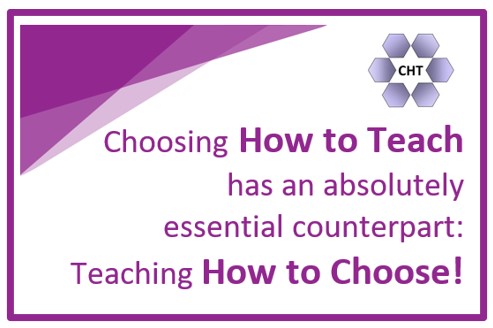
Choosing how to teach has an absolutely essential counterpart: teaching how to choose!

How to add more choices into your classroom?  During a regular day we have many opportunities to allow choices, starting from choosing whom to work with. By asking students to choose a partner who can help them in this assignment you are also encouraging students to recognize the good study habits of others. By providing a variety of assignments to choose from helps students to better articulate their competencies. By letting students choose which task they want to start with helps them understand their personal preferences.  By unpacking how decisions can be made and what we might want to think before choosing is a foundational skill in early grades. By asking students verbalize the steps they took while making a decision makes the process of choosing more visible. I think the ways of introducing more choices in learning environments are virtually infinite, if there is the will to make the change to happen.

Balance is important. If there are too many choices, students may become overwhelmed [2]. Embedding all three parts of Teachers’ Pedagogical Knowledge (TPK) framework to teacher training or PD is a way to ensure the necessary skills for fostering learning process by designing supportive instruction and assessment [2].When educators have enough knowledge of how to support students’ individual learning processes, embedding choices becomes much easier.

My personal credo about the best teacher being the one who makes herself unnecessary by empowering students become autonomous learners carries my values within it.  Our job is to help students to learn on their own, so that they can become life-long learners.

I believe, that only by allowing students to practice making good choices in an emotionally safe learning environment where their opinions or beliefs are never ridiculed, we can help the next generation reach their full potential and become critical thinkers. There is no shortcut to wisdom.

Other posts about choices:

Why choices are so important for learning process

Self-efficacy for deeper learning

Self-deternmination and learning process

Learner agency

🙂

Nina

[1] Patall, E. A., Cooper, H., & Robinson, J. C. (2008). The effects of choice on intrinsic motivation and related outcomes: a meta-analysis of research findings. Psychological bulletin, 134(2), 270.

[2] Iyengar, S. S., & Lepper, M. R. (2000). When choice is demotivating: Can one desire too much of a good thing?. Journal of personality and social psychology79(6), 995.

[3] Sonmark, K. et al. (2017), “Understanding teachers’ pedagogical knowledge: report on an international pilot study”, OECD Education Working Papers, No. 159, OECD Publishing, Paris. http://dx.doi.org/10.1787/43332ebd-en
Finding the Balance for More Effective Teaching

28 Dec

Imagine a wheel, like a bicycle wheel. What would the ride feel like if there were bumps on the wheel? Yet that is how we tend to emphasize only one aspect of learning and teaching in our classrooms.

Finding a balance is not always easy. After all, we have so very many details to include to our daily classroom teaching that it is sometimes hard to keep our thoughts straight. Here is a very simple 1-2-3 tool for checking the balance. It covers the most important areas of classroom teaching, no matter what level or grade you are working with.

1. Co-operate. Provide emotional support in the classroom. It helps your students learn, because they feel safe and more comfortable (read Mazlow if you don’t believe just my words). Be aware of learning problems, as well as the social ones, and address them in timely manner. Emotionally safe learning environment is the first premise for good quality teaching.

2. Be constructive. Create or adapt a classroom management system which is compatible with your own values and ideas about good teaching. Having extremely clear expectations for students cuts down the need of behaviour management – when student know what they are supposed to be doing creates lots of opportunities for the teacher to compliment them for their dedication and participation. Maximize the learning time by providing autonomous learning choices after finishing a task.

3. Strengthen the cognitive learning. Cater for concept development by asking lots of open ended questions and teaching your students ask those questions, too. Make sure to stop to listen to the answers. Provide feedback during the learning process instead of evaluating only the end result. This is the most important single thing enhancing their learning. Only those mistakes that are allowed to be corrected can help students learn more.

These steps also empower your students to move towards autonomous learning, because they focus more on learning than on teaching. And that is how it should be. After all, we are in the classroom to help our students learn, are we not? And one part of helping could be providing them a bit smoother ride.

The One Key for Being a Good Teacher

27 Dec

The key is teacher’s desire to empower her/his students to learn autonomously. Ultimately this makes the teacher become unnecessary. Of course, first you must convince your students that you are not a threat to them, but an ally.

Empowerment makes students want to learn. You can call it reverse psychology, or just avoiding the reactions of students when they are told to do things they might prefer not doing. Ultimately it is about teaching accountability, and doing things because they need to be done, not because someone tells me to.

The way empowerment is visible in the classrooms lies in the cooperative way of learning and teaching. We have a common goal. We work together towards reaching it. (This is so simple that I almost feel silly typing it down! – Yet, it still is too seldom practiced in our classrooms! Too many teachers engage in unnecessary power struggles every day.)

There is also a cognitive aspect in empowerment: unleashing your students intellectual curiosity. Helping and guiding students in their learning process is a non-threatening way to assess their learning, too. We all have different approaches to learning, and evaluating the process rather than the product gives much more information about how your students are advancing.

The constructive part of empowerment is helping your students make well informed choices every day. Small and big choices, but both equally justified – because it helps us understand why we do certain things. The important thing is to reflect back to previous experiences and build on the understanding we gained there. After all, we all helping our students to construct their own view of the world we live in.

Your life – your world – your choices.

I wish all students were empowered to know that!